
Non-FictionHealth & WellnessMedia Accessibility
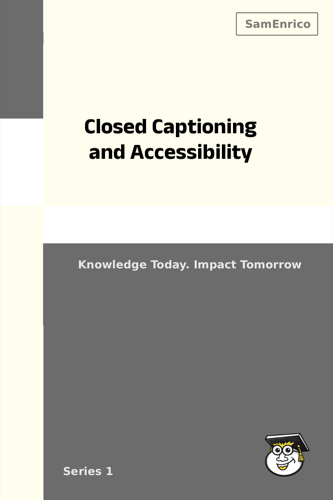
Closed Captioning and Accessibility Audiobook
Master captioning audio description and accessible
by Bundy Laine
Master captioning audio description and accessible TV settings for sensory loss.
Formats
Free sample
Chapter 1: The Silent Revolution--–- In a cramped laboratory at the Massachusetts Institute of Technology in 1971, a young electrical engineer named John Doe (name changed for privacy) stared at a waveform oscilloscope and realized he had just changed television forever. He had discovered a way to bury text inside the broadcast signal—in the vertical blanking interval, the invisible space between frames that everyone had assumed was empty dead air. That text could be turned on or off by the viewer. It could ride along with the picture and sound, hidden in plain sight, waiting to be summoned. He called it closed captioning.
His supervisors at the National Bureau of Standards called it a technical curiosity with no practical application. They were wrong. Within a decade, that curiosity would become a lifeline for millions of deaf Americans. Within four decades, it would become a standard feature on every television, every streaming service, and nearly every video ever recorded. Within six decades, it would spark a revolution in how all humans consume media—a revolution that is still unfolding as you read these words.This is that story.
But it is also your story, because you are part of this revolution whether you know it or not. Every time you have watched a video in a noisy airport, every time you have followed a recipe on a smart speaker while your hands were covered in flour, every time you have asked your phone to read you a text message while driving—you have used technology designed originally for people with disabilities. Closed captioning, audio description, and accessible TV settings are not separate, lesser versions of media. They are often the best versions. They demand clarity, intentionality, and empathy.
They force creators to think about who is watching and what they actually need.This chapter lays the foundation for everything that follows. It introduces you to the hidden history of captioning, the surprising demographics of who uses accessibility features and why, and the core philosophy that animates this entire book. By the time you finish, you will never look at a line of white text at the bottom of your screen the same way again.The Invention That Almost Didn't Happen The vertical blanking interval—that invisible space between frames—was never supposed to carry information. It was a relic of older television technology, a brief moment when the electron gun in a cathode-ray tube reset…
This is the end of the free sample. Get the Audiobook to keep going. Buy now
About this book
Details
- Author
- Bundy Laine
- Publisher
- SamEnrico
- Language
- English
- Genre
- Non-Fiction, Health & Wellness, Media Accessibility
- Released
- 2026-06-07
- Pages (approx.)
- 129
- Available as
- eBook, Audiobook

Listen in the VoxFlicks app
Audiobooks and audio dramas wherever you go. Sign in with your SamEnrico account and press play.
More by Bundy Laine
 Data Driven CreativityBundy Laine$11.99
 HIIT for Military FitnessBundy Laine$11.99
 Heist Blueprint TheftBundy Laine$11.99
 Smoking Cessation for Surgery PrepBundy Laine$11.99
 The Double Shadow: The Twin Lives of Cleopatra SeleneBundy Laine$11.99
 Echoes of the Infinite: The Untold Story of the First Deepfake ScandalBundy Laine$11.99
 Logistics B2B Middle EastBundy Laine$12.99
 Examplify Software Mastery GuideBundy Laine$12.99
 Unarmed Security OfficerBundy Laine$11.99
 Understanding Cardiogenital SyndromeBundy Laine$17.99
 How to Start a Fancy Goods (wholesale) Business (Beginners Guide)Bundy Laine$11.99
You may also like
 Hong Kong Handover 1997Dunn Johnnie$11.99
 Zumba For Postnatal Recovery CourseNeal Christian$11.99
 Zumba for BeginnersLadner Nikia$11.99
 YouTube Comment Mining GuideHumes Pandora$12.99
 Worry Box MeditationCarlin Rudy$11.99
 Workplace Stress MeditationNguyen Lynn$11.99
 Workplace Stress and Sleep RepairHawley Ivory$11.99
 Workplace Perfectionism CureDelaney Jeffry$11.99
 Workplace Injustice Anger GuideWallen Isabelle$11.99
 Work Addiction and Burnout LinkGreenwood Ester$11.99
 Women in Yoga and WellnessBeattie Galina$11.99
 Women in Stand Up ComedyChun Evangeline$11.99