
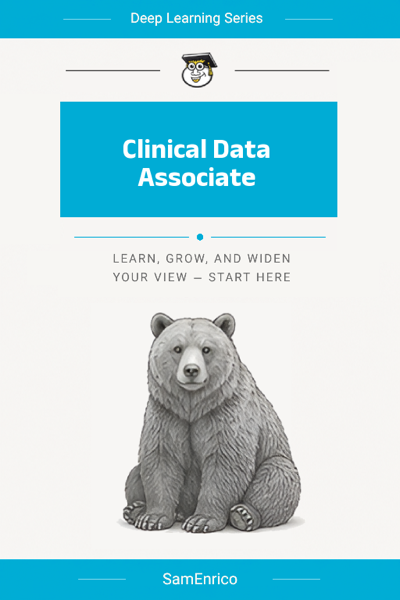
Clinical Data Associate eBook
A Coursebook on Clinical Data Associate
A Coursebook on Clinical Data Associate
Formats
Free sample
Chapter 1: The Guardian Awakens...---- The email arrives at 4:47 PM on a Tuesday. The subject line is deceptively simple: "Data query – Subject 203-409 – please advise." You open it. An automated system has flagged a single laboratory value: serum potassium of 9.2 mmol/L in a patient who, according to the electronic Case Report Form, is alive, asymptomatic, and still enrolled in a Phase III trial of a new heart failure drug. A potassium level that high should have killed the patient. But the patient is fine.
The data, therefore, is wrong. And you are the only person in the entire global clinical trial ecosystem who has been trained to catch this specific type of error before it reaches the FDA, before it becomes part of a drug submission, before it influences whether a life-saving medication ever reaches the pharmacy shelf.Welcome to the role of the Clinical Data Associate. You are not a data entry clerk. You are not an administrative assistant to the scientists. You are the guardian of the last mile between the messy reality of patient care and the pristine certainty of regulatory approval.
You sit at the intersection of medicine, technology, and law. And this chapter is where you begin to understand why that 4:47 PM email is not a nuisance – it is a calling.The Invisible Profession That Saves Lives Most people enter clinical research through the front door: they want to be doctors, nurses, or laboratory scientists. They want to hold the stethoscope, run the assay, or prescribe the pill. But there is a back door that leads to the same destination – better patient outcomes – and it is guarded by people who love puzzles, patterns, and precision. The Clinical Data Associate, or CDA, is the forensic accountant of clinical research.
While the principal investigator sleeps, while the sponsor reviews budgets, while the regulatory affairs team drafts submission documents, the CDA sits alone in front of a computer screen, scanning rows of numbers and letters, looking for the one inconsistency that could unravel years of work and billions of dollars.Consider what is at stake. A single undetected data error in a Phase III trial can produce a false safety signal, causing a promising drug to be abandoned. Conversely, a single undetected data error that masks a true safety signal can lead to a drug approval followed by post-market withdrawals, lawsuits, and patient harm. The difference between these outcomes is not always a matter of medical expertise or brilliant statistical design. Often, it is a matter of a CDA noticing that a patient's date of birth was entered as January 1, 1900 – the default value in a poorly programmed dropdown menu – and recognizing that a 124-year-old patient is impossible.This chapter establishes your professional identity.
By the time you finish reading, you will understand not only what a CDA does, but why the role exists, how it fits into the clinical trial ecosystem, and why smart, detail-obsessed people are leaving other careers to become CDAs. You will learn the boundaries of the role – where your authority ends and a Clinical Data Manager or Clinical Research Associate begins. You will be introduced to the regulatory frameworks that govern every action you take, from FDA 21 CFR Part 11 to ICH GCP E6(R2/R3) to the privacy requirements of HIPAA. And you will meet the Data Management Plan – the rulebook that will guide every decision you make in the chapters ahead.The Three Pillars of Clinical Research Execution Before we drill down into the CDA's specific duties, you need to understand the three operational roles that form the backbone of every clinical trial. These roles are often confused by outsiders, and sometimes even by people working in the industry.
But the distinctions are critical, because they define who has authority over what, and where the lines of responsibility begin and end.The Clinical Research Associate (CRA). The CRA is the site-facing role. They travel to hospitals, clinics, and academic medical centers where patients are being enrolled. They verify that the investigator and site staff are following the protocol, that informed consent is properly obtained, that the investigational product is stored at the correct temperature, and that source documents exist for every data point entered into the Case Report Form. The CRA asks the question: "Did the site do what they said they would do?" They are the eyes and ears of the sponsor on the ground.
But the CRA does not typically sit in the database, reviewing line by line, day after day. They visit, they verify, they leave, and they move to the next site.The Clinical Data Manager (CDM). The CDM is the strategic overseer of the data management function. They write the Data Management Plan, design the data validation specifications, approve the database lock, and communicate with the biostatisticians and regulatory affairs teams. The CDM decides which edit checks will be programmed, which discrepancies require immediate escalation, and what constitutes "clean data" ready for analysis.
They ask the question: "Is the data fit for purpose?" But the CDM does not typically review every patient record, write every query, or reconcile every external data file. They manage the system and the team, not the individual transactions.The Clinical Data Associate (CDA). And then there is you. You are the transactional role. You sit in the database, not just looking at summary reports, but opening individual patient records, scrolling through every visit, every form, every field.
You are the one who notices that a patient's weight increased by 30 kilograms between the screening visit and the baseline visit – a biological impossibility in a two-day window. You are the one who sees that the same site coordinator entered ten patients' blood pressure readings as exactly 120/80 – a statistical improbability that suggests fabrication, not measurement. You ask the question: "Is the data internally consistent?" You are the daily, hourly, minute-by-minute guardian of data integrity.If the clinical trial were a factory, the CRA would inspect the machinery, the CDM would design the quality control system, and the CDA would stand at the end of the assembly line, checking every single product before it ships. That is your role. And that is why your attention to detail is the last line of defense before the data reaches the statistician, the FDA reviewer, and ultimately, the patient.The Four Regulatory Frameworks You Cannot Ignore No CDA works in a vacuum.
Every click, every query, every correction you make is governed by a web of regulations that have the force of law. You do not need to become a regulatory attorney, but you do need to understand the four frameworks that will appear in every training session, every standard operating procedure, and every audit you will ever experience.FDA 21 CFR Part 11. This is the American regulation that governs electronic records and electronic signatures. It says, in essence, that an electronic record is legally equivalent to a paper record, provided that the computer system has certain features: audit trails, access controls, and validation. For the CDA, Part 11 means that everything you do inside the EDC system – every query you write, every data point you change, every time you log in and log out – is permanently…
This is the end of the free sample. Get the eBook to keep going. Buy now
About this book
Details
- Author
- Begley Yuriko
- Publisher
- SamEnrico
- Language
- English
- Genre
- Non-Fiction, Informative, Educational
- Released
- 2026-05-11
- Pages (approx.)
- 159
- Available as
- eBook, Audiobook

Read better in the ZLOADR app
Your eBooks on your phone or tablet. Sign in with your SamEnrico account and start reading.
More by Begley Yuriko
 Twitter Pinned Tweet PressureBegley Yuriko$11.99
 Legacy Letters Recovery Writing CourseBegley Yuriko$11.99
 Self Directed Exposure GuideBegley Yuriko$11.99
 Handling Passive AggressionBegley Yuriko$11.99
 OKR Goal Setting Framework GuideBegley Yuriko$11.99
 The Last Broadcast of the Phantom RadioBegley Yuriko$11.99
 Understanding Inhalant Abuse, Aliphatic HydrocarbonsBegley Yuriko$17.99
 Inflation Anxiety ToolkitBegley Yuriko$12.99
 Cash vs Digital Spending GuideBegley Yuriko$12.99
 How to Become a Chip TunerBegley Yuriko$11.99