
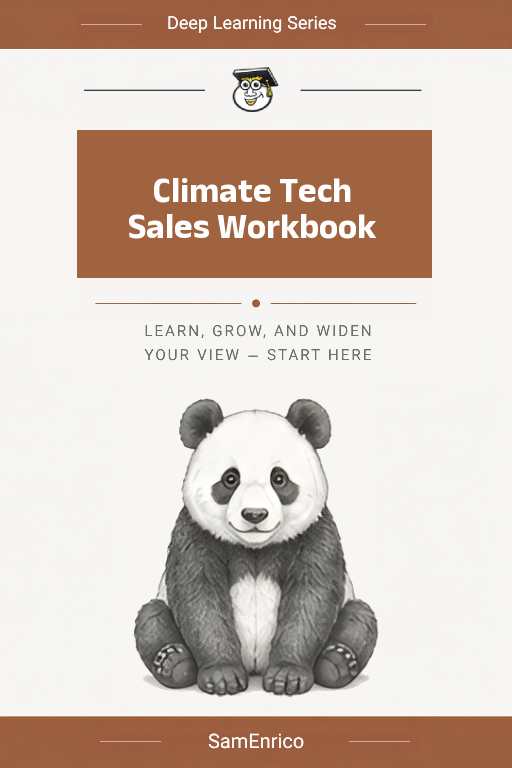
Non-FictionNon-Obvious CareerGreen Jobs
Climate Tech Sales Workbook eBook
Sell solar, battery storage, or carbon software to
Sell solar, battery storage, or carbon software to businesses using transferable B2B sales skills including lead generation and contract negotiation without STEM degrees.
Formats
Free sample
Chapter 1: The Translation Superpower...--–- In 2019, a 24-year-old philosophy major named Sarah walked into a conference room at a mid-sized manufacturing company in Ohio. She had no engineering degree, no background in energy, and no technical certifications. She was wearing a blazer she bought at a department store and carrying a spiral notebook. Across the table sat a plant operations manager with thirty years of experience, a chief financial officer who had reviewed twelve competing proposals, and an electrical engineer who had designed power systems for the US Navy.The engineer looked at Sarah’s resume, which listed “critical thinking” and “team collaboration” as key skills, and asked a question designed to end the conversation: “What’s the thermal runaway risk profile of your battery’s lithium iron phosphate cells at 45 degrees Celsius?”Sarah paused for exactly two seconds. Then she said: “That’s a great question.
I don’t have the thermal curve memorized, but I can tell you this: our system has been installed in forty-seven facilities with similar temperature profiles to yours, and zero have experienced thermal events. I’ll have our engineer send you the specific thermal model by end of day. But before I do, help me understand—are you currently dealing with overheating concerns in your existing power storage?”The engineer blinked. The CFO leaned forward. The operations manager wrote something down.Sarah did not have a STEM degree.
She had a translation superpower.She sold the battery system that quarter. It was a $1.2 million deal.The Problem This Chapter Solves If you are reading this workbook, you likely fall into one of three categories. First, you are a seller or aspiring seller in climate tech—solar, battery storage, or carbon software—and you do not have a science or engineering background. Second, you have been told, either directly or indirectly, that you need technical credentials to succeed in this industry. Third, you have experienced the sinking feeling of being asked a technical question you could not answer, and you are tired of feeling like an imposter.This chapter exists to solve a specific problem: the false belief that technical knowledge equals sales success in climate tech.The truth is the opposite.
Technical knowledge without translation skills is worse than useless—it actively confuses buyers. I have watched engineers with Ph Ds lose deals because they spent forty-five minutes explaining voltage curves to a CFO who only wanted to know one thing: “How much will this lower my electricity bill next year?”Climate tech is not unique in this regard. Every complex B2B industry faces the same dynamic. But climate tech has a particular problem: it is dominated by mission-driven technical founders who hire mission-driven technical sellers, and together they speak a language that ordinary business buyers do not understand. The result is a massive, underserved market of customers who want to buy solar, storage, and carbon software but cannot find anyone who will sell it to them in plain English.This chapter will give you three things.
First, a new framework for understanding what actually drives B2B sales in climate tech. Second, a clear articulation of why your non-technical background is not a weakness but a competitive advantage. Third, the first of many drills in this workbook—a skill you can practice today that will immediately separate you from every other seller in your space.By the end of this chapter, you will stop apologizing for what you do not know and start leveraging what you do know. You will stop trying to become a fake engineer and start becoming a real translator.The Voltage Versus Value Gap Let me define a term that will appear throughout this workbook: the Voltage Versus Value Gap.Voltage is a technical spec. It is real, measurable, and important to engineers.
But voltage does not pay a customer’s bills. Voltage does not reduce downtime. Voltage does not help a CFO sleep better at night. Voltage is a feature. Value is a business outcome.
Value is lower operating expenses. Value is avoided carbon tax risk. Value is energy independence from a volatile utility grid.The Voltage Versus Value Gap is the distance between what climate tech sellers say and what business buyers hear. When a seller says “Our panels have 22.8 percent efficiency,” the buyer hears “I am about to listen to a lecture I did not ask for.” When a seller says “Our software uses the GHG Protocol Scope 2 market-based method,” the buyer hears “This person is not speaking my language.”Closing this gap is the single most important skill in climate tech sales. It is more important than product knowledge.
It is more important than negotiation tactics. It is more important than having a massive contact list. Because if you cannot close the gap, you never get to use any of those other skills. You never get past the first conversation.Consider two sellers selling the exact same battery storage system to the exact same manufacturing plant.Seller A has a mechanical engineering degree. She says: “Our system has a round-trip efficiency of ninety-two percent, a C-rate of one point five, and a cycle life of six thousand cycles at eighty percent depth of discharge.
The lithium iron phosphate chemistry provides superior thermal stability compared to NMC.”Seller B has a degree in English literature. He says: “Last year, your facility paid about forty-seven thousand dollars in demand charges alone—that’s the fee the utility adds when you pull too much power too quickly. Our system watches your usage in real time and automatically smooths your peaks. Based on your last twelve months of data, we estimate you would have cut those demand charges by about sixty percent. That’s roughly twenty-eight thousand dollars back in your pocket.
And because the system pays for itself in thirty-one months, every dollar after that is pure savings.”Who wins the deal?Seller B wins, every single time, unless the buyer is an engineer buying for personal use. And corporate buyers are not engineers buying for personal use. They are professionals buying for business outcomes.This is not an argument against technical knowledge. You need some. Chapter 2 of this workbook will give you the 80/20 of technical and regulatory fluency—exactly what you need to know and nothing more.
But technical knowledge is table stakes. Translation is the differentiator.Why Engineers Make Terrible Sellers (And Why That Is Good News For You)I want to be careful here. I am not saying engineers are bad at their jobs. Engineers are essential. They design the systems, write the software, test the components, and ensure safety.
Without engineers, climate tech does not exist.But engineers make terrible sellers for a very specific reason: they are trained to value precision over persuasion.Engineering education rewards correct answers. If you are off by a decimal point, the bridge collapses. This mindset is essential for building things. It is disastrous for selling them. Because buyers are not precision machines.
Buyers have emotions, biases, competing priorities, and incomplete information. Buyers make decisions based on trust, urgency, and perceived value—not on accurate specifications.I have watched dozens of technical founders pitch their own products.…
This is the end of the free sample. Get the eBook to keep going. Buy now
About this book
Details
- Author
- Callender Sebrina
- Publisher
- SamEnrico
- Language
- English
- Genre
- Non-Fiction, Non-Obvious Career, Green Jobs
- Released
- 2026-05-29
- Pages (approx.)
- 149
- Available as
- eBook, Audiobook

Read better in the ZLOADR app
Your eBooks on your phone or tablet. Sign in with your SamEnrico account and start reading.
More by Callender Sebrina
 Emotional Intelligence For GrandparentsCallender Sebrina$11.99
 Paleo Vs Keto Comparison GuideCallender Sebrina$11.99
 People Pleasing Origins RecoveryCallender Sebrina$11.99
 Equifax Legacy IT SystemsCallender Sebrina$11.99
 The Trial of the Century: The Untold Story of the O.J. Simpson Civil CaseCallender Sebrina$11.99
 The Silk and Smoke Heist: Europe's First Balloon EspionageCallender Sebrina$11.99
 How to Start a Catseye Reflector Business (Beginners Guide)Callender Sebrina$11.99
 Wellness Tourism SpendingCallender Sebrina$12.99
 Energy Modeling SpecialistCallender Sebrina$11.99
 Understanding Generalized Malformations In Neuronal MigrationCallender Sebrina$17.99
You may also like
 Hong Kong Handover 1997Dunn Johnnie$11.99
 Zumba For Postnatal Recovery CourseNeal Christian$11.99
 Zumba for BeginnersLadner Nikia$11.99
 YouTube Comment Mining GuideHumes Pandora$12.99
 Worry Box MeditationCarlin Rudy$11.99
 Workplace Stress MeditationNguyen Lynn$11.99
 Workplace Stress and Sleep RepairHawley Ivory$11.99
 Workplace Perfectionism CureDelaney Jeffry$11.99
 Workplace Injustice Anger GuideWallen Isabelle$11.99
 Work Addiction and Burnout LinkGreenwood Ester$11.99
 Women in Yoga and WellnessBeattie Galina$11.99
 Women in Stand Up ComedyChun Evangeline$11.99