
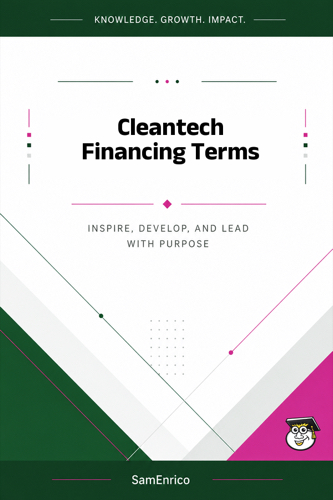
Non-FictionCapital & Valuation RegisterCleantech
Cleantech Financing Terms eBook
Project finance and infrastructure provisions from
Project finance and infrastructure provisions from 300 climate tech deals.
Formats
Free sample
Chapter 1: The Three-Body Problem--–- The conference room in Houston smelled of stale coffee and desperation. On one side of the table sat the founders of Green H2 Delta, a promising hydrogen startup with a revolutionary electrolyzer design. On the other side sat the credit committee from a major infrastructure bank. Between them lay a term sheet that had taken nine months to negotiate. The founders had done everything right: they had a Department of Energy grant, a strategic offtaker with an investment-grade credit rating, and a Tier 1 EPC contractor.
They had even brought in a former Goldman Sachs partner as CFO. And yet, the deal was stalling.The problem was not the technology. The problem was not the market. The problem was a single sentence buried on page 47 of the credit agreement, under a section titled "Sponsor Support Provisions." The sentence read: "In the event of a Trigger Event, each Sponsor shall provide additional equity contributions up to the amount of its original commitment, on a several but not joint basis, within ten (10) Business Days of notice from the Administrative Agent."The founders had read that sentence six times. They still could not figure out why it was a problem.
Their lawyer explained: the bank wanted the right to demand fresh cash from the sponsors if the project ran into trouble. And the sponsors — a strategic industrial company and an infrastructure fund — would be required to write checks on a "several but not joint" basis, meaning each was only responsible for its own share, not the other's. That seemed fair. But the lawyer pointed to the words "original commitment" and "ten Business Days." If the project needed $20M in a hurry, the strategic would have to write a check for its pro-rata share. But what if the strategic was going through its own quarterly earnings cycle and could not write a check in ten days?
The bank could declare an event of default. The founders would lose the company.The deal eventually closed, but only after the founders agreed to a modified provision that gave them 30 days and capped the additional equity at 50% of the original commitment. The term sheet had been negotiated by a team of lawyers who charged $1,500 per hour. The founders later admitted they never fully understood why the original language was dangerous. They just knew it almost killed the deal.This is the three-body problem of climate tech finance.
Unlike traditional infrastructure, where a single utility sponsor with a strong balance sheet provides both equity and operational expertise, climate tech projects require a delicate gravitational balance between three distinct types of capital providers: Strategics, Infrastructure Funds, and Development Companies (Dev Cos) . Each has its own incentives, its own risk tolerance, and its own definition of success. When these three bodies orbit each other, the resulting dynamics can either accelerate a project to commercial scale or tear it apart. Understanding the gravitational forces between them is the first step to speaking "bank" — the language this book teaches.The Old Model: One Sponsor to Rule Them All Before climate tech became a mainstream asset class, infrastructure finance was simpler. A single sponsor — typically a utility, an independent power producer, or a large industrial company — would develop, build, and operate an asset.
That sponsor had a balance sheet, a track record, and a relationship with a group of relationship banks. The sponsor's credit rating determined the cost of debt. The sponsor's operational expertise assured lenders that the asset would perform. The sponsor's equity commitment aligned interests.That model worked for natural gas plants, wind farms, and solar fields. It does not work for climate tech.
Here is why.A utility sponsoring a solar farm already owns and operates dozens of similar assets. It has an internal engineering team that understands every component. It has a treasury department that can write equity checks without blinking. It has a legal team that has closed fifty project finance deals. When that utility goes to a bank, the bank does not need to underwrite the utility's competence — that is already established.
The bank only needs to underwrite the specific project's cash flows.Now contrast that with a climate tech startup developing a novel electrolyzer. The startup has no balance sheet. It has no track record of operating industrial assets. It has never closed a project finance deal. The founders are brilliant engineers, but they do not speak the language of debt covenants, debt service coverage ratios, or cash waterfalls.
When they go to a bank, the bank looks at the sponsor and sees a blank page.This is why the single-sponsor model fails. But the solution is not to give up on debt financing. The solution is to recognize that climate tech projects require three sponsors instead of one. Each brings something the others lack. Each also brings its own risks.
The art of climate tech finance is learning to balance them.The New Trio: Strategics, Infra Funds, and Dev Cos The three-body problem of climate tech finance involves three distinct types of capital providers. Each has a different role, a different time horizon, and a different risk tolerance. Understanding these differences is the difference between a term sheet that closes and a deal that dies in diligence.Strategics: The Heavy Lifter A strategic investor is an industrial company that wants to use the project's output, integrate the technology into its own operations, or secure a competitive advantage in the energy transition. Strategics include oil and gas majors (Shell, BP, Total Energies), utilities (Next Era, Iberdrola, Engie), and industrial giants (Arcelor Mittal, Dow, Siemens). They bring three things that no other investor can provide.First, they bring balance sheet strength.
A strategic with an investment-grade credit rating can guarantee offtake agreements, provide parent company guarantees, and lower the cost of debt through the halo effect — a phenomenon where a bank offers better terms simply because a creditworthy name is attached to the deal. In Green H2 Delta, the strategic offtaker's AA- rating reduced the senior debt cost from 8% to 6.5%, saving the project $1.5M per year in interest.Second, they bring operational expertise. A strategic that already operates hydrogen pipelines, ammonia plants, or steel mills understands the industrial realities that founders often miss. They know that compressors fail, that feedstock quality varies, that labor disputes happen. This knowledge is invaluable during project design and commissioning.Third, they bring offtake certainty.
The most common reason a climate tech deal fails to reach financial close is the lack of a creditworthy offtaker. A strategic that agrees to buy the project's output solves that problem instantly — provided the strategic's own credit rating remains investment grade.But strategics come with their own risks. They demand exclusivity — the startup cannot sell its technology to competitors. They demand equity kickers — warrants or discounted equity that give them upside if the technology succeeds. And most dangerously, they may have conflicting incentives.
A strategic that is simultaneously investing in green hydrogen and operating a natural gas business may not be fully committed to the project's success. If natural gas prices spike, the strategic's treasury department might quietly prefer the hydrogen project to fail. This is not theoretical. It has happened.Infrastructure Funds…
This is the end of the free sample. Get the eBook to keep going. Buy now
About this book
Details
- Author
- Southard Teddy
- Publisher
- SamEnrico
- Language
- English
- Genre
- Non-Fiction, Capital & Valuation Register, Cleantech
- Released
- 2026-06-08
- Pages (approx.)
- 144
- Available as
- eBook, Audiobook

Read better in the ZLOADR app
Your eBooks on your phone or tablet. Sign in with your SamEnrico account and start reading.
More by Southard Teddy
 Micronutrients For Kidney Health GuideSouthard Teddy$11.99
 Postpartum Nap Recovery GuideSouthard Teddy$11.99
 MBSR for Driving StressSouthard Teddy$11.99
 Caregiver for Mental IllnessSouthard Teddy$11.99
 King of the RoastSouthard Teddy$11.99
 Self Managing Rental PropertySouthard Teddy$11.99
 Self Compassion Over Self DoubtSouthard Teddy$11.99
 Fibromyalgia and Trauma LinkSouthard Teddy$11.99
 Glitch in the Matrix: The Uncanny Rise of Deepfake PoliticsSouthard Teddy$11.99
 Changping: The Bloodbath That Shattered Qin's RiseSouthard Teddy$11.99
 Steel and Stone: The Grand Canyon's First Mechanical SurveySouthard Teddy$11.99
 The Strategist's Guide to Experience Curve EffectsSouthard Teddy$11.99
You may also like
 Hong Kong Handover 1997Dunn Johnnie$11.99
 Zumba For Postnatal Recovery CourseNeal Christian$11.99
 Zumba for BeginnersLadner Nikia$11.99
 YouTube Comment Mining GuideHumes Pandora$12.99
 Worry Box MeditationCarlin Rudy$11.99
 Workplace Stress MeditationNguyen Lynn$11.99
 Workplace Stress and Sleep RepairHawley Ivory$11.99
 Workplace Perfectionism CureDelaney Jeffry$11.99
 Workplace Injustice Anger GuideWallen Isabelle$11.99
 Work Addiction and Burnout LinkGreenwood Ester$11.99
 Women in Yoga and WellnessBeattie Galina$11.99
 Women in Stand Up ComedyChun Evangeline$11.99