
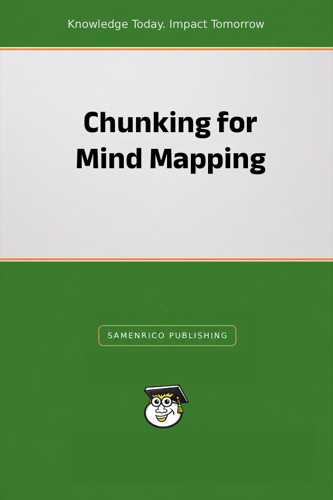
Non-FictionSelf-HelpMind Mapping
Chunking for Mind Mapping eBook
Organize mind map branches into meaningful cluster
by Allan Quinn
Organize mind map branches into meaningful clusters.
Formats
Free sample
Chapter 1: The $10,000 Branch--–- Sarah had spent eighteen hours preparing for the presentation. Her mind map for the $10 million product launch covered an entire whiteboard—147 branches radiating from a central node like an exploded diagram of a spaceship. Colors. Images. Keywords.
Everything Tony Buzan had ever recommended. She felt brilliant while drawing it. The connections flowed. The ideas sparked. Her assistant brought her coffee and said, "That's beautiful."Then she presented it to the CEO.The room fell silent.
Not the good kind of silent—the kind where fifteen people are trying to find a polite way to say, "I have no idea what I'm looking at." The CEO, a generally kind woman named Margaret, finally spoke. "Sarah," she said, tilting her head, "what am I supposed to do with this?"Sarah tried to explain. She pointed to branches. She traced paths. She talked about synergies and touchpoints and cross-functional alignment.
The words came out, but even as she spoke, she realized something terrible: she didn't understand her own map either. Not really. She had generated a massive quantity of ideas, but she had not organized them in any way that another human—or even herself, forty-eight hours later—could actually use.The meeting ended with a polite "Let's circle back on this." The project was delayed by three weeks. Sarah's credibility took a hit that took months to repair. The branch she had drawn that caused the most confusion?
A cluster of eight items under a node labeled "Miscellaneous." She had created a $10,000 branch—the cost of her team's wasted time, the delayed launch, the lost momentum.This book exists because of Sarah. And because of the thousands of people like her who have been told that mind mapping will solve their problems, only to discover that a messy mind map is worse than no map at all.The Great Lie of Mind Mapping Here is a truth that the productivity industry does not want you to hear: most mind maps are useless.Not all mind maps. Not the technique itself. But the way 95 percent of people actually use mind mapping—the sprawling, chaotic, everything-including-the-kitchen-sink approach—produces maps that are harder to understand than a simple bullet-point list.How do I know this? Because I have spent the last eight years teaching mind mapping to executives, students, engineers, and artists.
I have looked over their shoulders at thousands of maps. And I have watched the same pattern repeat endlessly: someone creates a map with fifty, eighty, or even a hundred and fifty branches. They feel productive while making it. They feel smart. But when they return to that map a week later, they cannot find the one insight that matters.
They cannot remember which branch held the breakthrough idea. They cannot explain the map to a colleague without apologizing for how "messy" it looks.The problem is not mind mapping. The problem is the absence of chunking.Chunking is the single most important cognitive skill that no one teaches you. It is the art of grouping related items into meaningful clusters. It is what turns a pile of LEGO bricks into a recognizable structure.
It is what separates the chess master who sees "kingside attack formation" from the beginner who sees thirty-two individual pieces. And it is what will transform your mind maps from confusing spider diagrams into surgical thinking tools.Without chunking, a mind map is not a map at all. It is a dump truck.Why Your Brain Laughs at Your Mind Map To understand why chunking matters, you need to understand a small but crucial piece of cognitive psychology. In 1956, a Harvard psychologist named George Miller published a paper with a deceptively simple title: "The Magical Number Seven, Plus or Minus Two." Miller's research found that the human brain can hold roughly seven random items in short-term memory—give or take two.Here is the part that most books get wrong. That "seven plus or minus two" finding applies to simple, random information like digits (3, 8, 2, 5, 9, 1, 4) or unrelated words (dog, house, red, car, tree, cup, fast).
When you are dealing with complex, meaningful information—the kind you put in a mind map about a product launch, a business strategy, or a textbook chapter—the real limit is not seven. It is not five. It is three to five chunks.Your working memory, the part of your brain that holds information while you think about it, is not a warehouse. It is a small whiteboard. You can write three to five meaningful ideas on that whiteboard before it fills up.
Everything beyond that spills onto the floor, forgotten until you look at it again.Now look at your typical mind map. Count the branches. If you are like most people, you have ten, twenty, or even fifty main branches. Each branch holds additional sub-branches. Your brain looks at that map and says, "I cannot hold fifty items.
I cannot even hold ten. I will not try." Then it shuts down.This is not a failure of your intelligence. It is a feature of your neurology. Your brain is protecting you from overload. But it is also preventing you from thinking clearly about complex problems.The Filing Cabinet vs.
The Dump Truck Here is a metaphor that will stick with you through this entire book. Imagine two ways to store information.The first way is a dump truck. You drive around collecting everything you can find—old furniture, broken toys, interesting rocks, soggy cardboard boxes—and you dump it all into a pile. That pile contains everything, but you cannot find anything specific. You know the red shoe is in there somewhere, but finding it requires digging through every other item.
This is the default approach to mind mapping. Write down every idea. Connect every association. Fill every branch. The result is a pile of information, not a map.The second way is a filing cabinet.
You label each drawer. You put related documents in the same folder. You organize not by the order you found things, but by their meaning and purpose. When you need the red shoe, you open the "Shoes" drawer, find the "Red" folder, and pull it out in three seconds. This is what chunked mind maps achieve.A dump truck mind map makes you feel productive because you generated many ideas.
A filing cabinet mind map makes you effective because you can find and use those ideas.The difference between a dump truck and a filing cabinet is not the amount of information. It is the structure of that information. And structure comes from chunking.Radiant Thinking vs. Random Thinking Tony Buzan, the inventor of modern mind mapping, coined the term Radiant Thinking to describe the natural, associative way the brain works. One thought leads to another, which leads to another, like sunlight radiating from a center.
This is beautiful and true. Your brain really does think radiantly.But here is the subtle trap. Many people confuse "radiant" with "random." They assume that because thinking is associative, any association is equally valuable. They draw branches that connect to branches that connect to branches, creating a sprawling web of ideas that radiates in every possible direction.…
This is the end of the free sample. Get the eBook to keep going. Buy now
About this book
Details
- Author
- Allan Quinn
- Publisher
- SamEnrico
- Language
- English
- Genre
- Non-Fiction, Self-Help, Mind Mapping
- Released
- 2026-06-10
- Pages (approx.)
- 134
- Available as
- eBook, Audiobook

Read better in the ZLOADR app
Your eBooks on your phone or tablet. Sign in with your SamEnrico account and start reading.
More by Allan Quinn
 Self Hypnosis Counting Method HandbookAllan Quinn$11.99
 Fitness Breathing BasicsAllan Quinn$11.99
 The Anger White Flag ProtocolAllan Quinn$11.99
 Commute Interruption Reclaim GuideAllan Quinn$11.99
 The Sky Splitter: When the Gods FellAllan Quinn$11.99
 Beyond the Stars: The Untold Story of Asia's Space PioneersAllan Quinn$11.99
 Front Office AssistantAllan Quinn$11.99
 No Estimates Kanban for BasecampAllan Quinn$12.99
 Best AI Art Midjourney StylesAllan Quinn$12.99
 Understanding Endometrial Stromal SarcomaAllan Quinn$17.99
 How to Start a Precious Stone Cutting Business (Beginners Guide)Allan Quinn$11.99
You may also like
 Hong Kong Handover 1997Dunn Johnnie$11.99
 Zumba For Postnatal Recovery CourseNeal Christian$11.99
 Zumba for BeginnersLadner Nikia$11.99
 YouTube Comment Mining GuideHumes Pandora$12.99
 Worry Box MeditationCarlin Rudy$11.99
 Workplace Stress MeditationNguyen Lynn$11.99
 Workplace Stress and Sleep RepairHawley Ivory$11.99
 Workplace Perfectionism CureDelaney Jeffry$11.99
 Workplace Injustice Anger GuideWallen Isabelle$11.99
 Work Addiction and Burnout LinkGreenwood Ester$11.99
 Women in Yoga and WellnessBeattie Galina$11.99
 Women in Stand Up ComedyChun Evangeline$11.99