
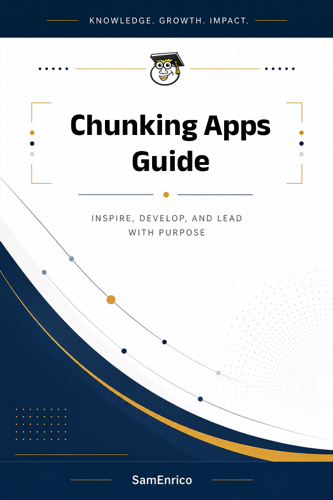
Free sample
Chapter 1: Your Liquid Brain--The problem isn’t that you’re lazy. The problem isn’t that you lack willpower. And the problem most certainly isn’t that you need yet another app promising to “change your life” with prettier buttons and a more satisfying notification sound.The problem is that your brain is a liquid container trying to hold a fire hose.My name isn’t important, but my崩溃 is. Three years ago, I sat in front of a computer screen at 11:47 PM, my fortieth cup of cold coffee beside me, staring at a project document that had grown to seventy-three pages. I had been “working” on this project for six weeks.
I had produced exactly nothing. Zero. Zilch. Not a single deliverable.But I had done so much. I had read forty-seven articles.
I had organized three spreadsheets. I had color-coded a timeline. I had watched sixteen You Tube tutorials on productivity systems. I had downloaded seven new apps, set them up with loving care, and then abandoned six of them within days. The seventh—I won’t name it, but its logo is a cheerful shade of purple—had become my digital prison.
Four hundred and thirty-two tasks. Endless subtasks. Tags, priorities, deadlines, dependencies. I had created a monument to my own paralysis.And here’s the terrifying part: I felt productive.I was not productive. I was procrastinating with a spreadsheet.That night, I had what I can only describe as a small breakdown.
Not the cinematic kind where you throw a laptop across the room. The quieter, more pathetic kind. I simply closed my laptop, laid my head on my desk, and whispered to no one: “I can’t do this anymore. I don’t even know what ‘this’ is.”That’s when I discovered the truth that changed everything.The truth isn’t about apps. The truth isn’t about systems.
The truth is about the size of the buckets you’re using to carry water from a river. If your buckets are too big, you can’t lift them. If they’re too small, you’ll spend all day walking back and forth. And if you don’t have buckets at all—if you’re just standing there, arms outstretched, hoping to catch the river in your hands—you’ll drown.Your brain is your hands. Chunking is the bucket.This book is not about working harder.
It’s about working smaller. It’s about taking the overwhelming, terrifying, chaotic mountain of your responsibilities and breaking it into pebbles. Then moving those pebbles, one by one, while everyone else is still staring at the mountain, frozen in fear.But before we can build the bucket, we need to understand why your brain is currently shaped like a sieve.The Myth of the Infinite Mind Let me ask you a question. Right now, without looking, can you name all seven of your active projects at work? Can you recall the three things your spouse asked you to do this week?
Can you remember the login password for that one account you set up last month—the one with the uppercase letter, the number, and the special character that you definitely wrote down somewhere?Of course you can’t. And that’s not a flaw. That’s a feature.The human brain is the most complex object in the known universe, but it has a ridiculously embarrassing limitation: its working memory can only hold about four things at once. Four. That’s it.This isn’t speculation.
In 1956, cognitive psychologist George Miller published a landmark paper titled “The Magical Number Seven, Plus or Minus Two.” His research suggested that the average person could hold between five and nine discrete items in short-term memory. More recent studies have revised that number downward. Most neuroscientists now agree that the true capacity of working memory is closer to four items. Four.Think about that for a moment. Your brain—the same brain that can recognize ten thousand faces, learn a language, compose a symphony, and navigate a moving vehicle through traffic—can only hold four thoughts at once.Now think about your to-do list.
How many items are on it? Fifty? A hundred? More?When you look at that list, your brain doesn’t see an organized collection of tasks. It sees an unmanageable flood.
And what does the brain do when it sees a flood? It panics. It activates the threat response. It releases cortisol. And then, to protect itself, it does something that looks like laziness but is actually self-preservation: it shuts down.That feeling of being overwhelmed?
That’s not a character flaw. That’s neurology.The Chunking Discovery The solution has been hiding in plain sight for decades. It’s called chunking.Chunking is the process of breaking information into smaller, meaningful units that your working memory can handle. You already do this unconsciously, every single day. When you read a phone number, you don’t try to remember 5551234567.
You remember 555-123-4567. Three chunks. When you learn a new dance routine, you don’t memorize thirty individual steps. You memorize three sequences of ten steps. Chunks.Chunking works because it exploits the fundamental architecture of your brain.
Your working memory can only hold four things, but those four things can be anything. They can be individual atoms of information. Or they can be clusters—chunks—each containing dozens or even hundreds of atoms.Here’s the magic: when you create a chunk, your brain treats it as a single unit. It compresses the information. It builds a neural pathway that fires all at once.
Instead of thinking “pick up pen, open notebook, turn to page twelve, read first paragraph, underline second sentence,” your brain thinks “study session.” One chunk. One action. One less thing to hold in your precious, limited working memory.The implications are staggering. If you can chunk effectively, you can dramatically expand your effective cognitive capacity. Not by changing your brain—you can’t—but by changing how you feed it.The Diagnostic: Are You Drowning?Before we go any further, let’s take a moment to diagnose where you are right now.
I’ve developed a simple assessment called the Chunking Score. Answer each question honestly, using the scale of 1 (never) to 5 (always).Question 1: When you look at your to-do list, you feel a sense of physical tension or anxiety. (1-5: _____)Question 2: You have more than ten tasks “in progress” at any given time. (1-5: _____)Question 3: You frequently forget what you were doing after an interruption. (1-5: _____)Question 4: You’ve started projects that you never finished because they felt too big.
(1-5: _____)Question 5: You spend more time organizing your tasks than doing them. (1-5: _____)Question 6: You have multiple apps for task management and can’t decide which one to use. (1-5: _____)Question 7: Your email inbox has more than 100 unread messages right now. (1-5: _____)Question 8: You’ve missed a deadline in the past month because you underestimated how long something would take. (1-5: _____)Question 9: You feel like you’re always busy but rarely productive.
(1-5: _____)Question 10: You can’t clearly articulate what your top three priorities are at this moment. (1-5: _____)Total your score.10-20…
This is the end of the free sample. Get the eBook to keep going. Buy now
About this book
Details
- Author
- Singleton Ada
- Publisher
- SamEnrico
- Language
- English
- Genre
- Non-Fiction, Self-Help / Technology
- Released
- 2026-06-09
- Pages (approx.)
- 135
- Available as
- eBook, Audiobook

Read better in the ZLOADR app
Your eBooks on your phone or tablet. Sign in with your SamEnrico account and start reading.
More by Singleton Ada
 PTSD Therapy For Conflict Zones ManualSingleton Ada$11.99
 Evidence Log for Self DoubtSingleton Ada$11.99
 Time Pressure Driving GuideSingleton Ada$11.99
 The Sobriety Sleep HygieneSingleton Ada$11.99
 Empowerment HandbookSingleton Ada$11.99
 FCPA Successor Liability CasesSingleton Ada$11.99
 TM For AsthmaSingleton Ada$11.99
 Self Talk For Layoff SurvivorsSingleton Ada$11.99
 The Phantom Heist of the Century: The Great Train Robbery of 1963Singleton Ada$11.99
 The Lion of Karkemish: Sennacherib's Defeat at the Euphrates (691 BC)Singleton Ada$11.99
 The World Carved from Bone: The Inuit Cosmic ForgeSingleton Ada$11.99
 Affiliate Analytics and OptimizationSingleton Ada$11.99
You may also like
 Parent Time Apps GuideWoodruff Shiela$11.99
 Notification Management GuideYamamoto Mui$11.99
 Scripting AppsDias Codi$11.99
 Loneliness and TechnologyEdmiston Isreal$11.99
 Caregiver Technology SolutionsCone Dorcas$11.99
 Habit Apps GuideTejada Dina$11.99
 Resilience Apps GuideFerris Carmelina$11.99
 Remote Work Tool StackHolland Kathy$11.99
 Pain Meditation AppsCroteau Elin$11.99
 Gratitude for TechnologyArreola Brenna$11.99
 Virtual Memory PalacesBillingsley Fe$11.99
 Senior Technology ConfidenceGallant Tonie$11.99