
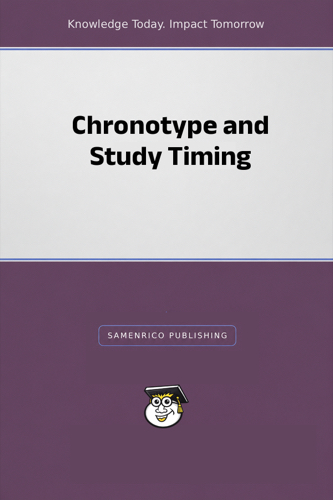
Non-FictionSelf-HelpChronotype
Chronotype and Study Timing eBook
Teaches matching study to lark or owl chronotype f
Teaches matching study to lark or owl chronotype for better recall.
Formats
Free sample
Chapter 1: The 8 AM Lie--You have been lied to.Not maliciously. Not by villains in dark rooms. But lied to nonetheless—by bell schedules, by tradition, by the quiet assumption that 8 AM is a perfectly reasonable time to expect a human brain to perform complex cognitive tasks.If you have ever sat in an early morning class, stared at a page, and felt your brain refuse to cooperate—if you have ever studied for two hours and remembered nothing—if you have ever called yourself lazy, undisciplined, or “just not a morning person”… this chapter is your permission to stop.The problem is not you. The problem is the schedule.The Invention of the 8 AM Class (And Why It Has Nothing to Do With Learning)Let us take a brief, painful journey into history.The modern school schedule was not designed by neuroscientists. It was not optimized for memory retention.
It was not tested against circadian rhythms or learning outcomes. It was designed by factory owners and industrialists in the 19th century who needed to train children for a lifetime of shift work. The bell rang. You showed up. You sat still.
You did not ask questions about whether your brain was actually ready to learn.That schedule—early start, rigid blocks, minimal regard for individual variation—has survived for nearly two hundred years, not because it works, but because it is convenient for adults who make the schedules.Consider what we know now that we did not know then:The human brain has an internal clock, synchronized to the 24-hour day, that regulates alertness, memory formation, and cognitive performance.This clock varies dramatically from person to person—by as much as six hours in natural peak alertness.For a significant portion of the population, 8 AM is not merely “early.” It is biologically equivalent to the middle of the night.And yet we continue to schedule calculus, organic chemistry, and foreign language exams at 8 AM, then wonder why students fail.This is not education. This is hazing.Your Internal Clock (The 24-Hour Conductor You Never Hired)Deep within your brain, buried beneath the folds of your prefrontal cortex and nestled above your brainstem, sits a tiny cluster of neurons called the suprachiasmatic nucleus. It is smaller than a grain of rice. And it runs your entire life.The suprachiasmatic nucleus is your body’s master clock. It receives signals from specialized light-sensing cells in your eyes—not the ones you use for vision, but a separate system designed specifically to detect sunrise and sunset.
When morning light hits those cells, they send a signal: “Wake up. Start producing cortisol. Raise body temperature. Prepare for the day.”When darkness falls, the clock sends a different signal: “Release melatonin. Lower body temperature.
Slow down. Sleep.”This system is not optional. You cannot override it with willpower any more than you can override your heartbeat. Every cell in your body—every organ, every tissue, every neuron—has its own clock, synchronized to the master pacemaker. When the master clock says “morning,” your liver produces digestive enzymes.
Your heart rate increases. Your kidneys slow urine production. Your brain sharpens its attention.When the master clock says “night,” the opposite happens. Your body prepares for rest. Your brain shifts into memory consolidation mode.
Your executive function—planning, inhibition, complex reasoning—drops by as much as 30%.Here is the critical point: that master clock does not care about your alarm settings. It does not care about your professor’s syllabus. It does not care that you have an 8 AM exam. It runs on light, on genetics, and on a rhythm that was set before you were born.And for millions of students, that rhythm says: “Not yet.”Social Jetlag (The Fatigue You Thought Was Normal)You have heard of jetlag. You fly from New York to London, crossing five time zones, and for three days your body insists on sleeping at the wrong times.
You are exhausted. You cannot focus. Your mood is terrible.Social jetlag is the same phenomenon, but instead of airplanes, the time zone shift comes from your schedule.Every morning when your alarm goes off before your biological clock is ready, you experience social jetlag. Every time you force yourself to study during your body’s natural trough, you experience social jetlag. Every weekend when you sleep until 11 AM to recover from a week of 6 AM alarms, you are measuring the gap between your biological time and your social time.That gap has a cost.Researchers who study chronobiology have found that each hour of social jetlag increases the risk of:Poor academic performance (by up to 20% per hour of mismatch)Depression and anxiety (by 11% per hour)Metabolic syndrome and obesity (by 33% for chronic mismatch)Cardiovascular disease (by 25% over ten years)Let us put that in student terms.
An Owl—someone whose natural peak is 10 PM—forced to wake at 6 AM for an 8 AM class is experiencing approximately four hours of social jetlag every single day. Over a sixteen-week semester, that is 448 hours of biologically-imposed cognitive impairment. That is the equivalent of flying from New York to London and back, twice a week, for four months, and being told to perform at your best.Would you expect anyone to succeed under those conditions?The Data That Schools Ignore The evidence against early start times is overwhelming. It is not controversial among sleep scientists. It is not disputed among chronobiologists.
It is simply ignored by the institutions that set school schedules.Here is what the research actually shows.Study One: The University Data Researchers at the University of California, Berkeley analyzed grade data from 10,000 students across multiple semesters. They found that students who took 8 AM classes had significantly lower GPAs than students who took the same classes at 10 AM or later—even when controlling for prior academic performance, sleep habits, and major.The effect was not small. Students in 8 AM sections scored an average of 0.3 grade points lower than their peers in later sections. That is the difference between a B+ and a B-, between a 3.3 and a 3.0. Over four years, that difference can determine whether a student graduates with honors, gets into graduate school, or receives a scholarship.But here is the most damning finding: the effect was strongest for students who were not morning people.
Owls in 8 AM classes performed substantially worse than Larks in the same classes. The mismatch was not a minor inconvenience. It was a systematic disadvantage baked into the schedule.Study Two: The Medical Error Data If you think early morning cognitive impairment only affects test scores, consider this: medical errors spike at predictable times of day.Researchers who analyzed hospital records found that diagnostic errors, medication mistakes, and procedural complications were significantly more likely to occur during the early morning hours—specifically between 4 AM and 8 AM for night shift workers, and between 8 AM and 11 AM for morning shift workers who started before their biological peak.The pattern was consistent across hospitals, across specialties, and across countries. When people work against their chronotype, they make mistakes. Not because they are careless.
Not because they are incompetent. Because their brains are literally not online.If we would not let a surgeon operate during…
This is the end of the free sample. Get the eBook to keep going. Buy now
About this book
Details
- Author
- Williford Tilda
- Publisher
- SamEnrico
- Language
- English
- Genre
- Non-Fiction, Self-Help, Chronotype
- Released
- 2026-06-07
- Pages (approx.)
- 133
- Available as
- eBook, Audiobook

Read better in the ZLOADR app
Your eBooks on your phone or tablet. Sign in with your SamEnrico account and start reading.
More by Williford Tilda
 Imposter Syndrome for Social WorkersWilliford Tilda$11.99Imposter Syndrome for Social WorkersWilliford Tilda$11.99
 The Gacy Victim MemorialWilliford Tilda$11.99
 Occupational Therapy Poverty AdaptationWilliford Tilda$11.99
 Belgian Diamond Heist AftermathWilliford Tilda$11.99
 Pattern Recognition in EngineeringWilliford Tilda$11.99
 Nicotine Patch To FreedomWilliford Tilda$11.99
 Mobutu Sese SekoWilliford Tilda$11.99
 RLS Trigger Avoidance GuideWilliford Tilda$11.99RLS Trigger Avoidance GuideWilliford Tilda$11.99
 The Secret Affair of the Royal Society: Love, Rivalry, and the Birth of Modern ScienceWilliford Tilda$11.99
 The Quantum Leap That Changed EverythingWilliford Tilda$11.99
You may also like
 Hong Kong Handover 1997Dunn Johnnie$11.99
 Zumba For Postnatal Recovery CourseNeal Christian$11.99
 Zumba for BeginnersLadner Nikia$11.99
 YouTube Comment Mining GuideHumes Pandora$12.99
 Worry Box MeditationCarlin Rudy$11.99
 Workplace Stress MeditationNguyen Lynn$11.99
 Workplace Stress and Sleep RepairHawley Ivory$11.99
 Workplace Perfectionism CureDelaney Jeffry$11.99
 Workplace Injustice Anger GuideWallen Isabelle$11.99
 Work Addiction and Burnout LinkGreenwood Ester$11.99
 Women in Yoga and WellnessBeattie Galina$11.99
 Women in Stand Up ComedyChun Evangeline$11.99