
Non-FictionBiographyDance Composition
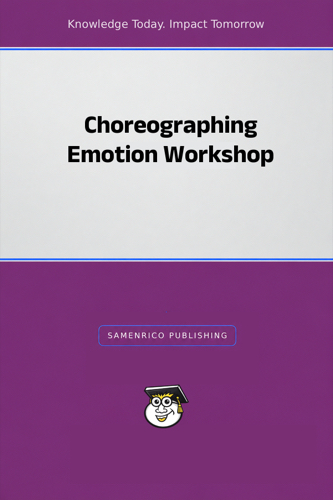
Choreographing Emotion Workshop eBook
Teaches translating raw feeling into movement sequ
by Hatch Rosia
Teaches translating raw feeling into movement sequences for compelling stage storytelling.
Formats
Free sample
Chapter 1: The Emotional Weather Report---– Most dancers spend years learning where to put their feet. They drill until the fifth position is a reflex, until the pirouette is automatic, until the body can execute almost anything the mind commands. And yet, when asked to choreograph something that makes an audience weep, or laugh, or sit forward in their seats with their hearts pounding, most dancers freeze. They have technique. They have steps.
What they lack is a vocabulary for the one thing that actually moves an audience: raw, legible, specific human feeling.This book exists because that vocabulary can be taught. It is not a mysterious gift bestowed on a lucky few. It is not something you either have or you don't. Emotional choreography is a skill—a set of practices, distinctions, and embodied knowledges that can be learned, rehearsed, and refined, just like a tendu or a chassé. And it begins with a single, deceptively simple question: What am I feeling right now, and where is it living in my body?Most people cannot answer that question with any precision.
They say things like "I feel stressed" or "I feel good" or "I feel weird." Those are not emotions. Those are weather reports without a thermometer. Stress is not an emotion—it is a physiological state that can contain fear, anxiety, rage, or exhaustion. Good is not an emotion—it is a vague positive evaluation that could mean joy, contentment, pride, or relief. Weird is not an emotion—it is a recognition that something does not fit, which could be shame, dread, dissociation, or simply the unfamiliar.
The first step toward choreographing emotion is learning to name it. Not vaguely. Not poetically. Specifically.This chapter provides the foundational lexicon for everything that follows. You will learn to identify sixteen core emotional states—not as abstract concepts, but as felt, located, somatic realities in your own body.
You will learn the daily practice of the Emotional Weather Report, a five-minute scan that builds the internal sensing ability (interoception) that all emotional choreography depends on. And you will begin to understand that emotion is not something you add to movement. Emotion is the movement's hidden score. Before you can write that score, you must learn to read it in yourself.The Sixteen Core Emotions: A Choreographer's Lexicon Most emotion lists are either too broad (happiness, sadness, anger, fear) or too narrow (seventy-two varieties of anxiety). This book uses a curated set of sixteen core emotional states, chosen because each has a distinct somatic signature—a specific way of living in the body—and each can be translated into movement with practice.
The first twelve are your primary building blocks. The remaining four are additional states that appear frequently in stage storytelling and require explicit attention.The Primary Twelve:Rage – Not simply anger. Rage is anger that has exceeded its container. It is hot, forward, explosive, and often accompanied by a sensation of pressure behind the sternum and a clenching of the jaw and fists. In the body: shoulders rise, breath becomes sharp and forceful, gaze locks forward or narrows.Grief – A hollowing out.
Grief is not sadness; sadness has an object (I am sad because), while grief is often objectless or exceeds its object. In the body: a sensation of emptiness in the chest, heavy limbs, a tendency to curl inward or sink downward, breath that catches or releases in long sighs.Ecstasy – Not happiness. Ecstasy is a state of being outside oneself, often accompanied by sensations of lightness, expansion, or dissolution of boundaries. In the body: lifted sternum, suspended breath or rapid, shallow breathing, a sense of electricity in the skin, limbs that feel lighter than usual.Fear – The anticipation of threat. Fear sharpens and narrows.
In the body: breath becomes shallow and high in the chest, muscles tense for action (often freezing before flight), eyes widen, the body's center of gravity rises slightly, hands may come up toward the face or chest.Longing – A reaching toward something absent. Longing is not the same as desire (which expects fulfillment) or hope (which expects possibility). Longing knows it may never arrive. In the body: the sternum softens and lifts slightly, the arms may float open, the head tilts as if listening for something, breath is slow and full, often ending in a sigh.Shame – The feeling of being seen as flawed or wrong. Shame collapses and hides.
In the body: the head drops or turns away, shoulders curl forward and rise toward the ears, the chest caves, the gaze drops, the body makes itself smaller.Awe – The feeling of being in the presence of something vast that exceeds one's frame of reference. Awe opens and stills. In the body: the spine lengthens, the head may tilt back slightly, the breath suspends (often on the inhale), the arms may fall still at the sides or open slowly, the mouth may part.Envy – The awareness of another's possession or quality combined with a wish to lack it no longer. Envy turns toward the other and pulls inward. In the body: a twisting sensation in the torso, the gaze flicks toward the other and then away, the jaw may tighten, one shoulder may lift slightly higher than the other.Tenderness – A soft, protective towardness.
Tenderness is not love (which is larger) or care (which is action). Tenderness is the felt sense of wanting something to be safe and unharmed. In the body: the hands soften and may reach with palms up, the breath slows and deepens, the chest opens slightly, the gaze softens and lingers.Pride – The feeling of one's own worth or accomplishment, often in relation to a standard. Pride lifts and expands. In the body: the chin lifts, the sternum rises, the shoulders draw back and down, the breath becomes full and even, the body takes up more space.Despair – The feeling that no action will change one's situation.
Despair is not sadness or grief; it is the absence of hope, often experienced as heaviness and stillness. In the body: a sensation of weight pressing down, the limbs feel difficult to move, the breath is shallow or held, the gaze drops and becomes unfocused, the body may slump but not collapse.Wonder – The feeling of curiosity and delight in the face of the new or mysterious. Wonder opens and reaches. In the body: the eyes widen, the mouth may open slightly, the breath suspends or becomes light and quick, the hands may lift toward the object of wonder, the spine lengthens.The Additional Four:Anxiety – The diffuse anticipation of future threat without a clear object. Unlike fear (which has a specific focus), anxiety is objectless or shifting.
In the body: shallow, rapid upper-chest breathing, restless micro-movements in the fingers and feet, a sensation of tightness across the chest or stomach, difficulty staying still, gaze that darts without settling.Resentment – The recurring memory of a wrong combined with the inability to confront it. Resentment is anger over time, stored rather than expressed. In the body: a holding pattern—the jaw stays clenched, the breath is shallow and regular (as if the body is waiting), the shoulders are slightly raised and held, the gaze may…
This is the end of the free sample. Get the eBook to keep going. Buy now
About this book
Details
- Author
- Hatch Rosia
- Publisher
- SamEnrico
- Language
- English
- Genre
- Non-Fiction, Biography, Dance Composition
- Released
- 2026-06-10
- Pages (approx.)
- 151
- Available as
- eBook, Audiobook

Read better in the ZLOADR app
Your eBooks on your phone or tablet. Sign in with your SamEnrico account and start reading.
More by Hatch Rosia
 Small Talk for Police OfficersHatch Rosia$11.99
 Combat Veteran NightmaresHatch Rosia$11.99
 Forgiveness for TeenagersHatch Rosia$11.99
 The Shanghai Opium Wars: The Triads' Shadow EmpireHatch Rosia$11.99
 Dormant Account ReactivationHatch Rosia$12.99
 How to Produce Battery HoldersHatch Rosia$11.99
 Insect CollectingHatch Rosia$11.99
 How to Start a Bedspreads Made of Lace Business (Beginners Guide)Hatch Rosia$11.99
You may also like
 Hong Kong Handover 1997Dunn Johnnie$11.99
 Zumba For Postnatal Recovery CourseNeal Christian$11.99
 Zumba for BeginnersLadner Nikia$11.99
 YouTube Comment Mining GuideHumes Pandora$12.99
 Worry Box MeditationCarlin Rudy$11.99
 Workplace Stress MeditationNguyen Lynn$11.99
 Workplace Stress and Sleep RepairHawley Ivory$11.99
 Workplace Perfectionism CureDelaney Jeffry$11.99
 Workplace Injustice Anger GuideWallen Isabelle$11.99
 Work Addiction and Burnout LinkGreenwood Ester$11.99
 Women in Yoga and WellnessBeattie Galina$11.99
 Women in Stand Up ComedyChun Evangeline$11.99