
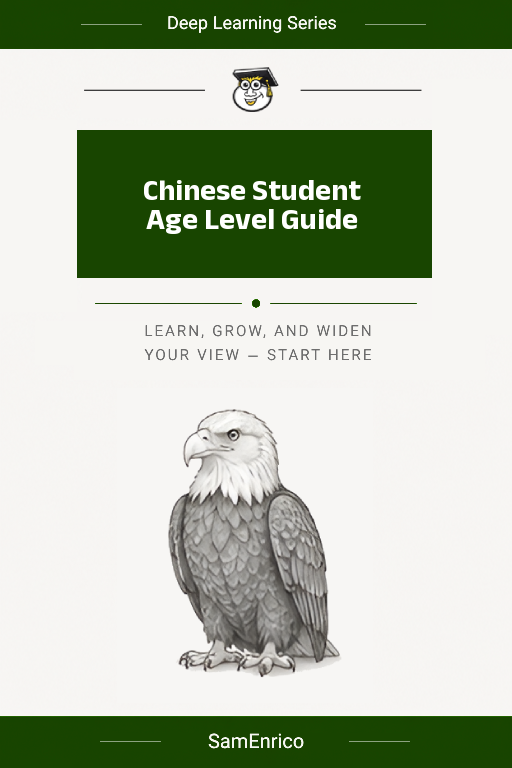
Non-FictionSide Hustle ArchitectAge Levels
Chinese Student Age Level Guide
Adapt lessons for 4-6 year olds, primary school, o
Adapt lessons for 4-6 year olds, primary school, or teens in China. Use age appropriate pacing, attention spans, and content complexity for each group.
Formats
About this book
Free sample
Chapter 1: The Neijuan Trap--–- "Mom, my stomach hurts," whispered seven-year-old Chen Xiaoming, clutching his math workbook to his chest. It was 9:47 PM. He had been studying since 4:30 PM, with only a thirty-minute dinner break. His mother, a well-intentioned financial analyst in Shanghai, had just introduced third-grade multiplication tables—two years ahead of the curriculum. Xiaoming could recite the products.
He could not tell you what multiplication meant. When asked to explain why 3 × 4 equals 12, he stared at the floor and began to cry.This scene is not an outlier. It is the norm in contemporary Chinese education. Across Beijing, Shenzhen, and countless other cities, millions of children are trapped in a system of neijuan (内卷)—a term borrowed from agricultural economics meaning "involution," where increased effort yields diminishing or even negative returns. Parents push toddlers to memorize English vocabulary.
First-graders drill third-grade math. Fifth-graders tackle middle school analytical essays. And by middle school, many of these children have lost something irreplaceable: the joy of learning, the ability to concentrate, and sometimes, their mental health.This chapter diagnoses the central pathology of modern Chinese parenting: the belief that earlier and harder always means better. It dismantles this assumption using developmental psychology, neuroscience, and real-world case studies. You will learn why cramming fails, what the Zone of Proximal Development actually means for your child, and how to distinguish between productive effort and destructive neijuan.
By the end of this chapter, you will have a diagnostic tool to assess whether your family has fallen into the neijuan trap—and a clear plan to escape it.The Three Pressure Points: Where Chinese Education Breaks Families The Chinese education system is not a smooth, gradual incline. It is a staircase with three brutal landings where the steps suddenly double in height. These are the critical pressure points: Grade 3, Grade 6, and Grade 9.Grade 3 (Approximately age 8-9): The Appearance of Abstraction In Grades 1 and 2, children learn concrete skills: recognizing characters, adding numbers, writing simple sentences. A child can succeed through memorization and repetition—the classic "foundation first" approach. Then Grade 3 arrives.
Multiplication requires understanding groups and quantities, not just counting. Reading comprehension demands inference, not just decoding. Suddenly, the child who…
This is the end of the free sample. Get the eBook to keep going. Buy now
Contents
- Chapter 1
- Chapter 2
- Chapter 3
- Chapter 4
- Chapter 5
- Chapter 6
- Chapter 7
- Chapter 8
- Chapter 9
- Chapter 10
- Chapter 11
- Chapter 12
Details
- Author
- Watts Nathaniel
- Publisher
- SamEnrico
- Language
- English
- Genre
- Non-Fiction, Side Hustle Architect, Age Levels
- Released
- 2026-05-30
- Pages (approx.)
- 157
- Available as
- eBook, Audiobook

Read better in the ZLOADR app
Your eBooks on your phone or tablet. Sign in with your SamEnrico account and start reading.
More by Watts Nathaniel
 Stress and Boss RelationshipsWatts Nathaniel$11.99
 Networking for Technical ProfessionalsWatts Nathaniel$11.99
 Mobile Travel Booking DemographicsWatts Nathaniel$11.99
 Breast Tenderness CausesWatts Nathaniel$11.99
 The Silk Road Conspiracy: A Prisoner’s GambitWatts Nathaniel$11.99
 How to Start a Hobby in CatsWatts Nathaniel$11.99
 Counterbalance Forklift OperatorWatts Nathaniel$11.99
 How to Produce Basketball EquipmentWatts Nathaniel$11.99
You may also like
 Hong Kong Handover 1997Dunn Johnnie$11.99
 Zumba For Postnatal Recovery CourseNeal Christian$11.99
 Zumba for BeginnersLadner Nikia$11.99
 YouTube Comment Mining GuideHumes Pandora$12.99
 Worry Box MeditationCarlin Rudy$11.99
 Workplace Stress MeditationNguyen Lynn$11.99
 Workplace Stress and Sleep RepairHawley Ivory$11.99
 Workplace Perfectionism CureDelaney Jeffry$11.99
 Workplace Injustice Anger GuideWallen Isabelle$11.99
 Work Addiction and Burnout LinkGreenwood Ester$11.99
 Women in Yoga and WellnessBeattie Galina$11.99
 Women in Stand Up ComedyChun Evangeline$11.99