
Non-FictionSelf-HelpChess Strategy
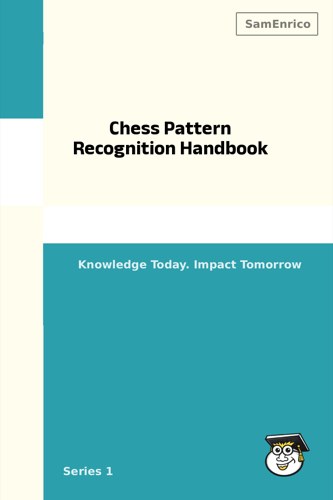
Chess Pattern Recognition Handbook eBook
Recognize tactical motifs and strategic patterns t
Recognize tactical motifs and strategic patterns to improve your game.
Formats
Free sample
Chapter 1: The Losing Move–- The clock showed 1:47 remaining. I had twenty minutes. My opponent, a twelve-year-old with glasses thick as bottle bottoms, had just played 15... Nf6. The position looked safe.
My king was tucked behind a solid wall of pawns on g2, f2, and h2. My rooks controlled the open file. I was up a pawn. I leaned back, satisfied.Seventeen moves later, I was shaking my opponent’s hand, staring at a board where my king lay smothered on the back rank, checkmated by a knight and a rook. The boy’s hand was small.
Mine was sweating. I had lost to a pattern I had studied, memorized, and taught to others.The Greek Gift sacrifice. Bxh7+. I had seen it coming. I had told myself, “Be careful of the bishop on c2.” And then I moved my knight away from g8 anyway.That night, I sat at my kitchen table with a glass of whiskey and a chessboard.
I replayed the game. Move by move. At move 22, my opponent played 22. Bxh7+ – the exact sacrifice I had feared. At move 23, his queen slid to h5.
At move 24, his knight jumped to g5. At move 25, my king was dead.I had seen the pattern. I had recognized the four triggers: the knight on g8 had moved, the queen could reach h5, the knight could reach g5, and my king had no escape to f8. I saw all of it. And then I calculated something else anyway.
I talked myself out of what my eyes told me. I trusted calculation over recognition.I lost because I did not believe what I saw.That is the secret this book exists to destroy.The Grandmaster’s Dirty Secret For years, I believed that grandmasters were deeper calculators than the rest of us. I thought that if I could only calculate six moves ahead instead of three, I would break through the 2000 rating barrier. I bought books on calculation. I spent hours on tactics trainers, forcing myself to see five moves deep.
My rating climbed – from 1200 to 1500 – and then it stopped.I was stuck.Meanwhile, a 2200-rated player at my club, a man named Carl who sold insurance and played chess in the evenings, never seemed to calculate at all. He would glance at a position for ten seconds, make a move, and walk away to get coffee. When I asked him how he saw the tactics so quickly, he shrugged. “I just recognize them,” he said. “They look like things I’ve seen before.”That was the lie I told myself was not real.
“He is just intuitive,” I thought. “I need real calculation.”But Carl was not intuitive. Carl was efficient. He had spent thirty years building a library of visual patterns in his head. When he looked at a chessboard, he did not see thirty-two individual pieces.
He saw chunks: a “fianchetto structure,” a “pinned knight against a king,” a “rook on the seventh rank.” He was not calculating because he did not need to. He already knew what the position was.This is the grandmaster’s dirty secret: they do not calculate better than you. They recognize faster than you.The Chunking Principle – How Your Brain Cheats at Chess Psychologists have a term for what Carl was doing. They call it “chunking.” When you learn to drive a car, you start by thinking about every action: check the mirror, signal, turn the wheel, press the gas. After a year, you do not think about any of it.
You just “drive.” Your brain has chunked all those small actions into a single pattern called “changing lanes.”Chess works the same way.A beginner looks at a chessboard and sees sixty-four squares, thirty-two pieces, and unlimited possibilities. Their brain is overwhelmed. They try to calculate, but they do not know what to calculate first. So they freeze, or they guess.A master looks at the same board and sees five or six chunks: “the pawn chain is broken,” “the bishop is bad,” “there is a potential fork on c7,” “the king is exposed.” They do not see pieces. They see relationships.
They see patterns.Here is the evidence: in a famous study from the 1970s, researchers showed chess positions to grandmasters and club players for five seconds. Then they asked them to reconstruct the positions from memory. The grandmasters could reconstruct nearly the entire board. The club players could remember only a few pieces.But here is the kicker. When the researchers showed random positions – pieces placed on the board with no logical relationship – the grandmasters performed no better than the club players.
They could not remember random noise.Why? Because grandmasters do not have photographic memories. They have pattern libraries. When they see a real chess position, they recognize chunks they have seen thousands of times before. “Ah, that is a Carlsbad pawn structure.” “That is a typical kingside attack.” Their brain compresses the information.
When the position is random, there are no chunks to recognize. So their advantage disappears.Your brain already knows how to chunk. You do it every day. When you see a face, you do not see eyes, a nose, a mouth – you see “your mother.” When you read a word, you do not sound out letters – you see “dog” and know what it means. Chess is the same.
You have just never trained your visual cortex to see the chunks.Signal vs. Noise – Why You Miss What Is Right in Front of You The second reason you miss patterns is that your brain is terrible at filtering signal from noise.Imagine you are in a crowded room with thirty people talking at once. Someone across the room says your name. You hear it immediately, even though you were not listening for it. That is your brain filtering noise to find signal.
It is called the “cocktail party effect.”Chess is a crowded room. Every move creates noise: threats, traps, captures, checks. Your brain tries to listen to all of it at once. And so it hears nothing.Pattern recognition gives you a filter. When you know what a “Greek Gift” looks like, your brain automatically scans for those four triggers.
When you see a “rook on the seventh,” your brain lights up. The signal becomes loud. The noise becomes quiet.I lost my game against the twelve-year-old because I had not trained my filter. I saw the Greek Gift triggers, but I did not trust them. I let noise – a thousand irrelevant calculations – drown out the signal.
My brain heard the crowd, not the voice saying my name.Lasker’s Forethought – The Oldest Secret in Chess In 1925, the world champion Emanuel Lasker wrote a book called Manual of Chess. It is dense, philosophical, and nearly unreadable. But buried in its pages is one sentence that changed how I think about chess:“Forethought, the core of chess mastery, is not the ability to see far ahead. It is the ability to see the right thing first.”Lasker understood that calculation without recognition is blindness. You can calculate ten moves ahead, but if you are calculating the wrong line, you have wasted ten minutes.
Pattern recognition tells you where to look. Calculation tells you if it works. Recognition first. Always.This is the opposite of…
This is the end of the free sample. Get the eBook to keep going. Buy now
About this book
Details
- Author
- Bolduc Isaura
- Publisher
- SamEnrico
- Language
- English
- Genre
- Non-Fiction, Self-Help, Chess Strategy
- Released
- 2026-06-11
- Pages (approx.)
- 115
- Available as
- eBook, Audiobook

Read better in the ZLOADR app
Your eBooks on your phone or tablet. Sign in with your SamEnrico account and start reading.
More by Bolduc Isaura
 Repairing After the ExplosionBolduc Isaura$11.99
 Sugar Addiction and Liver Health CourseBolduc Isaura$11.99
 Learning to Say No as a StudentBolduc Isaura$11.99
 Cortisol and Night Sweats GuideBolduc Isaura$11.99
 The Storm Chaser of the Silk Road: Ibn Sina’s Forgotten ExpeditionBolduc Isaura$11.99
 The Celestial Cartographer: Mapping the Stars of Ancient MesopotamiaBolduc Isaura$11.99
 How to Start a Fax Machines Business (Beginners Guide)Bolduc Isaura$11.99
 Norwegian Logistics DirectoryBolduc Isaura$12.99
 Bookkeeping Client OnboardingBolduc Isaura$12.99
 Understanding Elejalde SyndromeBolduc Isaura$17.99
 Facilities EngineerBolduc Isaura$11.99
You may also like
 Hong Kong Handover 1997Dunn Johnnie$11.99
 Zumba For Postnatal Recovery CourseNeal Christian$11.99
 Zumba for BeginnersLadner Nikia$11.99
 YouTube Comment Mining GuideHumes Pandora$12.99
 Worry Box MeditationCarlin Rudy$11.99
 Workplace Stress MeditationNguyen Lynn$11.99
 Workplace Stress and Sleep RepairHawley Ivory$11.99
 Workplace Perfectionism CureDelaney Jeffry$11.99
 Workplace Injustice Anger GuideWallen Isabelle$11.99
 Work Addiction and Burnout LinkGreenwood Ester$11.99
 Women in Yoga and WellnessBeattie Galina$11.99
 Women in Stand Up ComedyChun Evangeline$11.99