
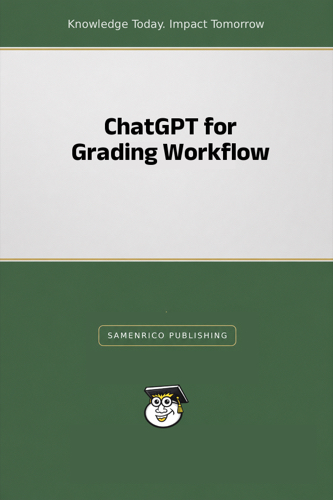
Non-FictionAI OperatorAssessment
ChatGPT for Grading Workflow Audiobook
Automate rubric-based grading of essays and short
Automate rubric-based grading of essays and short answers while maintaining quality.
Formats
Free sample
Chapter 1: The Sunday Night Dread...--Between September and May of any given school year, an estimated 67% of K-12 and university teachers report that grading is the single largest contributor to their workplace stress. Not lesson planning. Not classroom management. Not parent emails. Grading.
The stack of papers, the blinking cursor on a rubric spreadsheet, the repetitive comments written for the thirtieth time about comma splices or missing topic sentences. For the average secondary English or history teacher with 150 students, grading a single five-paragraph essay takes five to seven minutes per paper when done conscientiously. Multiply that by 150. That's 750 minutes—12.5 hours—per assignment. Now multiply that by six major assignments per year.
Seventy-five hours. Two full work weeks. And that is just essays. Short answers, lab reports, discussion post feedback, and daily check-ins add dozens more hours.This chapter is not an introduction. It is an intervention.
Before we talk about prompts, rubrics, or AI workflows, we must name the enemy clearly. The enemy is not lazy students, unreasonable administrators, or flawed curriculum. The enemy is the false belief that grading must be slow, lonely, and exhausting to be rigorous. That belief has cost teachers their evenings, their weekends, their relationships, and, in too many cases, their careers. In this chapter, we will quantify the true cost of grading, dismantle the myths that keep teachers trapped in inefficient workflows, introduce a new mental model for what an AI assistant can and cannot do, and end with a self-assessment that will show you exactly where you can save hours starting tomorrow.
If you have ever felt a knot in your stomach when you look at the ungraded pile, you are not broken. You are just grading like it is 1995. Let us change that.The Hidden Math of Grading Burnout Let us be precise. Grading burnout is not a feeling. It is a mathematical inevitability built into the current structure of teaching.
Consider a realistic scenario. You are a high school social studies teacher with five sections of 30 students each. That is 150 students. You assign a one-page written response requiring source citation and argumentation. A good-faith grading approach includes: reading for understanding, checking against a rubric, noting specific evidence, writing a short comment, and entering the score.
Research on teacher grading speed suggests that even experienced teachers average three to four minutes per page for thoughtful, rubric-aligned grading. That yields 450 to 600…
This is the end of the free sample. Get the Audiobook to keep going. Buy now
About this book
Details
- Author
- Falcon Antionette
- Publisher
- SamEnrico
- Language
- English
- Genre
- Non-Fiction, AI Operator, Assessment
- Released
- 2026-06-07
- Pages (approx.)
- 145
- Available as
- eBook, Audiobook

Listen in the VoxFlicks app
Audiobooks and audio dramas wherever you go. Sign in with your SamEnrico account and press play.
More by Falcon Antionette
 Fear of Happiness Cherophobia GuideFalcon Antionette$11.99
 Polish Human Chain PartisansFalcon Antionette$11.99
 Breath Awareness For RetirementFalcon Antionette$11.99
 Stress Related Skin Disorders HandbookFalcon Antionette$11.99
 Windigo's Lament: The Hunger of Winter's ShadowFalcon Antionette$11.99
 Understanding Marek DiseaseFalcon Antionette$17.99
 Croatia Tourism Real Estate GuideFalcon Antionette$12.99
 Strategy Meeting Glossary TermsFalcon Antionette$12.99
 How to Become a Seed PelleterFalcon Antionette$11.99
 Metric Dashboard DesignerFalcon Antionette$11.99
You may also like
 Hong Kong Handover 1997Dunn Johnnie$11.99
 Zumba For Postnatal Recovery CourseNeal Christian$11.99
 Zumba for BeginnersLadner Nikia$11.99
 YouTube Comment Mining GuideHumes Pandora$12.99
 Worry Box MeditationCarlin Rudy$11.99
 Workplace Stress MeditationNguyen Lynn$11.99
 Workplace Stress and Sleep RepairHawley Ivory$11.99
 Workplace Perfectionism CureDelaney Jeffry$11.99
 Workplace Injustice Anger GuideWallen Isabelle$11.99
 Work Addiction and Burnout LinkGreenwood Ester$11.99
 Women in Yoga and WellnessBeattie Galina$11.99
 Women in Stand Up ComedyChun Evangeline$11.99