
Non-FictionBiographyPost-Activism
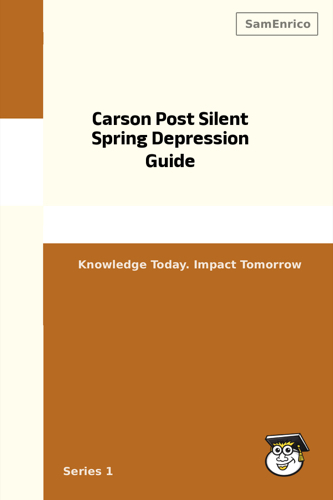
Carson Post Silent Spring Depression Guide eBook
Understand Carson's emotional collapse after the D
Understand Carson's emotional collapse after the DDT wars, her exhaustion, and eventual recovery through solitude.
Formats
Free sample
Chapter 1: The Let-Down Effect...-- On June 4, 1963, Rachel Carson did something that required more courage than writing Silent Spring itself. She walked onto a soundstage at CBS Television in New York, took a seat opposite journalist Eric Sevareid, and prepared to defend her life's work before an audience of fifteen million Americans-2. Her hands, she would later write to her closest friend, were trembling so badly she had to hide them beneath the folds of her skirt. Her body, ravaged by metastasizing breast cancer and the brutal treatments meant to slow its progress, ached with a fatigue so profound that merely sitting upright felt like an act of will-7. And yet, when the cameras began to roll, Rachel Carson appeared calm.
Reasonable. Unshakeable.The performance was masterful. Dressed in a modest suit, her voice low and steady, she answered Sevareid's questions with the precision of a scientist and the quiet passion of a poet. Across from her sat Dr. Robert White-Stevens, a spokesman for the agricultural chemical industry, dressed in a white lab coat and speaking with a stiff accent that somehow made him seem less credible with every exaggerated claim.
"The major claims of Miss Rachel Carson's book, Silent Spring, are gross distortions of the actual facts," White-Stevens declared, "completely unsupported by scientific, experimental evidence"-2. He warned that if Americans followed Carson's teachings, "we would return to the Dark Ages and the insects, and the diseases, and the vermin would once again inherit the Earth"-2.Watching from living rooms across the country, viewers saw a stark contrast. On one side, a woman speaking quietly about the web of life and the unintended consequences of poisoning the earth. On the other, a man in a lab coat shouting about the Dark Ages. Carson did not need to raise her voice.
Her composure was her argument.To the world, this was Rachel Carson's finest hour. The CBS Reports documentary, "The Silent Spring of Rachel Carson," aired just six weeks before a special panel appointed by President John F. Kennedy would release its findings—findings that substantiated nearly every major claim in her book-2. The tide of public opinion, which had been whipped into a frenzy by chemical industry propaganda, was turning. The woman who had been called a hysterical spinster, a nature mystic, a bird lover who cared more about feathers than children, was being vindicated on national television.She should have been happy.
She should have been triumphant.She was neither.The Weight of Winning There is a phenomenon known to psychologists who study high-stakes professionals—soldiers returning from combat, first responders after a mass casualty event, activists at the end of a long campaign. It is sometimes called the Let-Down Effect. It occurs when prolonged hyper-vigilance—the state of being constantly alert, constantly fighting, constantly braced for attack—is suddenly followed by a pause. The adrenaline that has been coursing through the body for months or years dissipates. The cortisol that has kept the nervous system on high alert begins to drop.
And what rushes in to fill the void is not relief or joy or satisfaction, but a crushing, inexplicable emptiness.Carson had been living in a state of hyper-vigilance since at least 1958, when she first began researching the effects of synthetic pesticides. But the true siege began in 1962, when The New Yorker published a three-part excerpt of Silent Spring before the book's official release. The chemical industry, caught off guard, mobilized with astonishing speed. The Velsicol Chemical Corporation threatened to sue The New Yorker and Houghton Mifflin, Carson's publisher, unless they canceled the planned book. When that failed, the industry launched a coordinated public relations assault.
They placed full-page advertisements in newspapers and magazines, accusing Carson of being "a fanatic defender of the cult of the balance of nature." They commissioned scientists to write scathing "reviews" of a book they had not yet read. They sent letters to members of Congress, warning that Carson's "emotional" and "unscientific" claims would lead to famine and disease.And then came the personal attacks. Time magazine dismissed Silent Spring as "emotional and inaccurate." The agricultural chemical industry's public relations firm, Hill and Knowlton, circulated a parody of the book titled "The Desolate Year," describing a world overrun by insects. A former Secretary of Agriculture wrote that Carson's book raised the question of "whether a spinster who loved cats more than people could be trusted on matters of life and death." Another critic suggested that Carson—who had adopted her orphaned grandnephew and was caring for him as a single mother while dying of cancer—"loved birds more than children."Carson read these attacks. She read the letters that poured into her publisher's office, some from ordinary citizens who had been convinced by the industry's propaganda that she was a murderer.
They accused her of causing malaria deaths in developing nations. They called her a tool of the Communists. They said she should be tried for crimes against humanity. And she read each one, night after night, alone in her house in Silver Spring, Maryland, unable to sleep, unable to stop the words from burrowing into her brain.The physical toll was staggering. Carson had undergone a radical mastectomy in April 1960, a procedure in which her left breast, chest muscles, and axillary lymph nodes were removed-7.
Her doctors told her the cancer was "bordering on malignancy"—a phrase that meant little to her but that she would later learn was an evasion. Six months after the surgery, she noticed soft tissue swelling on her chest wall. She sensed, with a dread she could not articulate, that she had not been told the truth about her diagnosis-7. She reached out to Dr. George Crile, Jr., a renowned breast surgeon at the Cleveland Clinic, asking what kind of doctor she should see for the new problem.The answer was devastating.
Her cancer had not been "bordering" on anything. It was malignant, and it had recurred. In early 1961, she underwent sterilization—the removal of her ovaries—in the hope that withdrawing her body's hormonal stimulation might slow the cancer's spread-7. There was a fifty-fifty chance it would work. Then came the radiation treatments.
Week after week, she submitted to blasts of ionizing radiation aimed at the tumors growing in her chest wall. The treatments left her nauseated, exhausted, and burned. In March 1962, just three months before Silent Spring was published, she developed enlarged, painful lymph nodes in her armpit and neck. More radiation. More exhaustion.
More dread-7.The Two Burdens She Carried Through all of this, Carson told almost no one about her illness. Her editor, her agent, her closest friends—most believed she was simply fatigued, perhaps suffering from the arthritis she occasionally mentioned. The deception was deliberate and multi-layered. She had two distinct reasons for hiding the truth, and understanding both is essential to understanding what happened to her next.The first reason was practical. Carson knew that if people learned she was dying, they would dither.
They would call and write and visit, offering help she did not want and could not use. They would treat her as an invalid, a patient, a dying woman—not as a writer finishing the…
This is the end of the free sample. Get the eBook to keep going. Buy now
About this book
Details
- Author
- Darling Frieda
- Publisher
- SamEnrico
- Language
- English
- Genre
- Non-Fiction, Biography, Post-Activism
- Released
- 2026-06-08
- Pages (approx.)
- 120
- Available as
- eBook, Audiobook

Read better in the ZLOADR app
Your eBooks on your phone or tablet. Sign in with your SamEnrico account and start reading.
More by Darling Frieda
 Franklin RNA Research Legacy CourseDarling Frieda$11.99
 Gut Microbiome Brain Axis GuideDarling Frieda$11.99
 Firefighter Failure FearDarling Frieda$11.99
 The Caregiver Veteran Care GuideDarling Frieda$11.99
 The Quantum Leap: How a Single Algorithm Changed the WorldDarling Frieda$11.99
 Tangaroa and Hina: The Tide That Bound the SkyDarling Frieda$11.99
 Understanding Foreign Accent SyndromeDarling Frieda$17.99
 AI Fraud Detection GuideDarling Frieda$12.99
 Non Technical CTO Interview WorkbookDarling Frieda$12.99
 Ultimate Handbook Guide to Wendeng : (China) Travel GuideDarling Frieda$11.99
 Value Stream CoachDarling Frieda$11.99
You may also like
 Hong Kong Handover 1997Dunn Johnnie$11.99
 Zumba For Postnatal Recovery CourseNeal Christian$11.99
 Zumba for BeginnersLadner Nikia$11.99
 YouTube Comment Mining GuideHumes Pandora$12.99
 Worry Box MeditationCarlin Rudy$11.99
 Workplace Stress MeditationNguyen Lynn$11.99
 Workplace Stress and Sleep RepairHawley Ivory$11.99
 Workplace Perfectionism CureDelaney Jeffry$11.99
 Workplace Injustice Anger GuideWallen Isabelle$11.99
 Work Addiction and Burnout LinkGreenwood Ester$11.99
 Women in Yoga and WellnessBeattie Galina$11.99
 Women in Stand Up ComedyChun Evangeline$11.99