
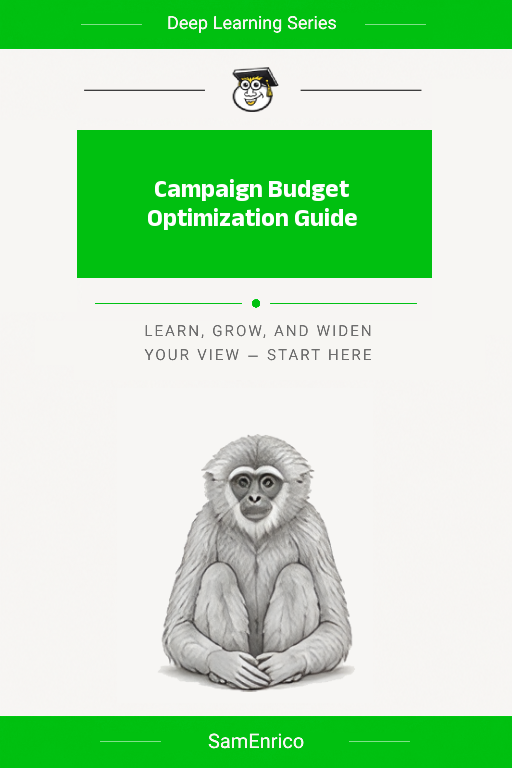
Non-FictionFirst 30 DaysBudgeting
Campaign Budget Optimization Guide eBook
Master Facebook's campaign budget optimization at
by Geer Carylon
Master Facebook's campaign budget optimization at campaign, ad set, and ad levels. Stretch your first budget wisely.
Formats
Free sample
Chapter 1: The Surrender Protocol--–- In the winter of 2019, I watched a media buyer named Sarah burn through 47,000inelevendays.Shewasbrilliant,meticulous,andutterlyconvincedthatherspreadsheetscouldoutsmart Facebook’salgorithm.Everymorningat6AM,shewouldloginto Ads Manager,sortheradsetsbycostperresult,andmanuallyshiftbudgetfromtheunderperformerstotheoverachievers.Shehadcolor−codedcharts.Shehadpivottables.Shehadatwenty−three−stepoptimizationchecklisttapedtohermonitor.Andshelostherclient47,000 in eleven days. She was brilliant, meticulous, and utterly convinced that her spreadsheets could outsmart Facebook’s algorithm. Every morning at 6 AM, she would log into Ads Manager, sort her ad sets by cost per result, and manually shift budget from the underperformers to the overachievers. She had color-coded charts. She had pivot tables.
She had a twenty-three-step optimization checklist taped to her monitor. And she lost her client 47,000inelevendays.Shewasbrilliant,meticulous,andutterlyconvincedthatherspreadsheetscouldoutsmart Facebook’salgorithm.Everymorningat6AM,shewouldloginto Ads Manager,sortheradsetsbycostperresult,andmanuallyshiftbudgetfromtheunderperformerstotheoverachievers.Shehadcolor−codedcharts.Shehadpivottables.Shehadatwenty−three−stepoptimizationchecklisttapedtohermonitor.Andshelostherclient47,000 because she refused to accept one uncomfortable truth: the era of human-controlled budget allocation was already dead.Sarah’s story is not unique. Every day, thousands of marketers repeat her mistake. They tweak, they pause, they reallocate, and they convince themselves that their micro-adjustments are adding value. But the data tells a different story.
In 2020, Meta made Campaign Budget Optimization the default for most advertising objectives, and the industry reacted with a mix of confusion and defiance. “I know my audience better than some algorithm,” they said. “I need to control where every dollar goes,” they argued. “What if the AI wastes my money?” they feared.These are all reasonable concerns. They are also entirely wrong.This book exists because I made Sarah’s mistakes too.
I spent five years and over $200,000 of my own money learning the hard way that manual budget control is not a strength—it is a tax on your ignorance. The marketers who win in today’s landscape are not the ones who fight the algorithm. They are the ones who partner with it. They understand that their role has shifted from “budget manager” to “growth strategist.” They set the rules of engagement, and then they get out of the way.Welcome to the Surrender Protocol. This is not a book about giving up.
It is a book about gaining leverage.The Illusion of Control Let us begin with a simple exercise. Open your Facebook Ads Manager right now. Look at any campaign that has been running for at least seven days. Sort your ad sets by cost per result. Now ask yourself: How many times have I manually moved budget from the higher-cost ad set to the lower-cost one?If you are like most advertisers, the answer is “many times.” And each time you did that, you likely felt a small rush of competence.
You were optimizing. You were being efficient. You were earning your keep.Here is the problem: you were probably destroying value.When you manually shift budget from a higher-cost ad set to a lower-cost one, you are making an assumption that the higher-cost ad set is worse. But cost per result is not a static metric. It fluctuates based on time of day, audience saturation, creative fatigue, and a hundred other variables.
An ad set that looks expensive at 10 AM might become the cheapest option at 3 PM. An ad set that has a high cost per result today might be entering a new pocket of efficiency tomorrow.More importantly, CBO does not allocate budget based on current cost per result alone. The algorithm considers predicted future performance, auction dynamics, and a concept called “incremental lift.” When you manually override the algorithm, you are effectively saying, “I know better than a system that analyzes billions of data points per second.” You do not. Neither do I. Neither does Sarah.The illusion of control is seductive because it feels productive.
Clicking buttons, moving numbers, and pausing “bad” ad sets gives us a sense of agency. But true mastery in Facebook advertising requires the opposite skill: the ability to sit on your hands.A Brief History of Budget Control To understand why the Surrender Protocol matters, we need to understand how we got here.The Ancient Era (Pre-2015): In the beginning, there was no automated budgeting. Advertisers set daily budgets at the ad set level, and Facebook spent that exact amount regardless of performance. If an ad set had a 50dailybudget,itspent50 daily budget, it spent 50dailybudget,itspent50. Period.
Optimization was entirely manual. Good media buyers earned their salaries by spotting underperformers and reallocating dollars every few hours.The Transition Era (2015-2019): Facebook introduced the first version of automated budgeting, but it was clunky and unreliable. Early CBO often wasted money on low-quality placements. Advertisers learned to distrust automation. Many kept using ABO out of habit and fear.
During this period, a generation of media buyers built careers on their ability to “beat the system.” They developed elaborate rules, scripts, and spreadsheets. They were the heroes of their own stories.The Mandate (2020-Present): Facebook made CBO the default for most campaign objectives. Advertisers could still choose ABO, but the platform’s documentation and support articles began steering everyone toward automation. The message was clear: the machine is ready. Let it work.Most advertisers ignored the message.
They found workarounds. They created “CBO” campaigns but still micro-managed ad set spend limits. They built complex account structures designed to trick the algorithm into doing what they wanted. They fought the future with spreadsheets.Here is what they missed: the 2020 mandate was not arbitrary. It was the result of Facebook investing billions of dollars in machine learning infrastructure.
The algorithm that allocates your budget today is more sophisticated than the one that flew a helicopter on Mars. It processes trillions of predictions per day. It knows things about your audience that you will never know.Fighting that algorithm is like bringing a knife to a drone strike.The Three Modes of CBOBefore we go any further, we need a shared vocabulary. Throughout this book, we will refer to the Three Modes of CBO. These are the distinct ways your campaign can allocate budget, and understanding them is the foundation of everything that follows.Mode 1: Lowest Cost (Default)In Lowest Cost mode, Meta’s goal is simple: spend your entire budget and get the most results possible, regardless of cost per result.
The algorithm will bid aggressively to secure impressions, and your cost per result will fluctuate based on auction competition.This is the default setting. It is also the most misunderstood.Many advertisers see fluctuating costs and assume something is broken. “Why did my CPA jump from 15to15 to 15to25?” they ask. The answer is often: because that is what it took to spend your budget and get results. In Lowest Cost mode, Meta prioritizes volume over efficiency.
If you want efficiency, you need to use a different mode.Best for: Scaling campaigns where you have margin to absorb fluctuations. Brands with high lifetime value. Retargeting campaigns where volume is more important than acquisition cost.Worst for: Beginners with small budgets. Anyone who needs predictable costs. Campaigns where a single expensive conversion could ruin your ROI.Mode 2: Cost Cap In Cost Cap mode, you tell Meta the maximum amount you are willing to pay per result.
The algorithm will still try to spend your budget and get results, but it will never pay more than your…
This is the end of the free sample. Get the eBook to keep going. Buy now
About this book
Details
- Author
- Geer Carylon
- Publisher
- SamEnrico
- Language
- English
- Genre
- Non-Fiction, First 30 Days, Budgeting
- Released
- 2026-06-01
- Pages (approx.)
- 155
- Available as
- eBook, Audiobook

Read better in the ZLOADR app
Your eBooks on your phone or tablet. Sign in with your SamEnrico account and start reading.
More by Geer Carylon
 Acrophobia Treatment GuideGeer Carylon$11.99
 Number Peg System HandbookGeer Carylon$11.99
 Relationship Trauma TriggersGeer Carylon$11.99
 Influence for Project Managers GuideGeer Carylon$11.99
 Australia Consumer OutlookGeer Carylon$11.99
 K-Pop Alchemy: The Secret Sound Architects of BTSGeer Carylon$11.99
 Almond Prunus HarvestingGeer Carylon$11.99
 How to Become a Set-key DriverGeer Carylon$11.99
 Satya Nadella Interview GuideGeer Carylon$12.99
 Understanding Ovarian Insufficiency Due to Fsh ResistanceGeer Carylon$17.99
You may also like
 Hong Kong Handover 1997Dunn Johnnie$11.99
 Zumba For Postnatal Recovery CourseNeal Christian$11.99
 Zumba for BeginnersLadner Nikia$11.99
 YouTube Comment Mining GuideHumes Pandora$12.99
 Worry Box MeditationCarlin Rudy$11.99
 Workplace Stress MeditationNguyen Lynn$11.99
 Workplace Stress and Sleep RepairHawley Ivory$11.99
 Workplace Perfectionism CureDelaney Jeffry$11.99
 Workplace Injustice Anger GuideWallen Isabelle$11.99
 Work Addiction and Burnout LinkGreenwood Ester$11.99
 Women in Yoga and WellnessBeattie Galina$11.99
 Women in Stand Up ComedyChun Evangeline$11.99