
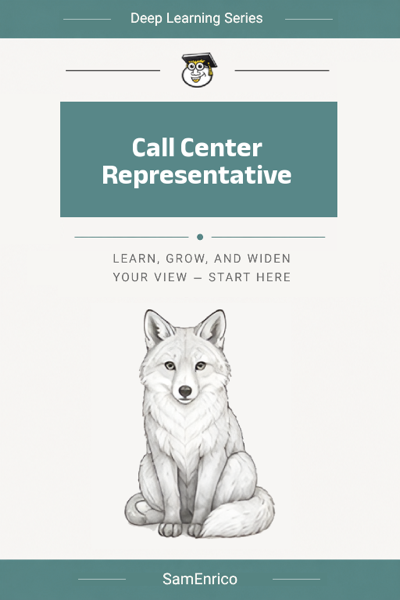
Non-FictionInformativeEducational
Call Center Representative eBook
A Coursebook on Call Center Representative
by Nance Linn
A Coursebook on Call Center Representative
Formats
Free sample
Chapter 1: The Voice Behind the Brand–- The phone rings. Not a physical bell or a mechanical chirp, but a digital tone—clean, insistent, manufactured. On the other end of that signal, somewhere in a different city, perhaps a different time zone, sits a human being. That person has a name, a history, a mood, a problem, and an expectation. They have already waited, on average, two minutes and thirty-seven seconds just to hear a human voice.
They have already navigated an automated menu, pressed three or four digits, and possibly shouted “representative” at a machine that does not understand frustration. Now, finally, they are connected to you.You are the voice behind the brand. You are the moment when abstract corporate promises collide with real human need. And before you speak a single word of policy or process, before you open a single screen or type a single keystroke, you need to understand one thing that most call center representatives never learn: you are not answering calls. You are managing relationships.This chapter is not about phone etiquette.
It is not about scripts or systems or metrics. Those will come later, and they are important. But before any of that, you need to understand what this job actually is, where it came from, and why your role has shifted from “order taker” to something far more strategic. You are about to learn the hidden architecture of the call center industry, the metrics that secretly govern your every move, and the mindset that separates a career representative from someone who simply answers phones until they burn out.Let us begin with a story.The Invention of Waiting In 1876, Alexander Graham Bell spoke the first complete sentence ever transmitted by telephone: “Mr. Watson, come here.
I want to see you.” It was a request, simple and direct. Within forty years, telephones had moved from experimental curiosity to household necessity. But the telephone did not create the call center. What created the call center was the combination of the telephone and something else: the customer complaint.By the 1920s, large companies like insurance firms and utility providers began receiving so many incoming calls that they could not route them all to the front desk. Secretaries and switchboard operators—almost exclusively women, because the industry believed female voices sounded more pleasant—were tasked with answering basic questions.
These early representatives had no headsets, no computers, no scripts. They had a physical switchboard with plugs and cables, a notepad, and a pencil. They were not “agents.” They were operators.For the next forty years, this remained the model. If you called a company, a human being answered. If that human being could not help you, they transferred you—physically, by unplugging a cable and plugging it into another port.
Wait times were measured in seconds because call volumes were low. Companies viewed customer service as a cost, not an investment. The representative’s job was to handle you quickly and move on.Then came the 1960s, and everything changed.The Cost Center Era The modern call center was born in 1965 when a British company called Birmingham Press and Mail installed the first private automatic branch exchange (PABX). For the first time, calls could be routed automatically without a human operator. This was efficiency.
This was the future. And it was also the beginning of a mindset that would plague the industry for decades: the belief that customer service should be as cheap and fast as possible.Throughout the 1970s and 1980s, call centers proliferated. Airlines needed reservation desks. Banks needed customer support. Retailers needed return processing.
And all of them discovered the same economic reality: it cost far less to hire a representative in a low-wage area than to lose a customer. But notice the framing there. It cost less to hire than to lose. That is the language of damage prevention, not value creation.This was the cost center era. In corporate finance, a cost center is any department that does not directly generate revenue but instead consumes resources.
Manufacturing is a profit center. Sales is a profit center. Customer service, in this model, is a cost center. Its job is to minimize expenses while preventing customer defection. The representative, therefore, is viewed as a necessary expense—a pair of hands on a phone, a voice in a headset, a body in a chair.The metrics of the cost center era reflect this philosophy.
They are almost entirely about speed and volume:Average Handle Time (AHT): How long from greeting to goodbye? Lower is better.Calls per Hour: How many customers can you process? Higher is better.Occupancy Rate: What percentage of your shift are you actively on a call? Higher is better.Average Speed of Answer (ASA): How quickly does a human pick up? Lower is better.These metrics are not wrong.
They are incomplete. And representatives who only understand the cost center model will treat every customer as an interruption, every call as a burden, and every metric as a weapon aimed at their job security. They will rush. They will cut corners. They will hang up as quickly as possible, often leaving problems half-solved.
And then they will wonder why customers are angry and why turnover is high.There is another way.The Profit Center Revolution In the late 1990s, a handful of companies—most famously USAA, L.L.Bean, and Nordstrom—began measuring something different. They looked at customer lifetime value. They looked at retention rates. They looked at how many problems were solved on the first call versus the third or fourth. And they discovered something the cost center model had missed entirely: customers who had a good service experience spent more money, stayed longer, and referred more friends.A customer who calls with a billing error and gets transferred three times is not just frustrated.
That customer is less likely to renew their subscription, less likely to upgrade, and more likely to post a negative review. The cost of that lost revenue far exceeds the fifteen seconds “saved” by rushing them off the phone.This realization created the profit center era. In this model, the call center is not a cost to be minimized but an asset to be optimized. Representatives are not expenses but brand ambassadors. Every call is not an interruption but an opportunity to strengthen the relationship.
And the metrics shift accordingly:First Call Resolution (FCR): Was the problem solved completely without a callback? Higher is better.Customer Satisfaction Score (CSAT): How happy is the customer after the interaction? Higher is better.Net Promoter Score (NPS): Would the customer recommend this company to a friend? Higher is better.Customer Effort Score (CES): How hard did the customer have to work to get their problem solved? Lower is better.Notice the difference.
Cost center metrics ask, “How fast did we process this call?” Profit center metrics ask, “How well did we serve this human?” The first question is about efficiency. The second is about effectiveness. And the most successful call centers in the world—the ones with the lowest turnover, the highest customer loyalty, and the strongest financial performance—have learned to balance both.Here is the truth…
This is the end of the free sample. Get the eBook to keep going. Buy now
About this book
Details
- Author
- Nance Linn
- Publisher
- SamEnrico
- Language
- English
- Genre
- Non-Fiction, Informative, Educational
- Released
- 2026-06-02
- Pages (approx.)
- 145
- Available as
- eBook, Audiobook

Read better in the ZLOADR app
Your eBooks on your phone or tablet. Sign in with your SamEnrico account and start reading.
More by Nance Linn
 Imposter Syndrome Thought LogNance Linn$11.99
 Food Desert FamilyNance Linn$11.99
 The Joy of ArtNance Linn$11.99
 Mindfulness for Chronic Pain BeginnersNance Linn$11.99
 Assertive Sales CommunicationNance Linn$11.99
 The Inferno of Dante: A Divine Vision in VerseNance Linn$11.99
 How to Start a Bagpipes and Reeds Business (Beginners Guide)Nance Linn$11.99
 Datadog SWOT Library GuideNance Linn$12.99
 Contribution Margin Formula HandbookNance Linn$12.99
 Understanding Myoglobinuria RecurrentNance Linn$17.99
You may also like
 Hong Kong Handover 1997Dunn Johnnie$11.99
 Zumba For Postnatal Recovery CourseNeal Christian$11.99
 Zumba for BeginnersLadner Nikia$11.99
 YouTube Comment Mining GuideHumes Pandora$12.99
 Worry Box MeditationCarlin Rudy$11.99
 Workplace Stress MeditationNguyen Lynn$11.99
 Workplace Stress and Sleep RepairHawley Ivory$11.99
 Workplace Perfectionism CureDelaney Jeffry$11.99
 Workplace Injustice Anger GuideWallen Isabelle$11.99
 Work Addiction and Burnout LinkGreenwood Ester$11.99
 Women in Yoga and WellnessBeattie Galina$11.99
 Women in Stand Up ComedyChun Evangeline$11.99