
Non-FictionHealth & WellnessNutrition
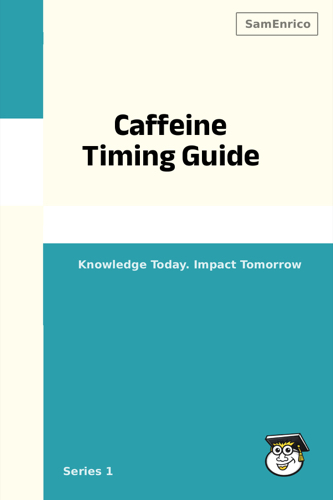
Caffeine Timing Guide eBook
Teaches stopping caffeine intake 8 hours before be
by Cole Patsy
Teaches stopping caffeine intake 8 hours before bedtime.
Formats
Free sample
Chapter 1: The 2 AM Mystery--It is 2:17 AM, and you are wide awake.Your phone reads the time in soft blue digits. You have been lying here for what feels like hours, your mind racing through the mundane details of tomorrow's to-do list, the replay of a conversation from three days ago, the sudden urgent need to remember the name of that actor in that movie. Your body is exhausted—heavy, limp, desperate for sleep—but your brain hums like a refrigerator in a quiet kitchen. You shift positions. You fluff the pillow.
You kick off the blanket, then pull it back. You close your eyes and try the breathing technique you saw on Instagram. Nothing.Somewhere in the house, a floorboard creaks. A car passes on the street. The silence after feels deafening.You glance at the clock again.
2:23 AM.This is the hour when the mind turns against itself. This is when small anxieties become catastrophes, when a passing worry about an email becomes a full-blown rehearsal of financial ruin. This is when you start calculating how many hours of sleep you will get if you fall asleep right now. Six hours? No, five and a half.
Then four. Then you stop calculating because the math only makes it worse.You have tried everything. You bought the blackout curtains. You stopped looking at your phone an hour before bed. You tried melatonin (it gave you weird dreams).
You tried white noise (it reminded you of an airplane bathroom). You even tried that expensive magnesium spray that claims to "melt away tension" but mostly just makes your sheets smell like a health food store.And yet, here you are. 2:30 AM. Staring at the ceiling. Again.Tomorrow, you will drag yourself through the day.
You will drink coffee at 8 AM, then another at 10 AM, then an espresso after lunch just to stay upright. By 3 PM, you will crash. By 8 PM, you will feel strangely alert again—just in time to lie in bed and start the whole cycle over.If any of this sounds familiar, you are not alone. According to the Centers for Disease Control and Prevention, one in three American adults does not get enough sleep. But here is what the CDC does not tell you: a significant percentage of those people are doing everything right when it comes to sleep hygiene—and still failing.
They have the dark room, the cool temperature, the consistent bedtime. They have eliminated every obvious culprit.Except one.The culprit is not your stress, although that does not help. It is not your phone, although that is certainly a problem. It is not your mattress, your neighbor's dog, or the phase of the moon.The culprit is sitting in your kitchen right now, probably in a ceramic mug or a paper cup with a cardboard sleeve. The culprit is the reason you felt alert at 8 PM instead of sleepy.
The culprit is the molecule that has been quietly, systematically dismantling your sleep architecture for years without you ever suspecting a thing.The culprit is your afternoon coffee.The Great Sleep Heist Let me tell you a story about a woman named Sarah. (I have changed her name and some details, but the story is real.)Sarah was a 34-year-old marketing director in Chicago. She was successful, driven, and exhausted. She came to me after trying everything for her insomnia. She had seen a sleep specialist, undergone a sleep study (no apnea), tried cognitive behavioral therapy for insomnia (CBT-I), and spent hundreds of dollars on supplements, weighted blankets, and a "circadian-friendly" alarm clock that simulated sunrise.Nothing worked.
She still woke up at 2 AM almost every night.When I asked about her caffeine intake, she shrugged. "Normal," she said. "A cup when I wake up, one around 10 AM, maybe a latte after lunch, and sometimes a Diet Coke in the afternoon. Nothing crazy."I asked her to write down the exact time of her last caffeine-containing drink for one week.Every single day, her last caffeine was between 2:00 PM and 4:00 PM.Sarah was doing what most of us do: using caffeine to push through the natural afternoon dip in energy. She had no idea that her 2:00 PM latte was still circulating in her bloodstream at 10:00 PM.
She had no idea that by midnight, a quarter of that caffeine was still bound to receptors in her brain, artificially blocking the signals that should have been telling her body to sink into deep, restorative sleep.When I explained this to her, she looked at me like I had just told her the sky was green. "But I drink coffee in the morning to wake up," she said. "How can it still be affecting me at midnight?"That is the question at the heart of this book. And the answer will change the way you think about every single sip you take.The Metric That Matters: Sleep Efficiency Before we go any further, we need to establish a common language for measuring sleep quality. Most people think about sleep in terms of duration—how many hours they were in bed.
But duration is a crude and misleading metric.Imagine two people.Person A lies down at 10:00 PM, falls asleep within 10 minutes, sleeps soundly until 6:00 AM, and wakes up once to use the bathroom (falling back asleep within 5 minutes). Total time in bed: 8 hours. Total time asleep: approximately 7 hours and 45 minutes.Person B lies down at 10:00 PM, tosses for 45 minutes, sleeps fitfully until 2:00 AM, lies awake for an hour, sleeps again until 5:30 AM, then dozes in and out until the alarm at 6:30 AM. Total time in bed: 8.5 hours. Total time asleep: approximately 5 hours and 30 minutes.Both people might say they slept "about eight hours" if you asked them casually.
But their actual sleep experience is worlds apart. Person A wakes up refreshed. Person B wakes up feeling like they have been hit by a truck.The metric that captures this difference is called Sleep Efficiency.Sleep Efficiency is a simple calculation:Sleep Efficiency = (Total Time Asleep ÷ Total Time in Bed) × 100A healthy sleep efficiency is 85% or higher. Elite sleepers—people who wake up feeling genuinely restored—often achieve 90-95%.Person A from our example: 7.75 hours asleep ÷ 8 hours in bed = 97% efficiency. Excellent.Person B: 5.5 hours asleep ÷ 8.5 hours in bed = 65% efficiency.
This is not sleep; this is a nightly battle.Here is what most people do not realize: caffeine is one of the most powerful disruptors of sleep efficiency ever discovered. And it works its mischief in ways that are almost invisible to the person experiencing them.What Caffeine Actually Does (A Preview)We will dive deep into the neuroscience in Chapter 2, but for now, understand this simple truth:Caffeine does not give you energy. It does not create alertness out of nothing. Caffeine is a borrower. It takes alertness from your future self and gives it to your present self.
And like all loans, it comes with interest.The currency in this transaction is a molecule called adenosine. Throughout the day, your brain produces adenosine. Think of adenosine as a biological hourglass: as adenosine levels rise, you feel sleepier. When adenosine binds to its receptors, it is like a key turning…
This is the end of the free sample. Get the eBook to keep going. Buy now
About this book
Details
- Author
- Cole Patsy
- Publisher
- SamEnrico
- Language
- English
- Genre
- Non-Fiction, Health & Wellness, Nutrition
- Released
- 2026-06-06
- Pages (approx.)
- 132
- Available as
- eBook, Audiobook

Read better in the ZLOADR app
Your eBooks on your phone or tablet. Sign in with your SamEnrico account and start reading.
More by Cole Patsy
 Mirroring and Rapport BuildingCole Patsy$11.99
 Jimmy Hoffa Disappearance FAQ HandbookCole Patsy$11.99
 Notion Relation and Rollup TutorialCole Patsy$11.99
 Improvised Tourniquet RisksCole Patsy$11.99
 Remote Work Slack ManagementCole Patsy$11.99
 Co-parenting Money StressCole Patsy$11.99
 The Alchemists of the Renaissance: Turning Lead into Gold and Science into EmpireCole Patsy$11.99
 The Silent Codebreakers: The Women Who Cracked EnigmaCole Patsy$11.99
 How to Produce Welding EquipmentCole Patsy$11.99
 Growing BrugmansiaCole Patsy$11.99
 How to Produce Musical CowbellsCole Patsy$11.99
 EU VAT Compliance Automation ToolsCole Patsy$12.99
You may also like
 Hong Kong Handover 1997Dunn Johnnie$11.99
 Zumba For Postnatal Recovery CourseNeal Christian$11.99
 Zumba for BeginnersLadner Nikia$11.99
 YouTube Comment Mining GuideHumes Pandora$12.99
 Worry Box MeditationCarlin Rudy$11.99
 Workplace Stress MeditationNguyen Lynn$11.99
 Workplace Stress and Sleep RepairHawley Ivory$11.99
 Workplace Perfectionism CureDelaney Jeffry$11.99
 Workplace Injustice Anger GuideWallen Isabelle$11.99
 Work Addiction and Burnout LinkGreenwood Ester$11.99
 Women in Yoga and WellnessBeattie Galina$11.99
 Women in Stand Up ComedyChun Evangeline$11.99