
Non-FictionHealth & WellnessCaffeine
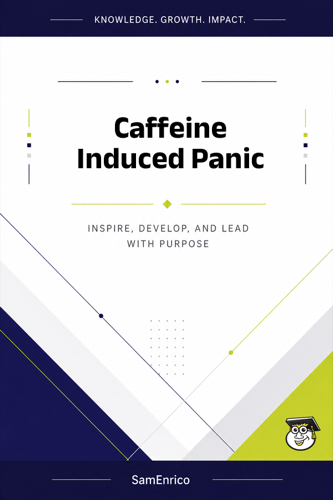
Caffeine Induced Panic eBook
Teaches reducing caffeine to prevent symptoms.
by Joy Marna
Teaches reducing caffeine to prevent symptoms.
Formats
Free sample
Chapter 1: The Jittery Awakening--The first time Sarah’s heart tried to punch its way out of her chest, she was standing over a conference room table in a downtown Seattle law firm, twenty-three floors above street level, with a $400 million merger hanging in the balance. She was thirty-four years old. She had slept four hours. She had consumed her usual morning routine: a large cold brew on the drive in, followed by a double espresso at her desk, followed by a “healthy” energy drink during the 9 AM partner meeting. By 10:15 AM, her hands were trembling so visibly that a junior associate asked if she was cold.
By 10:22 AM, she excused herself to the bathroom, locked the stall door, and sat on the floor convinced she was having a heart attack.The paramedics came. The EKG was normal. The ER doctor suggested she might have an anxiety disorder and prescribed a benzodiazepine. Sarah nodded, filled the prescription, and went back to work the next day. She did not reduce her caffeine intake.
In fact, she increased it, because now she had something new to fear—panic itself—and caffeine, as always, was there to help her push through.Over the next eighteen months, Sarah would visit the ER three more times. She would see two therapists, a cardiologist, and a neurologist. She would be diagnosed with generalized anxiety disorder, panic disorder, and—briefly, until the tests came back clean—a suspected cardiac arrhythmia. She would spend over eight thousand dollars on medical bills, therapy copays, and medications that made her feel numb or foggy or both. No one asked about her coffee habit.
No one asked about the energy drinks. No one asked about the pre-workout powder she used before her 6 AM spin class. No one connected any of it to panic.Then, on a whim, she quit caffeine during a two-week vacation. She expected headaches and fatigue. She did not expect her anxiety to vanish.
By day ten, she realized she had not felt a single twinge of panic in nearly a week—the longest she had gone since law school. By day fourteen, she was sleeping through the night for the first time in years. By day thirty, she called her therapist to ask a question no one had ever posed to her: What if it was the caffeine the whole time?The Epidemic Hiding in Plain Sight Sarah is not an outlier. She is an archetype. High-achieving, Type-A, professionally successful, and utterly convinced that her panic attacks were a sign of a broken brain rather than a predictable pharmacological reaction to a drug she consumed every single day.Let me say this as clearly as I can: Caffeine-induced panic disorder is one of the most misdiagnosed conditions in modern medicine.
And almost everyone—patients, therapists, psychiatrists, even cardiologists—misses it.Not because the science is complicated. The science is straightforward. Caffeine blocks adenosine, the brain’s natural calming chemical. This triggers a cascade of cortisol and adrenaline. In susceptible individuals, that flood of stress hormones produces the exact physical sensations of a panic attack: racing heart, chest tightness, shortness of breath, trembling, derealization, and the terrifying certainty that something is very, very wrong.But here is why almost everyone misses the connection.
First, the symptoms do not appear immediately. They peak sixty to ninety minutes after ingestion—long enough that most people do not connect the coffee they drank at 8 AM with the panic they felt at 9:30 AM. Second, chronic caffeine users have no baseline calm to compare against. They have felt jittery, wired, and on edge for so long that they assume it is normal. They do not realize there is another way to feel.
Third, caffeine is so culturally embedded that questioning it feels like questioning breathing. We do not ask whether coffee is causing our anxiety for the same reason we do not ask whether oxygen is causing our breathing.Let me repeat that. We do not ask whether coffee is causing our anxiety because coffee is too normal to suspect.The Undiagnosed Millions How many people are walking around with a panic disorder diagnosis that is actually a caffeine disorder? The data is frustratingly incomplete, but what exists is staggering.A 2022 systematic review published in the journal Nutrients found that individuals with panic disorder are up to four times more sensitive to caffeine than the general population. In controlled studies, approximately sixty percent of patients with panic disorder experienced a full panic attack after consuming 400mg of caffeine—roughly two to three strong cups of coffee.
Among healthy controls with no history of anxiety, that number dropped to less than twenty percent.But here is the kicker. The same review found that most of those panic-disorder patients had never been asked about their caffeine intake by a mental health professional. Not once.Another study from Johns Hopkins University School of Medicine, one of the world’s leading research centers on caffeine and anxiety, found that nearly ninety percent of adults with daily panic attacks consumed caffeine within two hours of their most recent episode. When researchers asked those patients whether they thought caffeine might be involved, fewer than ten percent said yes. The connection was invisible to them.Let me give you a number that should stop you cold.
The National Institute of Mental Health estimates that 2.7 million adults in the United States suffer from panic disorder. If even a fraction of those cases are actually caffeine-induced or caffeine-exacerbated—and the evidence suggests the fraction is large—we are talking about hundreds of thousands of people who are taking medications, undergoing therapy, and living in fear of their next attack when the solution might be as simple as changing what they drink in the morning.I am not saying therapy is useless. I am not saying medication has no place. Anxiety disorders are real. Panic disorder is real.
Therapy and medication save lives. But for a subset of patients—perhaps a very large subset—caffeine is the primary trigger, or at least a major exacerbating factor. And until that trigger is identified and removed, no amount of therapy or medication will fully resolve the problem. You cannot talk your way out of a biochemical reaction.The Type-A Trap Let me tell you who is most vulnerable to caffeine-induced panic. It is not the person who drinks one small cup of tea in the morning and goes about their day.
It is the high achiever. The perfectionist. The person who mistakes agitation for ambition.Here is why. Caffeine produces a very specific state of arousal. It increases heart rate, raises blood pressure, sharpens focus to a narrow point, and creates a sense of urgency.
In small doses, this can feel productive. In larger doses, it feels like anxiety. But the line between productive arousal and anxious hyperarousal is thin, and Type-A individuals cross it constantly.Consider the language we use to praise high performers. We say they are “driven.” We say they have “intensity.” We say they “run on high octane.” We do not say they are trembling, sweating, and one missed deadline away from a panic attack. We celebrate the jittery state.
We call it hustle. We call it grind. We call it the cost of success.And caffeine is the fuel for…
This is the end of the free sample. Get the eBook to keep going. Buy now
About this book
Details
- Author
- Joy Marna
- Publisher
- SamEnrico
- Language
- English
- Genre
- Non-Fiction, Health & Wellness, Caffeine
- Released
- 2026-06-06
- Pages (approx.)
- 145
- Available as
- eBook, Audiobook

Read better in the ZLOADR app
Your eBooks on your phone or tablet. Sign in with your SamEnrico account and start reading.
More by Joy Marna
 Nasya Nasal Oil GuideJoy Marna$11.99
 Self Talk for Veterans GuideJoy Marna$11.99
 Weight Loss Heart GuideJoy Marna$11.99
 Food Addiction and Depression LinkJoy Marna$11.99
 Consistency Persuasion GuideJoy Marna$11.99
 Journaling Body Esteem GuideJoy Marna$11.99
 Solo Sailor ManualJoy Marna$11.99
 Whispers of the Vanishing Shore: The Last Speakers of the YaghanJoy Marna$11.99
 Gilded Shadows: The Vanishing Art of Venetian GlassmakingJoy Marna$11.99
 How to Produce a Telescopic HandlerJoy Marna$11.99
 A Collector's Handbook to the Ford EscortJoy Marna$11.99
 Service Providers Guide to Blind CleaningJoy Marna$11.99
You may also like
 Hong Kong Handover 1997Dunn Johnnie$11.99
 Zumba For Postnatal Recovery CourseNeal Christian$11.99
 Zumba for BeginnersLadner Nikia$11.99
 YouTube Comment Mining GuideHumes Pandora$12.99
 Worry Box MeditationCarlin Rudy$11.99
 Workplace Stress MeditationNguyen Lynn$11.99
 Workplace Stress and Sleep RepairHawley Ivory$11.99
 Workplace Perfectionism CureDelaney Jeffry$11.99
 Workplace Injustice Anger GuideWallen Isabelle$11.99
 Work Addiction and Burnout LinkGreenwood Ester$11.99
 Women in Yoga and WellnessBeattie Galina$11.99
 Women in Stand Up ComedyChun Evangeline$11.99