
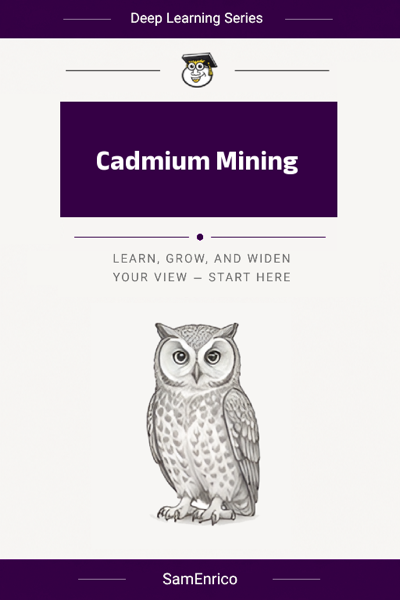
Non-FictionInformativeEducational
Cadmium Mining eBook
A Coursebook on Cadmium Mining
A Coursebook on Cadmium Mining
Formats
Free sample
Chapter 1: The Ghost Metal--–- Cadmium is the element that doesn’t exist. Walk into any modern electronics store, any mining conference, any government stockpile report, and you will find no mention of it. It has no lobbyists, no dedicated mines, no ticker symbol on the London Metal Exchange that moves millions of dollars with a single keystroke. And yet, for the better part of a century, this invisible metal has been hiding inside your most essential devices—powering your cordless drill, painting the yellow on your traffic signals, absorbing the neutrons in your nuclear submarines, and, more recently, generating gigawatts of solar electricity in the world’s fastest-growing renewable energy technology. Cadmium is the ghost at the banquet of modern industry: everywhere, essential, and utterly unnoticed.The paradox begins with its name.
Cadmium derives from the Greek kadmeia, an ancient term for zinc carbonate, and before that from Kadmos, the mythical Phoenician prince who brought the alphabet to Greece and slew the dragon of Thebes. There is a certain poetry in this etymology. Like its mythological namesake, cadmium is a transformer—it changes form, slips between identities, hides inside one metal while behaving like another. It arrives in the world not through its own mines but as a secret stowaway within zinc ore, emerging only after a long and violent industrial journey through roasters, leach tanks, and distillation columns. Most people have never heard of cadmium.
Those who have, however, tend to remember it for darker reasons. For cadmium is also a poison: slow, cumulative, and merciless. In Japan, it once bent bones and broke kidneys and earned the terrible nickname itai-itai—“ouch-ouch”—from the screams of its victims. This, then, is the ghost metal’s true nature: essential and lethal, ubiquitous and invisible, a shadow cast by the zinc industry that refuses to fade away.The Fundamental Paradox: A Metal Without Mines To mine cadmium, you must first understand a simple, counterintuitive truth: there is no such thing as a cadmium mine. Not a single commercial operation on earth extracts cadmium as its primary product.
The only cadmium mineral with any economic significance is greenockite (Cd S), named after Lord Greenock, a British aristocrat who never knew that the yellow crust on his mineral collection would become the subject of metallurgical textbooks. Greenockite is beautiful—it forms hexagonal crystals of a deep honey-yellow color—but it is also vanishingly rare. The entire known global reserve of greenockite, if concentrated in one place, would fit inside a medium-sized swimming pool. There is simply not enough of it to justify a dedicated mining operation.Instead, cadmium performs its most famous trick: hiding inside another mineral entirely. Sphalerite (Zn S), the primary ore of zinc, has a crystal structure that welcomes cadmium ions as unwitting guests.
At the atomic level, the story is one of impersonation. A cadmium ion (Cd²⁺) has an ionic radius of 0.97 angstroms, while a zinc ion (Zn²⁺) measures 0.74 angstroms—close enough to slip into the same lattice positions under the right conditions. During the slow, low-temperature formation of certain hydrothermal ore deposits, cadmium atoms substitute for zinc atoms, occupying perhaps one in every two hundred lattice sites. The result is a zinc concentrate that contains 0.1 to 0.5 percent cadmium by weight, invisible to the naked eye but very real to the metallurgist who must later separate them.This substitution is not random. It follows strict geochemical rules that prospectors have learned to exploit.
Cadmium prefers low-temperature environments, typically between 150 and 250 degrees Celsius, where the slower crystal growth allows the larger cadmium ion to find its place. Deposits that form quickly at high temperatures—like the vast Red Dog mine in Alaska—trap less cadmium, sometimes as little as 0.1 percent. Deposits with prolonged low-temperature histories, such as the Mount Isa mine in Australia or the Huoshaoyun deposit in China’s Xinjiang region, capture more, occasionally exceeding 0.6 percent. For the geologist, these differences are forensic clues; for the miner, they are the difference between profit and loss.The Market That Isn't There The byproduct nature of cadmium creates a market that defies every rule of normal commodity economics. For most metals—copper, aluminum, iron—the price is set by the balance between dedicated mines and dedicated demand.
When prices rise, mines ramp up production; when prices fall, marginal operations close. This is called elasticity, and it is the invisible hand that stabilizes markets.Cadmium has no such hand. Its supply is determined entirely by the zinc market. When zinc prices are high, zinc mines and refineries run at full capacity, and cadmium flows as an unavoidable byproduct regardless of whether anyone wants it. When zinc prices crash, the refineries close, and cadmium production stops—again regardless of demand.
This is perfectly inelastic supply, the economist’s nightmare. It means that the cadmium price can fall to zero and production will not change, because the cadmium is already there, already paid for by the zinc, and throwing it away would cost more than selling it at a loss.The consequences of this strangeness become visible in historical price charts. In the late 1970s, cadmium traded at approximately 3perpound.Bytheearly1990s,ithadclimbedto3 per pound. By the early 1990s, it had climbed to 3perpound.Bytheearly1990s,ithadclimbedto5. Then came the nickel-cadmium (Ni-Cd) battery boom.
Cordless power tools, emergency lighting, laptop batteries, and eventually hybrid vehicles all relied on Ni-Cd’s unique combination of high discharge rate, long cycle life, and excellent low-temperature performance. Demand surged. But supply could not surge with it, because zinc mines were already running flat out. The result was a price spike to nearly 12perkilogramin2000,followedbyacollapseto12 per kilogram in 2000, followed by a collapse to 12perkilogramin2000,followedbyacollapseto2 per kilogram in 1995—not because demand fell, but because zinc production fluctuated. Cadmium traders learned to watch zinc smelter utilization rates more closely than their own markets.The Battery That Changed Everything No single application has shaped cadmium’s modern history more profoundly than the nickel-cadmium battery.
Invented by Waldemar Jungner in Sweden in 1899, the Ni-Cd cell was the first rechargeable battery to achieve commercial success. Its chemistry is elegant and brutal in equal measure: a nickel hydroxide positive electrode, a cadmium hydroxide negative electrode, and an alkaline electrolyte of potassium hydroxide. During discharge, cadmium metal oxidizes to cadmium hydroxide, releasing electrons that flow through your device. During charging, the reaction reverses. The battery can withstand thousands of cycles, tolerate overcharge without catastrophic failure, and operate in temperatures from -20°C to +50°C.
For half a century, it was the undisputed king of portable power.The golden age of Ni-Cd began in the 1960s with cordless power tools. Black & Decker’s first cordless drill, introduced in 1961, used a sealed Ni-Cd cell that could be recharged in an hour and run for twenty minutes—barely enough to drive a few screws, but revolutionary in its freedom. By the 1980s, Ni-Cd batteries were everywhere: portable phones, camcorders, electric shavers, and the first laptop computers. The Sony Discman, the Motorola Dyna TAC mobile phone, the original Nintendo Game Boy—all ran on cadmium chemistry. At the peak of Ni-Cd production in the late 1990s, the battery industry consumed more than 40 percent of all cadmium refined worldwide.But the…
This is the end of the free sample. Get the eBook to keep going. Buy now
About this book
Details
- Author
- Garber Stefanie
- Publisher
- SamEnrico
- Language
- English
- Genre
- Non-Fiction, Informative, Educational
- Released
- 2026-05-06
- Pages (approx.)
- 146
- Available as
- eBook, Audiobook

Read better in the ZLOADR app
Your eBooks on your phone or tablet. Sign in with your SamEnrico account and start reading.
More by Garber Stefanie
 Values And Mission Alignment Value Violation Consequences GuideGarber Stefanie$11.99
 Mediterranean Research ReviewGarber Stefanie$11.99
 Framing Persuasion TechniqueGarber Stefanie$11.99
 The Traumatic Loss Grief GuideGarber Stefanie$11.99
 The Hollow Man of Eridu: When the First City Forgot Its GodsGarber Stefanie$11.99
 How to Start a Campers (transport) Rental (self Drive) Business (Beginners Guide)Garber Stefanie$11.99
 Understanding Trigonocephaly Broad ThumbsGarber Stefanie$17.99
 Remote Financial Model GuideGarber Stefanie$12.99
 Franchising into India GuideGarber Stefanie$12.99
You may also like
 Hong Kong Handover 1997Dunn Johnnie$11.99
 Zumba For Postnatal Recovery CourseNeal Christian$11.99
 Zumba for BeginnersLadner Nikia$11.99
 YouTube Comment Mining GuideHumes Pandora$12.99
 Worry Box MeditationCarlin Rudy$11.99
 Workplace Stress MeditationNguyen Lynn$11.99
 Workplace Stress and Sleep RepairHawley Ivory$11.99
 Workplace Perfectionism CureDelaney Jeffry$11.99
 Workplace Injustice Anger GuideWallen Isabelle$11.99
 Work Addiction and Burnout LinkGreenwood Ester$11.99
 Women in Yoga and WellnessBeattie Galina$11.99
 Women in Stand Up ComedyChun Evangeline$11.99