
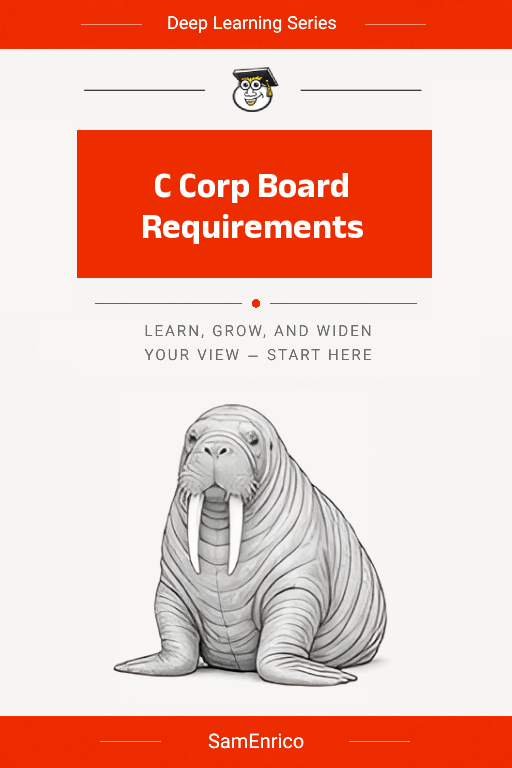
Non-FictionStartup GuideEntity Selection
C Corp Board Requirements eBook
Set up board of directors for C-Corp. Board meetin
Set up board of directors for C-Corp. Board meetings, minutes, and fiduciary duties.
Formats
Free sample
Chapter 1: The Three-Legged Stool--She lost everything because she thought she was the company.Maria had founded a fast-growing Saa S startup. She owned 100% of the shares. She was the sole director. She was the CEO. In her mind, "Maria" and "the corporation" were the same thing.
She paid vendors from her personal checking account when the corporate account was low. She signed a five-year office lease personally because it was "faster." And she never held a single board meeting because, as she put it, "I am the board."Three years later, a customer sued the corporation for breach of contract. The corporation had no money. But Maria had a house, savings, and another business. The plaintiff's lawyer asked for her corporate minute book.
It was empty. No meeting minutes. No director elections. No evidence that the corporation ever functioned as a separate entity. The court pierced the corporate veil and held Maria personally liable for the entire judgment.
She lost her house.This chapter exists to make sure that never happens to you.The single most important concept in corporate governance is this: a corporation is a separate legal person. It is not you. It is not your co-founder. It is not your investors. It is an artificial legal entity that owns its own assets, incurs its own debts, and must be governed by its own rules.
The three groups that bring this legal person to life are shareholders, directors, and officers. When they work together properly, they form a stable, legally protected structure. When they collapse into one person, courts treat the corporation as a fiction—and you lose the liability shield you incorporated to obtain.This chapter introduces the three-legged stool metaphor, explains exactly what each group does, clarifies where the boundaries lie, and gives you a self-diagnostic to determine whether your current structure is protecting you or exposing you. By the end of this chapter, you will understand the foundational separation of powers that every subsequent chapter builds upon.The Three-Legged Stool Metaphor Imagine a three-legged stool. Each leg represents one of the three distinct roles in a C Corporation: shareholders, directors, and officers.
The seat of the stool is the corporation itself—the separate legal entity. If all three legs are present and properly maintained, the stool stands firm. If one leg is missing or broken, the stool collapses. And when the stool collapses, courts are much more likely to ignore the corporation and hold the people behind it personally liable.This metaphor is not just a teaching device. It is embedded in the corporate laws of every state.
The law deliberately separates these three roles to create checks and balances. Shareholders cannot manage day-to-day operations. Directors cannot unilaterally act without a board vote. Officers cannot make strategic decisions without board approval. The separation is the feature, not a bug.Let us examine each leg in detail.Leg One: Shareholders Who they are: Shareholders own the corporation.
They buy shares (stock) in exchange for capital. A shareholder can be a founder, an early employee with equity, an angel investor, a venture capital firm, or a member of the public if the company is publicly traded. Shareholders may own one share or millions of shares. Their power is generally proportional to their ownership percentage.What they do: Shareholders do not manage the company. This is the most common misunderstanding among founders.
Owning shares does not give you the right to tell the CEO what to do, sign contracts, or fire employees. Instead, shareholders have a limited set of reserved powers that they exercise primarily by voting. The most important shareholder votes include:Electing directors. Shareholders vote for the people who will sit on the board. This is their primary control mechanism.
They do not vote for officers (like the CEO) except indirectly through the board.Approving major corporate transactions. These typically include mergers, asset sales outside the ordinary course of business, and dissolution (winding up the company).Amending the bylaws or certificate of incorporation. Shareholders must approve fundamental changes to the corporate governance documents, though boards often have concurrent power.Approving certain stock issuances. In some states and circumstances, shareholders must approve the issuance of new shares that would significantly dilute existing holders.Removing directors. Shareholders can vote to remove directors before their terms expire, with or without cause, depending on the bylaws and state law.
(We will cover removal in detail in Chapter 10.)What they do NOT do: Shareholders do not hire or fire the CEO (the board does). They do not set strategy (the board does, with input from officers). They do not sign contracts (officers do). They do not attend board meetings unless invited. They do not have access to confidential board materials unless the board chooses to share them.
A shareholder who acts like a manager—for example, by telling an employee what to do or signing a contract on behalf of the corporation—risks piercing the corporate veil because they are blurring the separation between ownership and management.The passive default: In a typical C Corporation with widely held shares (like a public company), shareholders are entirely passive. They buy shares, vote once a year (if they bother to return their proxy ballot), and otherwise do nothing. The board and officers run the company. In a closely held corporation (a small number of shareholders who are also often directors and officers), the lines blur, but the legal distinctions remain. Even if you are the only shareholder, you must still follow the formalities of electing directors (yourself) and holding meetings.Example: Suppose you own 100% of the shares of your corporation.
You want to fire the CEO. As the sole shareholder, you cannot simply call the CEO and fire them. You must either: (a) elect a new board (by voting your shares) that will fire the CEO, or (b) if you are also a director, you must vote at a board meeting to fire the CEO. The shareholder role alone gives you no employment authority.Leg Two: Directors Who they are: Directors are individuals elected by the shareholders to sit on the board of directors. A board can have one director (in most states, including Delaware) or many.
For a startup, three directors is the standard recommended minimum. Directors do not need to be shareholders, though they often are. They do not need any particular qualifications unless the bylaws specify them. Directors can be paid for their service (cash, stock, or both) and reimbursed for expenses.What they do: Directors are the strategic brain of the corporation. They do not manage day-to-day operations.
Instead, they govern. The board's primary responsibilities include:Selecting and overseeing officers. The board hires the CEO, sets the CEO's compensation, evaluates the CEO's performance, and fires the CEO when necessary. The board also typically approves other executive-level officers (CFO, CTO, etc.).Setting high-level strategy. The board approves annual budgets, major capital expenditures, acquisitions, divestitures, and entry into or exit from lines of business.Monitoring corporate performance.
The board reviews financial statements, key performance indicators, and compliance with legal and ethical standards.Fulfilling fiduciary duties. Directors owe three core duties to the corporation: the duty of care, the duty of loyalty, and…
This is the end of the free sample. Get the eBook to keep going. Buy now
About this book
Details
- Author
- Dinapoli Mitch
- Publisher
- SamEnrico
- Language
- English
- Genre
- Non-Fiction, Startup Guide, Entity Selection
- Released
- 2026-05-30
- Pages (approx.)
- 158
- Available as
- eBook, Audiobook

Read better in the ZLOADR app
Your eBooks on your phone or tablet. Sign in with your SamEnrico account and start reading.
More by Dinapoli Mitch
 The Difficult Conversation Role PlayDinapoli Mitch$11.99
 Troy Baker Many VoicesDinapoli Mitch$11.99
 Plant Based Menopause Relief HandbookDinapoli Mitch$11.99
 Teen Journaling Self EsteemDinapoli Mitch$11.99
 The General Contractor DirectoryDinapoli Mitch$11.99
 The Oxford Revolution: How a Medieval University Shaped the Modern MindDinapoli Mitch$11.99
 Monthly Bookkeeping ChecklistDinapoli Mitch$12.99
 Understanding X-linked Mental Retardation Type SnyderDinapoli Mitch$17.99
 The Cold War: Lessons for Today's ConflictsDinapoli Mitch$11.99
 Ultimate Handbook Guide to Bhilai Nagar : (India) Travel GuideDinapoli Mitch$11.99
You may also like
 Hong Kong Handover 1997Dunn Johnnie$11.99
 Zumba For Postnatal Recovery CourseNeal Christian$11.99
 Zumba for BeginnersLadner Nikia$11.99
 YouTube Comment Mining GuideHumes Pandora$12.99
 Worry Box MeditationCarlin Rudy$11.99
 Workplace Stress MeditationNguyen Lynn$11.99
 Workplace Stress and Sleep RepairHawley Ivory$11.99
 Workplace Perfectionism CureDelaney Jeffry$11.99
 Workplace Injustice Anger GuideWallen Isabelle$11.99
 Work Addiction and Burnout LinkGreenwood Ester$11.99
 Women in Yoga and WellnessBeattie Galina$11.99
 Women in Stand Up ComedyChun Evangeline$11.99