
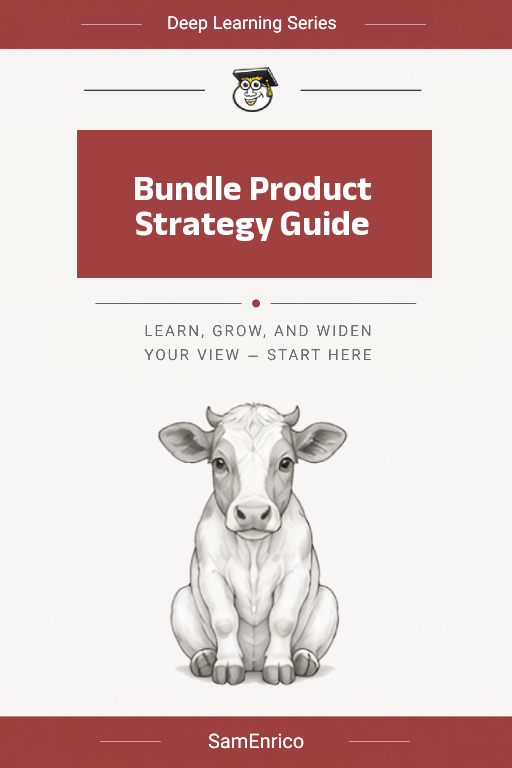
Non-FictionFirst 30 DaysBundling
Bundle Product Strategy Guide eBook
Combine multiple digital products into a high valu
by Murphy Nina
Combine multiple digital products into a high value bundle to increase average order value.
Formats
Free sample
Chapter 1: The Margin Mirage--–- Most digital product sellers are trapped in a quiet, compounding disaster. They wake up, check their sales dashboard, see another 27e−booksaleora27 e-book sale or a 27e−booksaleora15 template purchase, and feel a small rush of validation. Then they check their ad spend, their Stripe fees, their refund rate, and their cost of customer acquisition. The math does not lie. They are working harder, creating more products, driving more traffic, and yet their profit per customer is barely moving.
Some are actually losing money on every transaction, hoping to make it up in volume—a strategy that has never worked in the history of commerce.This is the margin mirage. It is the false belief that selling more individual digital products at low price points is a sustainable business model. On the surface, digital goods seem like a dream: zero marginal cost of replication, no inventory to hold, no shipping to manage. You create a PDF once and sell it a thousand times. What could go wrong?Almost everything.The truth is that low-priced digital products—e-books, printables, mini-courses, templates, checklists—have become commoditized faster than almost any other category in modern e-commerce.
Marketplaces like Gumroad, Etsy, and Teachers Pay Teachers are flooded with millions of sellers all competing for the same attention, often on price alone. The result is a race to the bottom where 27becomes27 becomes 27becomes17 becomes 9becomes9 becomes 9becomes4.99. And at $4.99, after marketplace fees, payment processing, and ad costs, there is nothing left. You are not a business owner. You are a digital panhandler.This book exists because there is a way out.
It is not a secret, but it does require a shift in identity. You must stop thinking of yourself as a product creator and start thinking of yourself as a solution architect. Instead of selling individual digital files, you will learn to combine them into high-value bundles that solve complete customer problems. And in doing so, you will transform a 27transactionintoa27 transaction into a 27transactionintoa97 transaction, a 97transactionintoa97 transaction into a 97transactionintoa297 transaction, and a one-time buyer into a long-term customer who sees you as essential.This chapter will show you why the single-product mindset is failing, how bundling changes the economic equation of digital goods, and why Average Order Value (AOV) must become your new North Star metric. By the end, you will understand that you are not in the business of selling files.
You are in the business of selling outcomes—and bundles are the most efficient vehicle for delivering those outcomes.The Commoditization Trap Let us start with a hard truth. Digital products have no inherent scarcity. A physical book requires paper, printing, binding, and warehouse space. A physical shirt requires fabric, cutting, sewing, and shipping. Each additional unit has a real, measurable cost.
That cost creates a natural floor beneath which prices cannot fall without destroying the business.Digital products have no such floor. A PDF costs exactly the same to produce for the thousandth customer as it did for the first: nothing. In economic terms, the marginal cost is zero. This sounds like a superpower, and in the early days of digital commerce, it was. Early adopters sold e-books for 47,coursesfor47, courses for 47,coursesfor500, and template packs for $97 because there were few competitors and customers had not yet learned to comparison shop.Those days are over.Today, the zero marginal cost that once protected digital sellers has become their greatest vulnerability.
Because it costs nothing to replicate a digital product, it costs nothing for a competitor to undercut you. And undercut you they will. The typical trajectory of a digital product category looks like this:Phase One: Innovation. A seller creates a genuinely new type of digital product—say, a set of social media templates for Instagram. They charge $47.
Customers are delighted.Phase Two: Imitation. Other sellers notice the success. They create similar templates. They charge 37.Then37. Then 37.Then27.
Then $17.Phase Three: Commoditization. The category is now flooded with hundreds or thousands of similar products. Customers can no longer distinguish quality. They sort by price, lowest first. The market clearing price drops to $9 or less.Phase Four: Exhaustion.
Sellers are now paying 5inadcoststoacquireacustomerwhospends5 in ad costs to acquire a customer who spends 5inadcoststoacquireacustomerwhospends9. After fees, they make 1or1 or 1or2 per sale. They cannot afford to improve their product, and they cannot afford to stop advertising. They are trapped.This is not a theory. This is the documented history of e-books, printables, Lightroom presets, Notion templates, Canva templates, stock photography, and dozens of other digital categories.
The only reason it has not happened to your category yet is because you are either early or small. Given enough time and attention, commoditization comes for everything.The Super-Bundle Escape The way out of the commoditization trap is not to create better single products. It is to stop selling single products altogether. This insight comes from an unlikely source: industrial manufacturing.In the 1990s, companies like General Electric and IBM faced a similar problem. They sold jet engines, turbines, and mainframe computers—highly engineered physical products with real marginal costs.
But they noticed a disturbing trend. Competitors, especially from emerging markets, were copying their components and selling them for less. A jet engine blade was a jet engine blade. Price was the only differentiator.Their solution was to stop selling components and start selling systems. GE stopped selling just jet engines.
Instead, they sold "engine uptime as a service." The customer paid for the number of hours the engine stayed in the air, and GE bundled the engine, predictive maintenance software, real-time monitoring, and replacement parts into a single contract. A competitor could copy the engine blade, but they could not copy the entire system overnight.IBM did the same. They stopped selling individual servers and storage devices. Instead, they sold "integrated enterprise solutions" that combined hardware, software, consulting, and financing into a single bundled offer. The customer was not buying a product; they were buying a solved problem.This is the Super-Bundle concept, and it applies directly to digital products.
Instead of selling a 27e−bookoncoldemail,sella"leadgenerationsystem"thatincludesthee−book(strategy),threeemailtemplates(execution),achecklist(implementation),andaswipefileofwinningcampaigns(inspiration).Insteadofsellinga27 e-book on cold email, sell a "lead generation system" that includes the e-book (strategy), three email templates (execution), a checklist (implementation), and a swipe file of winning campaigns (inspiration). Instead of selling a 27e−bookoncoldemail,sella"leadgenerationsystem"thatincludesthee−book(strategy),threeemailtemplates(execution),achecklist(implementation),andaswipefileofwinningcampaigns(inspiration).Insteadofsellinga15 set of Canva templates, sell a "brand launch kit" that includes the templates, a style guide, a font pack, and a one-hour video tutorial on how to customize everything.Do you see the difference? In the single-product model, you are competing on price with thousands of other e-book authors. In the Super-Bundle model, you are competing on coherence. Your bundle is not just a collection of files; it is a solution that takes the customer from confusion to clarity, from start to finish.
And because you have bundled multiple products together, the customer perceives higher value. They are willing to pay more. And because the bundle solves a complete problem, they are more likely to achieve results, which makes them…
This is the end of the free sample. Get the eBook to keep going. Buy now
About this book
Details
- Author
- Murphy Nina
- Publisher
- SamEnrico
- Language
- English
- Genre
- Non-Fiction, First 30 Days, Bundling
- Released
- 2026-06-01
- Pages (approx.)
- 146
- Available as
- eBook, Audiobook

Read better in the ZLOADR app
Your eBooks on your phone or tablet. Sign in with your SamEnrico account and start reading.
More by Murphy Nina
 Burnout Recovery AromatherapyMurphy Nina$11.99
 Opioid Cold Turkey GuideMurphy Nina$11.99
 The Interruption Evidence LogMurphy Nina$11.99
 Real Estate Dividends Beyond REITsMurphy Nina$11.99
 Goal Affirmation PracticeMurphy Nina$11.99
 The Sabbatical Transition StrategyMurphy Nina$11.99
 Procrastination For EntrepreneursMurphy Nina$11.99
 First Year Without ParentMurphy Nina$11.99
 The Silk Road Gambit: Han China's War for the WestMurphy Nina$11.99
 The Condottiero: Andrea Doria’s Rise and Fall in the Italian WarsMurphy Nina$11.99
 How to Produce Medical InstrumentsMurphy Nina$11.99
 FMLA Compliance Legal GuideMurphy Nina$12.99
You may also like
 Hong Kong Handover 1997Dunn Johnnie$11.99
 Zumba For Postnatal Recovery CourseNeal Christian$11.99
 Zumba for BeginnersLadner Nikia$11.99
 YouTube Comment Mining GuideHumes Pandora$12.99
 Worry Box MeditationCarlin Rudy$11.99
 Workplace Stress MeditationNguyen Lynn$11.99
 Workplace Stress and Sleep RepairHawley Ivory$11.99
 Workplace Perfectionism CureDelaney Jeffry$11.99
 Workplace Injustice Anger GuideWallen Isabelle$11.99
 Work Addiction and Burnout LinkGreenwood Ester$11.99
 Women in Yoga and WellnessBeattie Galina$11.99
 Women in Stand Up ComedyChun Evangeline$11.99