
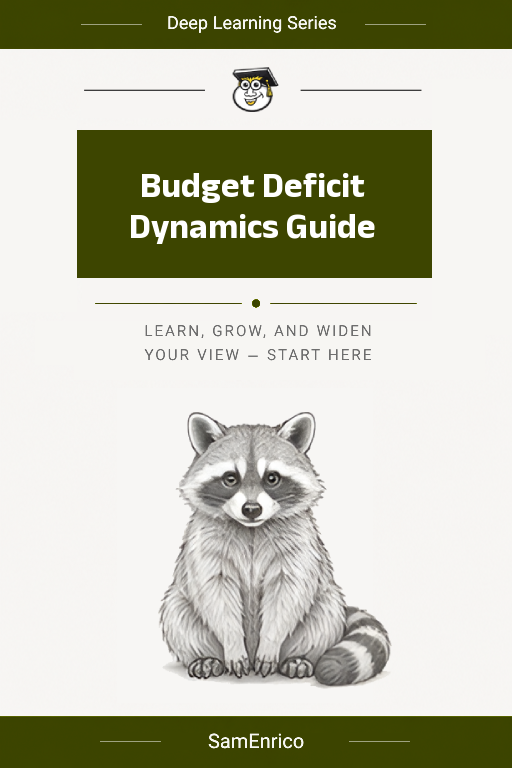
Budget Deficit Dynamics Guide
Model government debt-to-GDP ratios with primary d
by Guest Kyung
Model government debt-to-GDP ratios with primary deficits and growth rates. Simulate fiscal sustainability scenarios for macroeconomics exam questions.
Formats
About this book
Free sample
Chapter 1: The Solvency Illusion–- In 1824, the newly independent nations of Latin America did something that would echo across two centuries of financial history: they borrowed massive sums from London’s capital markets, promised to repay with interest, and then, one by one, stopped paying. The bondholders were furious. The governments were unapologetic. And the most puzzling question of all emerged from the wreckage: how could a country that owed more than it could possibly repay continue to borrow again just a few years later?The answer to that question is not found in balance sheets or interest rate formulas alone. It lies in a deceptively simple distinction that most people—including many professional economists—fail to make: the difference between solvency and sustainability.
A government can be insolvent on paper yet sustainable in practice. It can be solvent by the numbers yet politically unsustainable. And understanding this distinction is the single most important step toward mastering budget deficit dynamics.This chapter establishes the theoretical bedrock for everything that follows. It answers the foundational question: When is a government truly solvent? But more importantly, it introduces the conceptual tools—the intertemporal budget constraint, the No-Ponzi game condition, and the transversality condition—that transform vague worries about national debt into precise, testable propositions.
By the end of this chapter, you will be able to look at a country’s debt numbers and make a sober, defensible judgment about whether that country is living within its means or slowly marching toward a fiscal crisis.The $100 Trillion Question Let us begin with a provocation. In 2024, the United States government owed approximately 34trilliontoitscreditors.Thatisroughly34 trillion to its creditors. That is roughly 34trilliontoitscreditors.Thatisroughly100,000 for every American citizen. If you were a financial advisor looking at an individual with that kind of debt—$100,000 owed for every member of the household—you would declare bankruptcy immediately. You would say this person is hopelessly insolvent.Yet the United States government continues to borrow.
Investors continue to lend. And the dollar remains the world’s reserve currency. What explains this apparent contradiction?The answer is that governments are not households.…
This is the end of the free sample. Get the eBook to keep going. Buy now
Contents
- Chapter 1
- Chapter 2
- Chapter 3
- Chapter 4
- Chapter 5
- Chapter 6
- Chapter 7
- Chapter 8
- Chapter 9
- Chapter 10
- Chapter 11
- Chapter 12
Details
- Author
- Guest Kyung
- Publisher
- SamEnrico
- Language
- English
- Genre
- Non-Fiction, Student's Shortcut, Public Finance
- Released
- 2026-05-30
- Pages (approx.)
- 155
- Available as
- eBook, Audiobook

Read better in the ZLOADR app
Your eBooks on your phone or tablet. Sign in with your SamEnrico account and start reading.
More by Guest Kyung
 Catherine Great Nobility ControlGuest Kyung$11.99
 Exercise Stress ReductionGuest Kyung$11.99
 Mindfulness for Weight LossGuest Kyung$11.99
 Financial Stress for Low Income FamiliesGuest Kyung$11.99
 The Architect of the Cosmos: Benjamin Banneker's Celestial CalculationsGuest Kyung$11.99
 Elderly CompanionGuest Kyung$11.99
 How to Produce an Auto ClutchGuest Kyung$11.99
 How to Start a Blancmange Powder Business (Beginners Guide)Guest Kyung$11.99