
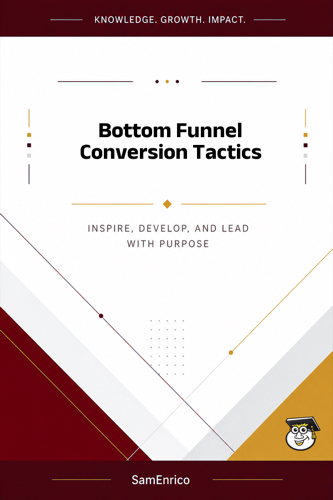
Non-FictionBusiness BriefConversion
Bottom Funnel Conversion Tactics eBook
Close leads with sales calls, checkout optimizatio
by Wampler Luba
Close leads with sales calls, checkout optimization, and urgency triggers.
Formats
Free sample
Chapter 1: The Valley of Death--The deal was perfect. The prospect had attended three demos, read every case study, and even told the sales rep, “This is exactly what we need.” The price was within budget. The ROI calculation was undeniable. And then… nothing. The email thread went silent.
Calls went to voicemail. The deal—worth $47,000—simply evaporated.The sales rep, Sarah, did everything by the book. She followed up five times. She offered a discount. She asked, “Did we do something wrong?” The reply, when it finally came, was a dagger: “We decided to stick with our current solution for now.”Sarah’s manager blamed her.
“You didn’t close hard enough,” he said. But that wasn’t the problem. The problem was that Sarah had never been taught the single most important truth about the bottom of the sales funnel: logic doesn’t close deals. Fear does. And when you don’t manage that fear, even the most enthusiastic prospect will run back to the devil they know.This is the reality of the bottom funnel.
It is not a place of rational decision-making, careful comparison, or thoughtful deliberation. It is a psychological battlefield where the ancient, primal parts of the brain wage war against the modern, logical parts. And the ancient brain almost always wins.Welcome to the Valley of Death.The 90-Yard Illusion In football, the hardest yards are the last ten. Teams can march effortlessly from their own 20-yard line to the opponent’s 10, only to stall four times in a row and turn the ball over on downs. The end zone is right there.
Victory is visible. And yet, something happens in those final ten yards that defies logic.The bottom of the sales funnel is exactly the same.A prospect can sail through awareness, interest, and consideration. They can watch your videos, read your reviews, and even tell you they love your product. But when they reach that final 10 percent of the journey—the space between “I want this” and “I will pay for this right now”—something shifts. The rules change.
The rational brain that said “this is a good deal” is suddenly drowned out by a voice whispering: “What if I’m wrong?”This chapter is about that space. I call it the Valley of Death.Not because deals go there to die quietly. They go there to die in plain sight, surrounded by every sign that they should live. The Valley of Death is where enthusiasm turns to hesitation, hesitation turns to inaction, and inaction turns to “maybe next year.” It is the single greatest leak in any sales funnel, and it is almost entirely invisible to the people who run the numbers.Most businesses measure everything above the valley. They track click-through rates, form completions, and demo requests.
They optimize headlines and adjust button colors. But they never look at the Valley of Death because they don’t know it exists. They see a prospect who said “yes” and then disappeared, and they assume the prospect was never serious. That is a mistake.The prospect was serious. The prospect wanted to buy.
But somewhere between the last “yes” and the final click, fear took the wheel and drove them back to safety.To understand why this happens—and how to prevent it—we need to go deeper than tactics. We need to go into the psychology of decision-making under pressure. And that starts with two Nobel Prize-winning insights that explain almost every stalled deal you have ever lost.The Two Dragons: Loss Aversion and Status Quo Bias In the 1970s, psychologists Daniel Kahneman and Amos Tversky began a series of experiments that would eventually upend economics and earn Kahneman a Nobel Prize. Their most famous finding is also the most relevant to the bottom funnel: loss aversion.Here is the experiment that changed everything.Kahneman and Tversky gave people two choices. First choice: you can have $50 for certain.
Second choice: you can flip a coin. If it lands heads, you get $100. If it lands tails, you get nothing.The rational, mathematical choice is the coin flip. The expected value is $50—exactly the same as the certain $50, but with a chance at $100. Yet the vast majority of people chose the certain $50.
Why? Because the fear of getting nothing (a loss of the guaranteed $50) was more powerful than the excitement of possibly getting $100.Then they flipped the experiment. They told people they would lose $50 for certain, unless they flipped a coin. Heads: lose nothing. Tails: lose $100.Now the math is identical.
The expected value is a loss of $50 either way. But this time, the vast majority chose the coin flip. Why? Because the certainty of a loss is unbearable. People would rather risk a larger loss than accept a smaller, certain loss.Kahneman and Tversky quantified this asymmetry.
They found that, on average, the pain of losing $100 is about twice as powerful as the pleasure of gaining $100. Loss aversion is not a 1:1 ratio. It is 2:1. Losses hurt twice as much as gains feel good.Now let me translate this to your bottom funnel.When a prospect is considering your product, they are not calculating a net gain. They are calculating a potential loss.
Every dollar they spend is a loss of that dollar. Every minute they commit to implementation is a loss of that time. Every risk they take by switching from their current solution is a potential loss of reliability, status, or sanity.Your product might offer $10,000 in value. But if the prospect feels they might lose $5,000 in the process, the math is not $10,000 minus $5,000 equals $5,000 gain. The math is: gain of $10,000 (feels like +1) versus loss of $5,000 (feels like –2).
Net feeling: negative. They feel worse off.That is loss aversion at work.The second dragon is status quo bias. This is the human tendency to prefer things as they are, even when change would be objectively beneficial. In one famous study, researchers gave participants a choice between a mug and a chocolate bar. Half chose the mug.
Half chose the chocolate. Then they told the mug-owners they could trade their mug for a chocolate bar. Almost none did. And they told the chocolate-owners they could trade for a mug. Almost none did.Once people own something—even for five minutes—they overvalue it.
The mug that was worth $3 becomes worth $6 in the owner’s mind. The chocolate bar that was worth $3 becomes worth $6.Your prospect already owns their current situation. It might be painful, expensive, or inefficient. But it is theirs. They have adapted to its flaws.
They know how to work around its failures. Switching to your solution means giving up that known quantity for an unknown one. And because of loss aversion, the unknown feels riskier than it actually is.Status quo bias plus loss aversion equals the Valley of Death. Your prospect is not lazy. They are not stupid.
They are biologically wired to stay put. The fact that they even got to the bottom of your funnel is a miracle of modern marketing. But getting them across the finish line requires understanding these dragons—and learning to slay them, one micro-commitment at a time.The Commitment Gap Between intention…
This is the end of the free sample. Get the eBook to keep going. Buy now
About this book
Details
- Author
- Wampler Luba
- Publisher
- SamEnrico
- Language
- English
- Genre
- Non-Fiction, Business Brief, Conversion
- Released
- 2026-06-07
- Pages (approx.)
- 150
- Available as
- eBook, Audiobook

Read better in the ZLOADR app
Your eBooks on your phone or tablet. Sign in with your SamEnrico account and start reading.
More by Wampler Luba
 Chronic Exhaustion Recovery PlanWampler Luba$11.99
 Group Creative Energy Management WorkbookWampler Luba$11.99
 Arnold Palmer Life Story GuideWampler Luba$11.99
 Physical Pain Anger ConnectionWampler Luba$11.99
 The Spice Hunter’s Secret: Ibn Battuta’s Forgotten Voyage Across the Indian OceanWampler Luba$11.99
 The Clockwork Genius: How a Farm Boy Built the First Practical Combustion EngineWampler Luba$11.99
 10 Ways to Use Chayote (Recipe Book)Wampler Luba$11.99
 Bankruptcy Asset BuyersWampler Luba$12.99
 Grist Spreadsheet Database GuideWampler Luba$12.99
 Understanding Chromosome 9, Duplication 9q21Wampler Luba$17.99
 VP of EngineeringWampler Luba$11.99
You may also like
 Hong Kong Handover 1997Dunn Johnnie$11.99
 Zumba For Postnatal Recovery CourseNeal Christian$11.99
 Zumba for BeginnersLadner Nikia$11.99
 YouTube Comment Mining GuideHumes Pandora$12.99
 Worry Box MeditationCarlin Rudy$11.99
 Workplace Stress MeditationNguyen Lynn$11.99
 Workplace Stress and Sleep RepairHawley Ivory$11.99
 Workplace Perfectionism CureDelaney Jeffry$11.99
 Workplace Injustice Anger GuideWallen Isabelle$11.99
 Work Addiction and Burnout LinkGreenwood Ester$11.99
 Women in Yoga and WellnessBeattie Galina$11.99
 Women in Stand Up ComedyChun Evangeline$11.99