
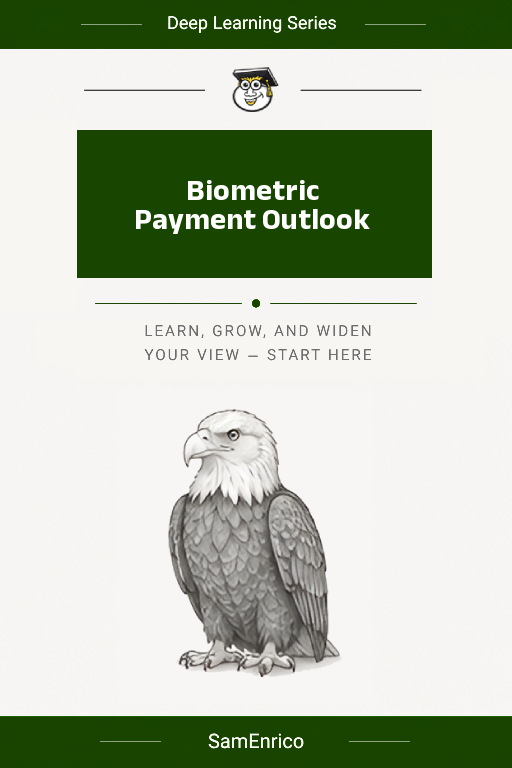
Biometric Payment Outlook
Forecast fingerprint, facial recognition, and palm
by Oates Bong
Forecast fingerprint, facial recognition, and palm vein payment adoption for in-store and remote transactions through 2030.
Formats
About this book
Free sample
Chapter 1: The Friction Economy--–- In 2023, a major European airline discovered that nearly 12% of its passengers abandoned their checked baggage at self-service kiosks when asked to insert a credit card and enter a PIN. Not because they couldn’t pay, but because the process took too long. The queue behind them grew restless. The screen froze twice. The magnetic stripe had worn smooth from airport use.
Each of these abandoned bags cost the airline $85 in manual handling, rerouting, and customer service calls. Across the industry, this single friction point—the humble payment step—was bleeding hundreds of millions of dollars annually. And that was just one airline, one vertical, one type of friction.Welcome to the friction economy—the hidden tax that traditional payment methods impose on merchants, banks, and consumers every single day. It is a trillion-dollar drag on global commerce, and for decades, we have simply accepted it as the cost of doing business. But that acceptance is ending.
This chapter will quantify the scale of the problem, introduce the four macro-forces that are making friction intolerable, and establish the core forecasts that drive the rest of this book: 3.5 billion biometric payment users by 2030 generating $11.5 billion in vendor revenue—with less than 2% of those users relying on the much-hyped biometric payment card.The Hidden Mathematics of a Lost Second Before we examine biometric solutions, we must understand the problem they solve. Friction in payment systems is not merely an annoyance; it is a measurable economic drain with three distinct components: fraud losses, abandonment costs, and operational overhead.Let us begin with fraud. Card-Not-Present (CNP) fraud—transactions where the physical card is not present, typically e-commerce or phone orders—cost global merchants nearly $100 billion annually according to 2024 industry data from the Nilson Report. This is the low-hanging fruit. A thief needs only a 16-digit number, an expiration date, and a CVV.
No fingerprint. No face. No proof of identity. The payment system was designed for a world of physical cards and handwritten signatures; it has been stretched far beyond its original intent.But fraud is only the visible iceberg. Beneath…
This is the end of the free sample. Get the eBook to keep going. Buy now
Contents
- Chapter 1
- Chapter 2
- Chapter 3
- Chapter 4
- Chapter 5
- Chapter 6
- Chapter 7
- Chapter 8
- Chapter 9
- Chapter 10
- Chapter 11
- Chapter 12
Details
- Author
- Oates Bong
- Publisher
- SamEnrico
- Language
- English
- Genre
- Non-Fiction, Forecast & Outlook, Biometrics
- Released
- 2026-06-01
- Pages (approx.)
- 145
- Available as
- eBook, Audiobook

Read better in the ZLOADR app
Your eBooks on your phone or tablet. Sign in with your SamEnrico account and start reading.
More by Oates Bong
 IBS Breath Testing Interpretation HandbookOates Bong$11.99
 Harvard Extension vs LSE Faculty AccessOates Bong$11.99
 The Lost German TouristOates Bong$11.99
 Recovery Books Sex AddictionOates Bong$11.99
 Anansi's Web: The Spider King's Grand DesignOates Bong$11.99
 The Silent Revolution: How Tim Scott Broke Barriers in the Deep SouthOates Bong$11.99
 Understanding Hurler SyndromeOates Bong$17.99
 Ultimate Handbook Guide to Tanger : (Morocco) Travel GuideOates Bong$11.99
 Demo Day Pitch Win HandbookOates Bong$12.99
 Run Chart AnalystOates Bong$11.99