
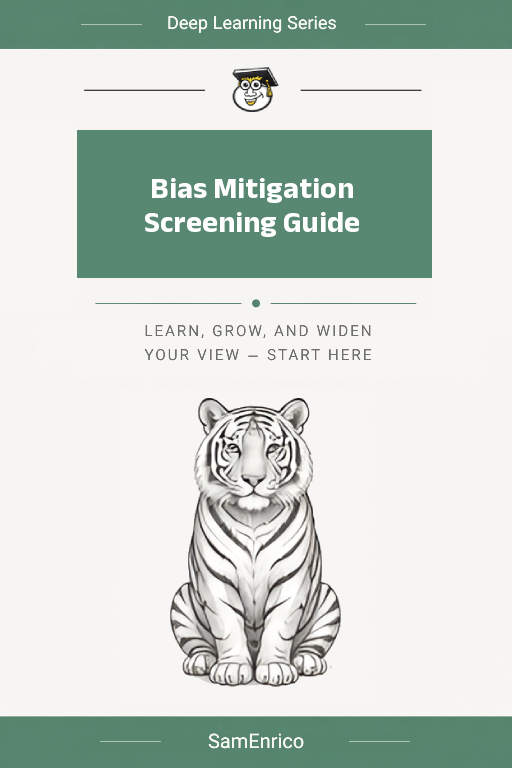
Non-FictionAI OperatorFair Hiring
Bias Mitigation Screening Guide eBook
Blind AI screening that removes names, photos, and
Blind AI screening that removes names, photos, and address data, then flags demographic skew in your shortlists to promote equitable hiring.
Formats
Free sample
Chapter 1: The Eight-Second Glitch--The average hiring manager spends less time reviewing a resume than it takes to brew a cup of coffee. Eight seconds. That is the median glance a human being devotes to a document that represents years of education, decades of experience, and the full professional identity of another person. In those eight seconds, the brain is not engaged in careful analysis or rational deliberation. It is pattern-matching, shortcut-taking, and stereotype-activating at speeds that the conscious mind cannot track.This chapter is not about blaming recruiters.
It is not about calling out bad actors or accusing well-intentioned professionals of malice. The argument here is far more uncomfortable and far more useful: good people running good-faith hiring processes produce biased outcomes because the human brain was not designed for fairness. It was designed for speed. And speed, in the context of evaluating another human being, is the enemy of equity.We begin with the neurobiology of the eight-second glance, move through the paradox of well-intentioned screeners, and end with a practical intervention that any organization can implement tomorrow morning. But before we get to the solution, we must sit with the problem long enough to feel its weight.
Because if you do not believe that you are biased, you will never bother to build systems that protect you from yourself.The Dirty Data Environment of Traditional Resume Review Imagine a recruiter named Sarah. She has forty-seven resumes to review before her 2:00 PM meeting. She has been doing this for six hours straight. Her coffee is cold. Her inbox just pinged with an urgent request from the CFO.
And she is genuinely committed to diversity—she attended the unconscious bias training last quarter, took notes, and believes in the mission.Sarah opens the first resume. Within half a second, her brain has registered the name at the top. Within two seconds, she has noted the university. Within five seconds, she has scanned the last job title. By the time she reaches eight seconds, she has already formed a "gut feeling" about whether this person moves forward.
She will spend the next thirty seconds justifying that gut feeling by selectively looking for evidence that supports it.This is not a failure of character. This is a failure of environment. The traditional resume is what cognitive scientists call a "dirty data environment"—a document cluttered with irrelevant demographic signals that trigger automatic associations. Every piece of information on a resume is not created equal. Some of it predicts job performance.
Most of it does not. But the brain cannot tell the difference when it is moving at eight-second speed.The dirty data problem manifests in three specific ways. First, demographic proxy signals—names, addresses, graduation years, extracurricular activities—activate unconscious stereotypes before any substantive skill is evaluated. A name that sounds African American, for example, triggers a cascade of associations that have nothing to do with accounting proficiency or software engineering ability. Second, formatting and style cues—unusual fonts, non-traditional job titles, gaps in employment—are interpreted as signals of quality or lack thereof, even though they have zero correlation with actual competence.
Third, emotional resonance—a resume that reminds Sarah of her favorite former colleague, or her nephew, or the person who sits next to her on the train—produces an unconscious preference that she will mistake for objective judgment.The dirty data environment is not a bug in the hiring process. It is a feature of how human perception works. But it is a feature that systematically produces worse outcomes for candidates from underrepresented groups, and systematically produces worse hires for organizations that rely on it.The "Good People/Bad Systems" Paradox One of the most replicated findings in the social sciences is that implicit bias predicts behavior even when explicit bias is absent. That is, people who genuinely believe in equality and would never consciously discriminate still exhibit discriminatory patterns in their decisions under time pressure and cognitive load. This is the "good people/bad systems" paradox, and it is the single most important concept to understand before attempting to fix hiring.Let us be precise about what this paradox means and what it does not mean.
It does not mean that all recruiters are secretly prejudiced. It does not mean that unconscious bias training is useless (though much of it is poorly designed). It does mean that the structure of the screening task—fast, repetitive, cognitively demanding, and information-dense—activates mental shortcuts that bypass conscious values. You can hold egalitarian beliefs at the level of your stated principles while your automatic brain patterns produce inegalitarian outcomes at the level of your daily decisions.Consider a classic study from the field of behavioral economics. Researchers presented identical resumes to experienced hiring managers, varying only the name at the top.
Resumes with white-sounding names received 50 percent more callbacks than identical resumes with Black-sounding names. The managers who made these decisions were not racists. They were busy people trying to do a difficult job with limited time. Their brains took a shortcut: "familiar name equals safer bet." That shortcut produced discrimination.The same pattern appears for gender. Resumes with female names are rated as less competent for male-dominated jobs, even when the content is identical.
Resumes with male names are rated as less competent for female-dominated jobs. The evaluators are not consciously deciding to penalize women or men. They are pattern-matching on associations they did not choose and may not endorse.The good people/bad systems paradox has a crucial implication for hiring: you cannot train your way out of bias. Training can raise awareness. Training can motivate effort.
But training cannot override the basic architecture of human cognition under realistic working conditions. When a recruiter has forty-seven resumes to review before 2:00 PM, the training module they watched six months ago is not going to be the thing that guides their thumb. The eight-second pattern-match will be the thing that guides their thumb.This is not a counsel of despair. It is a counsel of humility. Once you accept that your brain is not the fair-minded instrument you believed it to be, you can stop trying to be a better person and start building a better system.Why Traditional Bias Training Fails at Scale Organizations in the United States spend approximately eight billion dollars annually on diversity training.
The vast majority of that training is ineffective. Some of it is counterproductive. Meta-analyses of workplace diversity training programs find that one-shot, awareness-based interventions produce no measurable change in hiring outcomes and, in some cases, increase backlash and resentment.Why does training fail? The reasons are multiple and interconnected, but they cluster around three core failures.First, training misdiagnoses the problem as a knowledge deficit. The implicit assumption behind most bias training is that people discriminate because they do not know better.
Teach them about bias, the logic goes, and they will stop being biased. This is demonstrably false. Knowing about the confirmation bias does not prevent you from engaging in the confirmation bias. Knowing about the halo effect does not stop you from being influenced by the halo effect. Awareness is necessary but not sufficient for behavior change, and in the context…
This is the end of the free sample. Get the eBook to keep going. Buy now
About this book
Details
- Author
- Clifford Danelle
- Publisher
- SamEnrico
- Language
- English
- Genre
- Non-Fiction, AI Operator, Fair Hiring
- Released
- 2026-06-01
- Pages (approx.)
- 158
- Available as
- eBook, Audiobook

Read better in the ZLOADR app
Your eBooks on your phone or tablet. Sign in with your SamEnrico account and start reading.
More by Clifford Danelle
 Diamond Heist Escape Car DiscoveryClifford Danelle$11.99
 Cognitive Function HGH GuideClifford Danelle$11.99
 Imposter Syndrome Work GuideClifford Danelle$11.99
 Bipolar Exercise Prescription GuideClifford Danelle$11.99
 Cocktail Party Name RecallClifford Danelle$11.99
 Retirement Assets and HSAClifford Danelle$11.99
 Receiving Criticism Without DefensivenessClifford Danelle$11.99Receiving Criticism Without DefensivenessClifford Danelle$11.99
 Period Disc GuideClifford Danelle$11.99
 Kashmir Militant CaptureClifford Danelle$11.99
 The Silent Revolution: How a Native American Healer and a Spanish Physician Unlocked the Secrets of BoneClifford Danelle$11.99
 The Oslo Accords: Secrets Behind the HandshakeClifford Danelle$11.99
You may also like
 Hong Kong Handover 1997Dunn Johnnie$11.99
 Zumba For Postnatal Recovery CourseNeal Christian$11.99
 Zumba for BeginnersLadner Nikia$11.99
 YouTube Comment Mining GuideHumes Pandora$12.99
 Worry Box MeditationCarlin Rudy$11.99
 Workplace Stress MeditationNguyen Lynn$11.99
 Workplace Stress and Sleep RepairHawley Ivory$11.99
 Workplace Perfectionism CureDelaney Jeffry$11.99
 Workplace Injustice Anger GuideWallen Isabelle$11.99
 Work Addiction and Burnout LinkGreenwood Ester$11.99
 Women in Yoga and WellnessBeattie Galina$11.99
 Women in Stand Up ComedyChun Evangeline$11.99