
Non-FictionSelf-HelpGuided Imagery
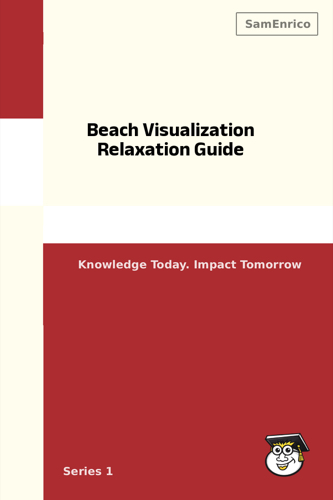
Beach Visualization Relaxation Guide eBook
Imagine warm sand, gentle waves, and seabirds to r
by Lantz Hanna
Imagine warm sand, gentle waves, and seabirds to release tension and calm your nervous system.
Formats
Free sample
Chapter 1: The Blueprint of Calm--–- You are about to discover something your smartphone cannot give you, your vacation days cannot hurry toward you, and your medication—however helpful—cannot teach your nervous system to do on its own. You are about to learn how to build a beach inside your mind, and that beach will become one of the most reliable tools you will ever own.The invitation sounds strange, doesn't it? Build a beach inside your mind. But here is the truth that neuroscientists have been confirming over the past twenty years: your brain cannot fully distinguish between a real experience and a vividly imagined one. When you close your eyes and truly feel warm sand beneath your feet, your somatosensory cortex lights up as if you were actually standing on a shoreline.
When you hear the imagined rhythm of waves, your auditory cortex responds. When you smell salt air in your imagination, your olfactory bulbs send signals directly to your amygdala and hippocampus—the very centers of emotion and memory.This is not New Age wishfulness. This is neurobiology.And it is the foundation of everything you will learn in this book.The Problem Your Nervous System Cannot Ignore Before we walk onto that imaginary beach together, we need to understand what you are carrying right now. Not in your hands—in your body.Close your eyes for just three seconds. Notice the default tension in your jaw.
Feel your shoulders. Is there a slight upward creep toward your ears? Now notice your breathing. Is it shallow, centered high in your chest? Does your exhale feel shorter than your inhale?Open your eyes.What you just experienced is the resting state of the modern stressed nervous system.
It is not your fault. Your body was designed to react to physical threats—a predator, a fall, a sudden danger—with a burst of cortisol and adrenaline, then return to calm. But the modern world presents thousands of non-physical threats: emails from your boss, news alerts, unpaid bills, social comparisons, traffic, deadlines, and the low-grade hum of "not enough time."Your nervous system cannot tell the difference between a lion charging at you and a notification buzzing on your nightstand at 11:00 PM. It responds to both with the same cascade of stress hormones. And unlike our ancestors, who either outran the lion or died trying, you never get the resolution.
The notifications never stop. The threats never fully disappear.So your nervous system does the only thing it can: it stays on. Not full fight-or-flight—that would exhaust you in hours. But a chronic, low-grade alertness. Your jaw stays slightly clenched.
Your shoulders stay slightly raised. Your breathing stays slightly shallow. Your peripheral vision narrows. Your digestive system slows. Your immune system suppresses.This is called allostatic load, and it is the single greatest contributor to insomnia, anxiety, digestive disorders, chronic pain, high blood pressure, and burnout.You did not cause this alone.
But you can interrupt it. And that interruption begins with a beach that exists only in your mind.Why the Beach? The Neuroscience of Blue Space In environmental psychology, researchers use a term you will hear throughout this book: blue space. Natural environments dominated by water—oceans, lakes, rivers, even fountains—have been shown to reduce cortisol, lower heart rate, and improve mood more consistently than green space (forests, parks, fields). There are several reasons for this.First, the color blue itself has a measurable calming effect on the human nervous system.
Studies using functional magnetic resonance imaging (f MRI) show that viewing blue light reduces activity in the amygdala, the brain's fear and threat detection center. Your brain interprets blue as safety, perhaps because for millions of years, blue skies and clean water meant the absence of immediate danger.Second, the rhythm of waves is nearly identical to the rhythm of human breathing at rest. A typical wave cycle—crash, hiss, pause, crash—lasts five to seven seconds. A typical resting breath cycle (inhale, exhale, pause) lasts five to seven seconds. Your brain loves patterns it recognizes.
When you hear waves, your brain unconsciously thinks: "That rhythm is familiar. That rhythm is safe. I will match it."Third, the beach engages all five senses simultaneously. Most relaxation techniques ask you to focus on one thing: your breath, a mantra, a single image. But the beach offers sand (touch), waves (hearing), salt air (smell), horizon (sight), and sometimes even the taste of sea spray.
A multi-sensory experience is harder for your anxious mind to ignore. It fills your attentional bandwidth completely, leaving less room for rumination, worry, and intrusive thoughts.But here is the most important finding, and the one that transforms this book from a pleasant collection of beach memories into a clinical tool: you do not need to be at the beach to get these benefits.Mental Imagery Is Not Pretending Many people hear "visualization" and think of something frivolous—daydreaming, wishful thinking, or the kind of positive affirmations that feel silly when you are genuinely stressed. That is not what this book teaches.Mental imagery, as studied in cognitive neuroscience, is the deliberate, structured, and repeatable process of creating sensory experiences in the absence of external stimuli. When you imagine the feeling of warm sand, your primary somatosensory cortex activates. When you imagine the sound of waves, your primary auditory cortex activates.
When you imagine the smell of salt air, your olfactory cortex and limbic system activate.These are not weaker versions of real experiences. In many cases, imagined sensory experiences create stronger emotional responses than real ones because your brain fills in the gaps with idealized or concentrated sensations. A real beach might have cold wind, sharp shells, noisy crowds, or jellyfish. Your imagined beach can be perfect—exactly what your nervous system needs in that moment.This is not escapism. Escapism avoids reality.
This is training. You are teaching your nervous system to down-regulate on command. You are building a neural pathway that says: "When I close my eyes and recall the beach, my parasympathetic nervous system activates." With enough repetition, that pathway becomes automatic. You will not need to complete a full twelve-minute visualization to calm down. You will simply think the word "beach" or feel your feet on any warm surface, and your body will begin to relax.That is the goal of this book.
Not to give you twelve pleasant exercises. To rewire your nervous system.How to Use This Book (Essential Reading)Before you go any further, read this section carefully. It will save you confusion and help you get the most from every chapter.Each chapter is standalone. Do not read this book sequentially in one sitting. Each chapter contains a complete visualization designed for a specific need, body position, and time of day.
Chapter 2 asks you to stand or walk slowly. Chapter 3 asks you to lie down. Chapter 4 asks you to sit. Chapter 9 asks you to imagine floating. Choose the chapter that matches your current setting and need.
You are not expected to do all twelve in order.Eyes closed for nearly everything. For all chapters except Chapter 5 (The Horizon Gaze), you will close your…
This is the end of the free sample. Get the eBook to keep going. Buy now
About this book
Details
- Author
- Lantz Hanna
- Publisher
- SamEnrico
- Language
- English
- Genre
- Non-Fiction, Self-Help, Guided Imagery
- Released
- 2026-06-09
- Pages (approx.)
- 143
- Available as
- eBook, Audiobook

Read better in the ZLOADR app
Your eBooks on your phone or tablet. Sign in with your SamEnrico account and start reading.
More by Lantz Hanna
 Military Deployment Return GuideLantz Hanna$11.99
 Dashcam Calm EffectLantz Hanna$11.99
 PCOS Supplement Stack GuideLantz Hanna$11.99
 The Niels Bohr Quantum JourneyLantz Hanna$11.99
 The Silk Road's Digital Phoenix: How a 19th-Century Merchant Built the First Global Tech EmpireLantz Hanna$11.99
 How to Start a Church of Scotland Business (Beginners Guide)Lantz Hanna$11.99
 French Language Graduate BonusLantz Hanna$12.99
 Chubb SWOT GuideLantz Hanna$12.99
 Understanding Ossicular Malformations, FamilialLantz Hanna$17.99
 Sales Enablement CoordinatorLantz Hanna$11.99
You may also like
 Hong Kong Handover 1997Dunn Johnnie$11.99
 Zumba For Postnatal Recovery CourseNeal Christian$11.99
 Zumba for BeginnersLadner Nikia$11.99
 YouTube Comment Mining GuideHumes Pandora$12.99
 Worry Box MeditationCarlin Rudy$11.99
 Workplace Stress MeditationNguyen Lynn$11.99
 Workplace Stress and Sleep RepairHawley Ivory$11.99
 Workplace Perfectionism CureDelaney Jeffry$11.99
 Workplace Injustice Anger GuideWallen Isabelle$11.99
 Work Addiction and Burnout LinkGreenwood Ester$11.99
 Women in Yoga and WellnessBeattie Galina$11.99
 Women in Stand Up ComedyChun Evangeline$11.99