
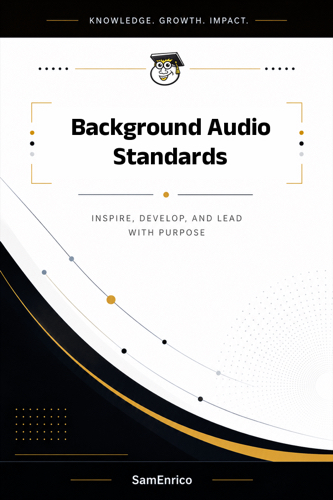
Non-FictionSelf-HelpSound Design
Background Audio Standards Audiobook
Selects and mixes music, nature sounds, and silenc
Selects and mixes music, nature sounds, and silence for hypnotic recordings.
Formats
Free sample
Chapter 1: The Entrainment Engine...--–- The first time I watched someone slip into trance because of a sound I had engineered, I wasn't playing a complex melody or a layered symphony of binaural beats. I was playing a single, repeating note on a cracked, detuned Casio keyboard, recorded onto cassette tape, then digitized through a broken preamp that added a 2d B bump at 63Hz. The listener—a self-described insomniac who had "tried everything"—was asleep within eleven minutes. Not dozing. Not resting.
Asleep in the electrophysiological sense: theta waves dominant, heart rate dropped by eighteen percent, and a small smile on her face that her husband later said he hadn't seen in years. That was the moment I stopped believing in "relaxation music" and started reverse-engineering what actually works. This chapter is what I found.The Paradox of the Loop Every beginner makes the same mistake. They assume that hypnotic audio needs to be complex, evolving, interesting. They layer five pads, three nature tracks, a binaural beat generator, and a whispered affirmation track.
The result is a dense, exhausting audio assault that keeps the listener's brain hypervigilant, scanning for threats, unable to surrender. The unconscious mind does not want to be entertained. It wants to be bored into submission.Repetition is the most misunderstood tool in the hypnotic producer's arsenal. In pop music, repetition is a crutch—a way to make a chorus stick in the listener's head. In hypnotic audio, repetition is the entire mechanism.
The brain's electrical rhythms—specifically theta waves at 4–8 Hz and delta waves at 0.5–4 Hz—naturally synchronize with external rhythmic stimuli through a phenomenon called frequency following response. This is not metaphor. This is measurable neurophysiology. When you present the brain with a regular, repeating stimulus at approximately 4 Hz (four events per second), the brain's dominant oscillatory frequency will shift toward 4 Hz within three to five minutes. This is entrainment.But here is where almost everyone gets it wrong.
The stimulus does not need to be a "beat" in the musical sense. It can be a repeating texture, a pulsing pad, a rhythmic crackle, or even the predictable rise and fall of a filtered noise sweep. The brain will entrain to any temporally regular stimulus, regardless of whether you would call it "music." In fact, the less it sounds like music, the faster entrainment occurs, because the brain does not waste cognitive resources…
This is the end of the free sample. Get the Audiobook to keep going. Buy now
About this book
Details
- Author
- Sellers Selena
- Publisher
- SamEnrico
- Language
- English
- Genre
- Non-Fiction, Self-Help, Sound Design
- Released
- 2026-06-07
- Pages (approx.)
- 132
- Available as
- eBook, Audiobook

Listen in the VoxFlicks app
Audiobooks and audio dramas wherever you go. Sign in with your SamEnrico account and press play.
More by Sellers Selena
 The Interruption Bouncer TechniqueSellers Selena$11.99
 Technology Dividend Stocks GuideSellers Selena$11.99
 Methamphetamine NeurotoxicitySellers Selena$11.99
 Goal Hierarchy MethodSellers Selena$11.99
 Procrastination Recovery After SlipSellers Selena$11.99
 Burnout Recovery Music TherapySellers Selena$11.99
 Grief and Fundraising After Child LossSellers Selena$11.99
 Héctor Núñez: The Unstoppable Marathoner Who Defied War and DistanceSellers Selena$11.99
 The Beat of the East: How Tarek Abou El Naga Shaped Arab Pop MusicSellers Selena$11.99
 Growing AethionemaSellers Selena$11.99
 How to Produce Medical BeddingSellers Selena$11.99
 Workers Comp Legal GuideSellers Selena$12.99
You may also like
 Hong Kong Handover 1997Dunn Johnnie$11.99
 Zumba For Postnatal Recovery CourseNeal Christian$11.99
 Zumba for BeginnersLadner Nikia$11.99
 YouTube Comment Mining GuideHumes Pandora$12.99
 Worry Box MeditationCarlin Rudy$11.99
 Workplace Stress MeditationNguyen Lynn$11.99
 Workplace Stress and Sleep RepairHawley Ivory$11.99
 Workplace Perfectionism CureDelaney Jeffry$11.99
 Workplace Injustice Anger GuideWallen Isabelle$11.99
 Work Addiction and Burnout LinkGreenwood Ester$11.99
 Women in Yoga and WellnessBeattie Galina$11.99
 Women in Stand Up ComedyChun Evangeline$11.99