
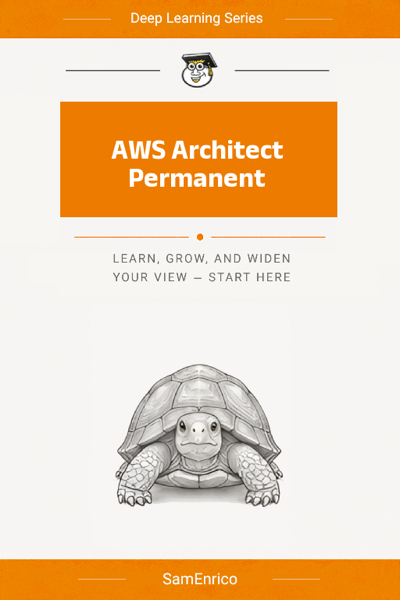
Non-FictionInformativeEducational
AWS Architect Permanent eBook
A Coursebook on AWS Architect Permanent
by Hutto Ariel
A Coursebook on AWS Architect Permanent
Formats
Free sample
Chapter 1: The $47,000 Mistake...--–- The first time I saw a six-figure AWS bill for a workload that should have cost three hundred dollars, I was sitting in a cramped conference room with a CTO who had stopped blinking. His company had passed the AWS Solutions Architect Associate exam six months earlier—one of their engineers, bright, certified, and well-intentioned. That engineer had built what everyone thought was a perfectly reasonable architecture. A single Auto Scaling group, a load balancer, some EC2 instances running a containerized web app. Nothing fancy.
Nothing that screamed danger. And yet, when the bill arrived, it showed forty-seven thousand dollars for a single month. Forty-seven thousand. For an application that served maybe two thousand daily active users.The CTO slid the PDF across the table. "Tell me where we went wrong," he said.
"And tell me how to make sure it never happens again."I opened the bill and started tracing the charges. The pattern was immediately recognizable—not because it was unusual, but because I had seen its cousins a dozen times before. The engineer had configured the Auto Scaling group with a minimum of ten instances instead of one. Not out of malice, not out of incompetence, but because the default setting in the console had changed after a UI update, and he had clicked through without noticing. Ten instances ran for three full weeks before anyone looked at the bill.
Each instance was an m5.large—reasonable for the workload—but ten of them running 24/7 added up fast. Then there were the unattached EBS volumes, left over from terminated instances, each costing a few dollars a month. There were dozens of them. Then there was the NAT Gateway charging per gigabyte of data processed, even though most of the traffic never needed to leave the private subnet. Then there was the S3 bucket with versioning enabled but no lifecycle policy, storing every single version of every single file going back two years.The engineer had passed his certification.
He knew what Auto Scaling was. He knew what EBS was. He knew what a NAT Gateway did. What he didn't know—what no certification exam had ever asked him—was how to think permanently about architecture. He had learned to pass a test, not to build a system that could survive its own maintenance.This book exists because of that engineer, and because of every architect I have watched make the same category of mistake over the past decade.
The mistake is never about lacking knowledge. It is always about lacking a framework for permanent decision-making.The Anatomy of a Tactical Thinker Before we can become permanent architects, we have to understand what we are unlearning. Tactical thinking is not stupidity. It is not laziness. Tactical thinking is, in fact, extremely efficient—in the short term.
The tactical architect asks: Does this work right now? Can I launch it today? Will it pass the test? These are not bad questions. They are simply incomplete questions.Let me give you a concrete example.
A tactical architect needs to store user-uploaded images for a new feature. They create an S3 bucket, make it public (because that is the easiest way to serve the images), and write a quick Lambda function to resize images on upload. The feature works. The demo goes well. The tactical architect moves on to the next task.Six months later, someone discovers that the S3 bucket has been serving pornographic images inserted by a bot that found the public write endpoint.
The company's brand is damaged. The security team is furious. The tactical architect, if they are still employed, learns a painful lesson about public S3 buckets.The permanent architect, facing the same requirement, asks five different questions before writing a single line of code:What happens when someone accidentally deletes an image? (Versioning)What happens when the upload rate spikes 100x? (Throttling, queueing)What happens when a security vulnerability is discovered in the image processing library?
(Immutable infrastructure, canary deployments)What happens when the person who set this up leaves the company? (Documentation, infrastructure as code)What happens when the compliance team asks for a report on who accessed each image? (Cloud Trail, access logging)None of these questions are about whether the feature works today. They are all about whether the feature will continue to work—safely, reliably, and without surprise—for months and years into the future.The difference between a tactical architect and a permanent architect is not experience. I have met engineers with twenty years of experience who still think tactically.
They have simply gotten very good at fixing the same problems over and over again. The difference is mindset. The permanent architect treats every decision as an investment in future stability. The tactical architect treats every decision as a task to be checked off.The Permanent Decision Matrix Throughout this book, we will return to a single mental model: the Permanent Decision Matrix. It is simple enough to fit on a sticky note but powerful enough to guide architecture reviews for multi-million-dollar systems.The matrix has two axes:Adaptability – How easily can this choice be changed later?
If we pick the wrong instance family, can we swap it without downtime? If we pick the wrong database, can we migrate without corrupting data? High adaptability means low regret if you are wrong.Foundational Stability – How likely is this choice to remain a best practice for the next three to five years? Using a Graviton processor? High stability—AWS is doubling down on ARM.
Using a t2.micro instance in 2026? Low stability—that family has been superseded twice already.Every architectural choice lands somewhere on this matrix. The goal is to make decisions that are high on both axes when possible, and to recognize when you are trading off one for the other.Consider the S3 bucket example. Making the bucket public gives you high adaptability (you can change it later) but very low foundational stability (public buckets are increasingly considered security anti-patterns). Using Cloud Front with an origin access identity gives you moderate adaptability (you can add more distributions later) and high stability (this pattern has been a best practice for years).
The permanent architect chooses the second option not because it is more difficult, but because it survives the Ten-Year Tuesday test.The Ten-Year Tuesday test is the second mental model we will use throughout this book. It asks a single question: If I get hit by a bus next Tuesday, can someone with only this book and access to the AWS console maintain this system for ten years?That question forces you to evaluate every decision through the eyes of a future stranger. Could they understand why you chose that VPC CIDR block? Could they safely modify that IAM policy without breaking everything? Could they recover that database from backup without calling a psychic?
The Ten-Year Tuesday test is brutal. It will make you write documentation you did not want to write. It will make you choose simpler solutions over clever ones. It will make you a permanent architect.The Shared Responsibility Model (As a Who-Gets-Fired Matrix)Let us start with a concept that every AWS…
This is the end of the free sample. Get the eBook to keep going. Buy now
About this book
Details
- Author
- Hutto Ariel
- Publisher
- SamEnrico
- Language
- English
- Genre
- Non-Fiction, Informative, Educational
- Released
- 2026-05-04
- Pages (approx.)
- 141
- Available as
- eBook, Audiobook

Read better in the ZLOADR app
Your eBooks on your phone or tablet. Sign in with your SamEnrico account and start reading.
More by Hutto Ariel
 Stress And Type 2 DiabetesHutto Ariel$11.99
 Pakistan Consumer GuideHutto Ariel$11.99
 Loci for Student SuccessHutto Ariel$11.99
 Sexual Trauma Trigger RecoveryHutto Ariel$11.99
 Influence for Healthcare ProvidersHutto Ariel$11.99
 The Great Emoji War: How a Tiny Symbol Sparked a Global DebateHutto Ariel$11.99
 Understanding PachydermoperiostosisHutto Ariel$17.99
 Lead Generation First CampaignHutto Ariel$12.99
 David Solomon InsightsHutto Ariel$12.99
 How to Start a Abaca and other Vegetable Textile Fibre Growing Business (Beginners Guide)Hutto Ariel$11.99
You may also like
 Hong Kong Handover 1997Dunn Johnnie$11.99
 Zumba For Postnatal Recovery CourseNeal Christian$11.99
 Zumba for BeginnersLadner Nikia$11.99
 YouTube Comment Mining GuideHumes Pandora$12.99
 Worry Box MeditationCarlin Rudy$11.99
 Workplace Stress MeditationNguyen Lynn$11.99
 Workplace Stress and Sleep RepairHawley Ivory$11.99
 Workplace Perfectionism CureDelaney Jeffry$11.99
 Workplace Injustice Anger GuideWallen Isabelle$11.99
 Work Addiction and Burnout LinkGreenwood Ester$11.99
 Women in Yoga and WellnessBeattie Galina$11.99
 Women in Stand Up ComedyChun Evangeline$11.99