
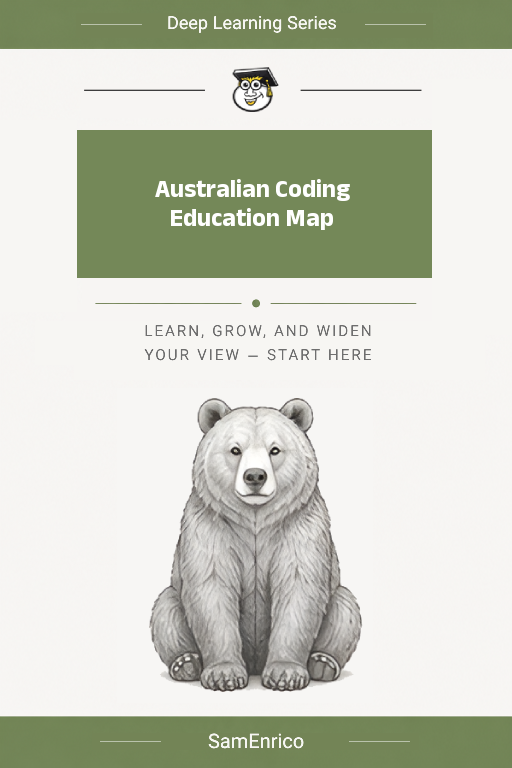
Non-FictionStudent's ShortcutAustralian Careers
Australian Coding Education Map eBook
Navigate bootcamp recognition in Sydney, Melbourne
by Ojeda Niki
Navigate bootcamp recognition in Sydney, Melbourne, and Brisbane versus respected CS degrees from Go8 universities for local hiring.
Formats
Free sample
Chapter 1: The $220k Question--–- Jasmine, nineteen years old, sat in her childhood bedroom in Western Sydney with two acceptance letters spread across her desk. One was from UNSW’s prestigious computer science program – a three-year journey with an estimated price tag of 80,000in HECSdebt,notcountingthefourhoursofdailycommutingorthe80,000 in HECS debt, not counting the four hours of daily commuting or the 80,000in HECSdebt,notcountingthefourhoursofdailycommutingorthe45,000 in foregone wages she could have earned working full-time. The other was from a twelve-week coding bootcamp in Surry Hills, costing $15,000, promising a job within six months, and backed by a money-back guarantee. Her parents, both non-tech immigrants who had sacrificed everything for her education, couldn’t understand why this was even a question. “University is the dream,” her mother said.
“We didn’t come here for you to skip university.”–- Jasmine’s story is not unique. Across Sydney, Melbourne, and Brisbane, thousands of prospective students are frozen at the same crossroads. Behind them is the gravitational pull of tradition – the Go8 or Group of Eight universities, sandstone institutions that have defined Australian excellence for over a century. Ahead of them is the chaotic, exhilarating, and deeply uncertain world of coding bootcamps, TAFE pathways, and micro-credentials – options that barely existed a decade ago. And in the middle is a job market that has fundamentally changed while the education system has barely noticed.–- This book exists because the old maps are broken.
The conventional wisdom that a university degree is the only safe path to a middle-class life – a wisdom drilled into Australian high school students by parents, teachers, and career advisers – has collided with three irreversible shifts in the economy. First, the technology sector is growing at 12–16 percent annually according to Jobs and Skills Australia, adding tens of thousands of roles that did not exist five years ago. Second, the cost of a Go8 degree has ballooned to nearly a quarter of a million dollars when you include living expenses and opportunity cost – a number that would have been unthinkable to the generation that paid $2,000 annual HECS fees in the 1990s. Third, and most disruptive of all, employers have quietly but decisively moved toward skills-based hiring, with 90 percent of Australian companies that have adopted capability-first models reporting better retention and faster time-to-productivity than their degree-obsessed competitors.–- Yet the myth of the degree as the golden ticket persists. It persists because universities have spent billions on branding.
It persists because parents remember a different economy. And it persists because hiring managers themselves – many of whom hold Go8 degrees – unconsciously favor candidates who mirror their own paths. This book is not an anti-degree screed. It is not a bootcamp advertisement disguised as journalism. It is a decision-making framework designed to answer one question with brutal honesty: given who you are, where you want to work, and what you can afford, what is the optimal educational pathway to a sustainable, high-income career in Australian tech?–- To answer that question, we must first understand the landscape.
And the landscape has four distinct regions, each with its own terrain, weather patterns, and survival strategies.The Four Vectors of Australian Tech Education–- Before we can make a decision, we need a map of the territory. The Australian coding education ecosystem has fractured into four competing pathways, each optimized for different outcomes, timelines, and types of learners. Understanding the strengths and weaknesses of each is the prerequisite for any intelligent choice.Vector One: The Go8 Computer Science Degree–- The Group of Eight – the University of Melbourne, Australian National University, University of Sydney, University of Queensland, UNSW Sydney, Monash University, University of Western Australia, and University of Adelaide – represents the top tier of Australian research universities. A computer science degree from any of these institutions costs between 45,000and45,000 and 45,000and80,000 in HECS debt for a domestic student, plus three to four years of foregone earnings. The true economic cost, factoring in living expenses and lost wages, is closer to $220,000 – a number that will make your parents wince and your accountant weep.–- What do you get for that investment?
You get depth. You get algorithms, discrete mathematics, operating systems, compilers, and the theoretical foundations that bootcamp graduates often lack. You get access to research labs, distinguished academics, and internship pipelines with companies like Google, Atlassian, and Canva. You get an alumni network that spans boardrooms and governments. And you get a credential that still, in certain corners of the economy – particularly banking, government, and traditional consulting – functions as a non-negotiable entry ticket.–- But you also get inefficiencies.
Many Go8 computer science programs are taught by academics whose last industry experience predates the i Phone. You will learn functional programming languages that no commercial employer uses. You will spend weeks on topics that have no bearing on your first job. And you will graduate with a distinction average but no idea how to deploy a web application, set up a CI/CD pipeline, or troubleshoot a production outage – skills that every employer actually needs.Vector Two: The Coding Bootcamp–- The bootcamp model emerged around 2011 in Silicon Valley and reached Australian shores around 2015. The value proposition is seductive in its simplicity: twelve to twenty-four weeks of immersive, project-based training in the modern web stack (Java Script, React, Node.js, Python, sometimes C# or Java), followed by job placement support, all for 10,000to10,000 to 10,000to25,000.
No prior experience required. No HECS debt. No three-year commitment.–- The best bootcamps deliver on this promise. They recognize that the first year of a junior developer’s career is about mastering a small number of high-leverage skills: version control with Git, building RESTful APIs, managing state in React, writing SQL queries, deploying to cloud platforms, and communicating effectively in a product team. These are teachable skills, and they can be taught in twelve weeks to a motivated learner.–- But the bootcamp model has sharp edges that marketing materials obscure.
The first is selection bias: bootcamps work best for career switchers who already possess the meta-skills of adult learning – discipline, time management, comfort with ambiguity – and who have existing professional networks to activate. An eighteen-year-old fresh out of high school is rarely a good fit. The second is the filter problem: many applicant tracking systems still scan for degree keywords, and a bootcamp certificate alone may never reach human eyes. The third is the ceiling problem: bootcamp graduates who lack algorithmic fundamentals often hit a “theory wall” at the five-to-ten-year mark, struggling to advance to senior, staff, or architect roles without significant self-study.Vector Three: TAFE and Vocational Education–- Technical and Further Education, or TAFE, is Australia’s most underrated tech pathway. For a fraction of the cost of a university degree – often 5,000to5,000 to 5,000to15,000 total, with government subsidies reducing that to near-zero for some students – TAFE offers diplomas and advanced diplomas in networking, cybersecurity, programming, and systems administration.
These programs emphasize hands-on, practical skills taught by industry practitioners, not academics.–- The hidden superpower of TAFE is the “earn while you learn” model. Because TAFE classes are often offered part-time, evenings, or online, many students work full-time or close to it while studying. A typical TAFE cybersecurity student might work as a…
This is the end of the free sample. Get the eBook to keep going. Buy now
About this book
Details
- Author
- Ojeda Niki
- Publisher
- SamEnrico
- Language
- English
- Genre
- Non-Fiction, Student's Shortcut, Australian Careers
- Released
- 2026-05-30
- Pages (approx.)
- 154
- Available as
- eBook, Audiobook

Read better in the ZLOADR app
Your eBooks on your phone or tablet. Sign in with your SamEnrico account and start reading.
More by Ojeda Niki
 Personal Ing For Success Value PropositionOjeda Niki$11.99
 Intuitive Eating Postpartum WorkbookOjeda Niki$11.99
 The AI Displacement Talent FlowOjeda Niki$11.99
 Acetaminophen Liver SafetyOjeda Niki$11.99
 The Layaway GraduateOjeda Niki$11.99
 The Forgotten Depths: The Medieval Cave Explorers of Southeast AsiaOjeda Niki$11.99
 How to Start a Private Security Business (Beginners Guide)Ojeda Niki$11.99
 FinCEN BOI Reporting GuideOjeda Niki$12.99
 Role-playing GamesOjeda Niki$11.99
 Understanding Biliary Malformation Renal Tubular InsufficiencyOjeda Niki$17.99
You may also like
 Hong Kong Handover 1997Dunn Johnnie$11.99
 Zumba For Postnatal Recovery CourseNeal Christian$11.99
 Zumba for BeginnersLadner Nikia$11.99
 YouTube Comment Mining GuideHumes Pandora$12.99
 Worry Box MeditationCarlin Rudy$11.99
 Workplace Stress MeditationNguyen Lynn$11.99
 Workplace Stress and Sleep RepairHawley Ivory$11.99
 Workplace Perfectionism CureDelaney Jeffry$11.99
 Workplace Injustice Anger GuideWallen Isabelle$11.99
 Work Addiction and Burnout LinkGreenwood Ester$11.99
 Women in Yoga and WellnessBeattie Galina$11.99
 Women in Stand Up ComedyChun Evangeline$11.99