
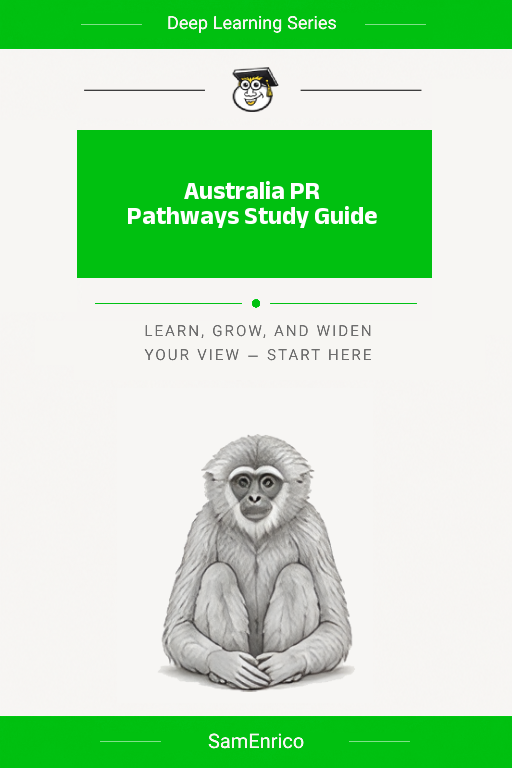
Non-FictionStudent's ShortcutSettlement Guide
Australia PR Pathways Study Guide eBook
Explains how international students can transition
Explains how international students can transition from study visa to permanent residence through skilled migration, employer sponsorship, and state nomination.
Formats
Free sample
Chapter 1: The Backwards Map--–- Every year, over 700,000 international students arrive in Australia with dreams of sunshine, world-class education, and the quiet hope of one day calling this country home. They pack their bags, kiss their families goodbye, and board flights with carefully printed offer letters and freshly granted student visas. What most of them do not pack is a strategy. They have chosen a university based on a glossy brochure, a course based on a friend’s recommendation, or a city based on Instagram reels. Three years later, seventy percent of them will board another flight—this time home—permanent residency denied, their degrees not enough to open the door they thought they were walking through.This book exists to ensure you are not one of them.The difference between the thirty percent who secure Australian permanent residency and the seventy percent who do not is not intelligence, hard work, or luck.
The difference is strategy. More specifically, the difference is knowing that your PR journey does not begin when you graduate. It begins the day you enrol.Most students choose their course based on passion, university reputation, cost, or location. They ask: What do I want to study? Where do I want to live?
Which university has the best campus? These are not bad questions. But they are the wrong first questions. The correct first question—the one that separates permanent residents from temporary visitors—is this:Which occupations lead to Australian permanent residency, and which course will get me there?This chapter teaches you how to reverse engineer your entire Australian journey. You will learn to start with the destination (permanent residency) and work backwards to the course, the university, the city, and the visa strategy.
By the end of this chapter, you will never look at a university prospectus the same way again.The Seventy Percent Lie Let us begin with a hard truth that no education agent will tell you and no university brochure will print.Approximately seventy percent of international students who come to Australia never obtain permanent residency. They complete their degrees, burn through their post-study work rights, and eventually return to their home countries—often with significant debt and a sense of failure.This is not because Australia does not want migrants. Australia takes approximately 160,000 to 190,000 permanent skilled migrants every year. The problem is that most international students do not realise that a degree does not equal a pathway. You can earn a Bachelor of Business, a Master of Marketing, or a Graduate Certificate in Management and discover that your occupation is not on any list that leads to PR.Here is the mechanism that determines everything:Australia uses three primary occupation lists to determine which skilled workers can apply for which visas.
Think of these lists as different colored tickets. Each ticket grants access to different rides (visas). Choose the wrong ticket, and the rides you want are simply not available to you.The Three Lists You Must Memorise The MLTSSL: The Gold Ticket The Medium and Long-term Strategic Skills List (MLTSSL) is the most valuable list in Australian migration. Occupations on this list are eligible for:Subclass 189 (Skilled Independent) – the visa with no strings attached Subclass 190 (Skilled Nominated) – state-sponsored permanent residency Subclass 491 (Skilled Work Regional) – provisional regional visa All employer-sponsored visas (482, 186, 494)If your occupation appears on the MLTSSL, every major PR pathway is open to you. This is where you want to be.Examples of MLTSSL occupations include: Registered Nurse, Software Engineer, Electrician, Chef (not Cook – we will get to that), Carpenter, Secondary School Teacher, Social Worker, Civil Engineer, and ICT Security Specialist.The STSOL: The Silver Ticket The Short-term Skilled Occupation List (STSOL) is more limited.
Occupations on this list are eligible for:Subclass 190 (but only if a state nominates you)Subclass 491Some employer-sponsored visas (but not the direct permanent 186)Crucially, STSOL occupations are not eligible for the Subclass 189 independent visa. You cannot apply on your own; you need a state or an employer to champion you.Examples of STSOL occupations include: Marketing Specialist, Hotel Manager, Cook (notice the distinction from Chef), Fitness Instructor, and Graphic Designer.The ROL: The Regional Ticket The Regional Occupation List (ROL) exists exclusively for the Subclass 491 (regional provisional) visa. If your occupation is only on the ROL, you cannot apply for any PR visa without living and working in a designated regional area for at least three years.Examples include: Agricultural Technician, Aquaculture Farmer, and some niche trades.The CSOL: The New Player The Core Skills Occupation List (CSOL) is a newer framework introduced as part of the Migration Strategy reforms. Do not confuse it with the MLTSSL. The CSOL is primarily for employer-sponsored visas (the new Skills in Demand visa, covered in Chapter 8).
It is not a replacement for the MLTSSL. Think of it as a parallel structure for workers with employer backing.Your first job: Before you enrol in any course, search for your intended occupation on the Australian Department of Home Affairs website. If it is not on the MLTSSL, ask yourself: Am I comfortable with a more limited pathway? If the answer is no, choose a different occupation.Qualification vs. Skilled Occupation: The Critical Distinction Here is where countless students make an irreversible mistake.You can complete a Bachelor of Commerce degree.
You can graduate with honours. You can receive your testamur in a leather folder at a formal graduation ceremony. None of that makes you an "Accountant" for migration purposes.A qualification is the piece of paper. A skilled occupation is a determination by an assessing authority that your specific subjects, work experience, and skills match the Australian standard for that occupation.To be assessed as an Accountant, for example, you must have completed specific core subjects: financial accounting, management accounting, taxation, audit, and business law. A general commerce degree without these subjects will fail the skills assessment (see Chapter 5 for the full skills assessment process).To be assessed as a Software Engineer, your degree must have a sufficient proportion of computer science and programming subjects.
A general IT degree with electives in project management and business analysis may not qualify.The rule is brutal but simple: The name of your degree matters less than its content. You must map your course subjects to the assessment criteria of the relevant authority before you enrol, not after you graduate.Trade vs. Higher Education: Two Different Worlds Many international students assume that a university degree is the only path to PR. This is false. Trade qualifications (Certificate III or IV, Diploma, Advanced Diploma) often lead to PR faster, with lower points, and with less competition than many professional degrees.The Trade Pathway Trade occupations on the MLTSSL include:Chef Electrician (General)Carpenter Joiner Plumber Automotive Electrician Welder (First Class)Bricklayer Cabinetmaker The trade pathway has three distinct advantages:Advantage One: Lower Points.
While an Accountant might need 95+ points for an invitation, a Chef or Carpenter might receive an invitation at 65–75 points. The points race is less brutal.Advantage Two: Genuine Shortage. Australia has chronic shortages in construction, hospitality, and automotive trades. These are not temporary gaps; they are structural deficits that both major political parties acknowledge.Advantage Three: Regional Demand.…
This is the end of the free sample. Get the eBook to keep going. Buy now
About this book
Details
- Author
- Crayton Jeanice
- Publisher
- SamEnrico
- Language
- English
- Genre
- Non-Fiction, Student's Shortcut, Settlement Guide
- Released
- 2026-06-01
- Pages (approx.)
- 138
- Available as
- eBook, Audiobook

Read better in the ZLOADR app
Your eBooks on your phone or tablet. Sign in with your SamEnrico account and start reading.
More by Crayton Jeanice
 Fear Of Failure In RelationshipsCrayton Jeanice$11.99
 Anchor Technique InductionCrayton Jeanice$11.99
 Rainbow Bridge VisualizationCrayton Jeanice$11.99
 Prep Center for Non US SellersCrayton Jeanice$11.99
 The Metta for Retirement TransitionCrayton Jeanice$11.99
 The Silk Road's Phantom Tycoon: The Rise and Fall of a 13th-Century Trade MogulCrayton Jeanice$11.99
 Insurance Sales AgentCrayton Jeanice$11.99
 Alibaba Trade Assurance vs Amazon A to ZCrayton Jeanice$12.99
 Understanding Renal Agenesis Meningomyelocele Mullerian DefectCrayton Jeanice$17.99
 How to Start a Bands Made of Rubber Business (Beginners Guide)Crayton Jeanice$11.99
You may also like
 Hong Kong Handover 1997Dunn Johnnie$11.99
 Zumba For Postnatal Recovery CourseNeal Christian$11.99
 Zumba for BeginnersLadner Nikia$11.99
 YouTube Comment Mining GuideHumes Pandora$12.99
 Worry Box MeditationCarlin Rudy$11.99
 Workplace Stress MeditationNguyen Lynn$11.99
 Workplace Stress and Sleep RepairHawley Ivory$11.99
 Workplace Perfectionism CureDelaney Jeffry$11.99
 Workplace Injustice Anger GuideWallen Isabelle$11.99
 Work Addiction and Burnout LinkGreenwood Ester$11.99
 Women in Yoga and WellnessBeattie Galina$11.99
 Women in Stand Up ComedyChun Evangeline$11.99