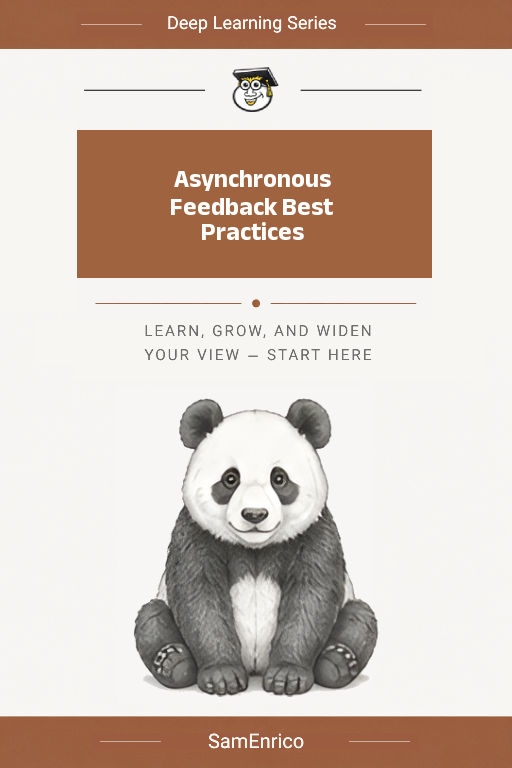
Asynchronous Feedback Best Practices Audiobook
Give effective written feedback for remote perform
Give effective written feedback for remote performance reviews across time zones using structured templates.
Formats
Free sample
Chapter 1: The Interruption Economy--–- The notification arrived at 11:47 PM. Maria, a senior backend engineer in Berlin, was brushing her teeth before bed. Her work phone buzzed on the bathroom counter. A Slack message from her new manager in San Francisco: “Hey Maria – quick question on the auth endpoint. Can you jump on a call?” Maria stared at the screen.
It was 2:47 PM in San Francisco. Her manager was fresh from lunch, energized, and probably hadn’t even considered what time it was in Berlin. If Maria responded now, she would work until 1 AM. If she ignored it until morning, her manager would wake up to a stale question, assume she was slow or unresponsive, and the “quick question” would metastasize into a 45-minute fire drill. She set the phone face-down and finished brushing her teeth.
But the knot in her stomach remained. This was not collaboration. This was a tax. And Maria was paying it with her sleep, her focus, and her growing resentment toward a job she once loved.This scene plays out thousands of times every hour across the global economy. It is the defining, unaddressed dysfunction of distributed work.
We have built magnificent tools for real-time communication – Slack, Teams, Zoom, Whats App – and then we have used those tools to destroy the very thing that makes remote work possible: deep, uninterrupted focus. We have created what this book calls The Interruption Economy – an invisible marketplace where managers trade their own anxiety for their employees‘ attention, where the currency is notifications, and where the ultimate price is paid in burnout, turnover, and quiet quitting.The most dangerous myth of modern management is the belief that the “quick chat” is harmless. It is not harmless. It is the single greatest productivity killer in the history of knowledge work. And until we recognize it for what it is – a tax, a trap, a failure of discipline – we will continue to wonder why our distributed teams feel exhausted, fractured, and unproductive even though everyone is “always working.”The Physics of Attention To understand why the quick chat is so destructive, we must first understand the physics of human attention.
The brain is not a computer. It does not run multiple programs simultaneously. When you switch from one task to another, you are not multitasking. You are task-switching – and task-switching carries a heavy metabolic cost.Groundbreaking research from the University of…
This is the end of the free sample. Get the Audiobook to keep going. Buy now
About this book
Details
- Author
- Varney Cecille
- Publisher
- SamEnrico
- Language
- English
- Genre
- Non-Fiction, Professional's Cheat Sheet, Feedback Guide
- Released
- 2026-05-30
- Pages (approx.)
- 143
- Available as
- eBook, Audiobook

Listen in the VoxFlicks app
Audiobooks and audio dramas wherever you go. Sign in with your SamEnrico account and press play.
More by Varney Cecille
 Fortnite Gaming Addiction GuideVarney Cecille$11.99
 Grain Phobia Rice Gradual TouchVarney Cecille$11.99
 Financial Ruin Suicide Attempt RecoveryVarney Cecille$11.99
 1031 Exchange into TICsVarney Cecille$11.99
 The Stress Diabetes Connection GuideVarney Cecille$11.99
 The Philosophers of the Nile: Guardians of Ancient WisdomVarney Cecille$11.99
 Mobile EngineerVarney Cecille$11.99
 Renewable Energy PPAs GuideVarney Cecille$12.99
 How to Become a Selvage-machine OperatorVarney Cecille$11.99
 Understanding Marfan-like Syndrome, Boileau TypeVarney Cecille$17.99