
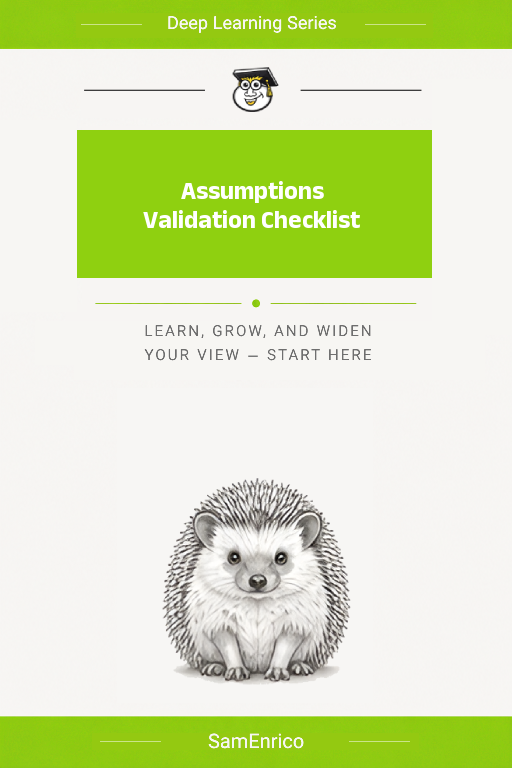
Non-FictionFirst 30 DaysAssumptions
Assumptions Validation Checklist eBook
List key business assumptions on your one-page pla
List key business assumptions on your one-page plan and track validation progress.
Formats
Free sample
Chapter 1: The Canvas Trap--Most entrepreneurs do not fail because they cannot build. They fail because they cannot stop believing.I have watched founders spend six months developing a food delivery app, $200,000 in development costs, and countless sleepless nights—only to discover on launch day that their target customers were perfectly happy calling the pizza place down the street. I have seen Saa S companies raise venture capital based on a slide deck filled with hockey-stick projections, hire a team of fifteen engineers, and then learn eighteen months later that the “urgent problem” they were solving was merely a mild inconvenience. And I have sat across from devastated founders who ask the same question: “But our research said people wanted this.”Here is the truth that venture capitalists, accelerators, and most business books will not tell you: research lies. Not intentionally.
Not maliciously. But surveys, focus groups, and friendly conversations produce answers designed to please you, not to predict behavior. The gap between what people say and what people do is where startups go to die. And the only way to bridge that gap is to stop treating your business plan as a set of facts and start treating it as a set of untested assumptions.This book is not about building a better business plan. It is about destroying the one you have.
Or rather, it is about transforming your business plan from a static document of beliefs into a dynamic checklist of hypotheses that you will systematically prove or disprove. The tool for that transformation is called the Assumptions Validation Checklist, and by the time you finish this chapter, you will understand why your current planning process is likely leading you toward a painful and expensive surprise.The 90 Percent Illusion Let us begin with a number that should terrify you: ninety percent of startups fail. According to research by Harvard Business School professor Shikhar Ghosh, 75 percent of venture-backed startups never return investor capital. If you include all registered startups, the failure rate climbs above 90 percent. The standard explanation for this statistic is execution—bad hires, poor product-market fit, running out of cash, or getting outcompeted.
But those are symptoms, not causes.The underlying cause is almost always the same: founders make critical assumptions about their business, treat those assumptions as facts, and invest time and money before testing them.Consider the anatomy of a typical startup failure. A founder has an idea. She believes customers have a problem. She believes her solution will solve it. She believes people will pay a certain price.
She believes she can reach them through Facebook ads or Salesforce or retail partnerships. She believes her costs will be manageable. She believes she can defend against competitors. She believes regulators will not intervene.Each of those beliefs is an assumption. None of them is a fact until tested.
But the founder writes them into a business plan, pitches investors, raises money, hires a team, and builds a product. Eighteen months later, she discovers that one of those assumptions was wrong. Often, it is a single lethal assumption—the one thing that, if false, makes the entire venture impossible. And because she never isolated and tested that assumption first, she wasted eighteen months and millions of dollars learning what she could have learned in two weeks with a $100 experiment.The food delivery startup I mentioned earlier is a real case. The founders assumed that young urban professionals wanted faster delivery than existing options.
They never tested that assumption. They simply built a logistics network, hired drivers, negotiated with restaurants, and launched. On day one, they discovered that their potential customers cared about price far more than speed, and that the existing pizza and Chinese delivery options were already “fast enough.” The startup folded within six months, having burned through 1.2million.Asimpletest—runningadsforafakedeliveryservicewithdifferentpriceandspeedclaims—wouldhaverevealedthetruthinunderaweekforlessthan1.2 million. A simple test—running ads for a fake delivery service with different price and speed claims—would have revealed the truth in under a week for less than 1.2million.Asimpletest—runningadsforafakedeliveryservicewithdifferentpriceandspeedclaims—wouldhaverevealedthetruthinunderaweekforlessthan500.That is the cost of untested assumptions: millions of dollars and years of life.Facts Versus Assumptions: The Critical Distinction Before we go further, we need to establish a vocabulary that will run through every chapter of this book. A fact is something you already know from direct measurement.
You have data. You have observed behavior. You have evidence that is verifiable and repeatable. An assumption is a belief that you hold without sufficient evidence. It might be true.
It might be false. You do not yet know.Here is the problem: entrepreneurs routinely mistake assumptions for facts. They say “our customers need this” when they have spoken to exactly three friends who said “sure, that sounds interesting.” They say “we can acquire customers for $10 each” when they have never run a single ad. They say “our technology is defensible” when any competent engineer could replicate it in a weekend.The human mind is wired to seek confirmation. Once we believe something, we look for evidence that supports it and ignore evidence that contradicts it.
Psychologists call this confirmation bias, and it is the single greatest threat to entrepreneurial success. Every founder suffers from it. The ones who succeed are the ones who build systems to counteract it.This book is that system.The Assumptions Validation Checklist is a structured process for listing every key assumption your business depends on, designing experiments to test those assumptions with minimal time and money, and tracking your progress as you move from belief to knowledge. By the end of this book, you will have transformed your business plan into a one-page dashboard of validated and invalidated claims. You will know exactly what you have proven, what you have disproven, and what you still need to test.
And you will have done so without building anything expensive first.But we must start with the canvas.The One-Page Assumptions Canvas Most business plans are works of fiction disguised as strategy. They are thirty-page documents filled with market size estimates, competitive analysis, and five-year financial projections—none of which have been tested. The more detailed the plan, the more likely it is to be wrong, because every additional detail is an additional untested assumption.The solution is not a longer plan. It is a shorter one.The One-Page Assumptions Canvas is a single-page planning tool that captures only the seven essential elements of your business. Every element represents a category of assumptions that you will test.
The canvas forces you to be concise, which forces you to be honest about what you truly believe versus what you actually know.Here are the seven elements:1. Problem – What specific pain or need do your target customers experience? Not a vague “they want to save time,” but a concrete, observable frustration. “Small business owners waste three hours per week manually reconciling bank statements” is a problem. “People want efficiency” is a feeling.2.
Solution – What will you build or offer to address that problem? Again, be specific. “A mobile app that automatically categorizes transactions and flags discrepancies” is a solution. “A platform” is a buzzword.3. Channel – How will you reach your target customers?
Which specific marketing and distribution methods will you use? “Linked In In Mail campaigns targeting controllers at companies with 50–200…
This is the end of the free sample. Get the eBook to keep going. Buy now
About this book
Details
- Author
- Huggins Annamaria
- Publisher
- SamEnrico
- Language
- English
- Genre
- Non-Fiction, First 30 Days, Assumptions
- Released
- 2026-05-30
- Pages (approx.)
- 157
- Available as
- eBook, Audiobook

Read better in the ZLOADR app
Your eBooks on your phone or tablet. Sign in with your SamEnrico account and start reading.
More by Huggins Annamaria
 Alpha Diversity InterpretationHuggins Annamaria$11.99
 Meditation for Sleep Apnea CopingHuggins Annamaria$11.99
 Eyes Closed Meditation TechniqueHuggins Annamaria$11.99
 Medical Worker Sleep AidHuggins Annamaria$11.99
 Moving Stress Couple GuideHuggins Annamaria$11.99
 CFA Formula Peg SystemHuggins Annamaria$11.99
 UAE Remote Tax GuideHuggins Annamaria$11.99
 Neuropathic Pain BooksHuggins Annamaria$11.99
 Bipolar Exercise Energy ManagementHuggins Annamaria$11.99
 Zero Day: The Hunt for Stuxnet's Shadow ArchitectsHuggins Annamaria$11.99
 The Underground Warriors: Europe's Forgotten MMA Pioneers (1950-1980)Huggins Annamaria$11.99
 The Ghost in the Machine: How a Hacker Almost Stole an ElectionHuggins Annamaria$11.99
You may also like
 Hong Kong Handover 1997Dunn Johnnie$11.99
 Zumba For Postnatal Recovery CourseNeal Christian$11.99
 Zumba for BeginnersLadner Nikia$11.99
 YouTube Comment Mining GuideHumes Pandora$12.99
 Worry Box MeditationCarlin Rudy$11.99
 Workplace Stress MeditationNguyen Lynn$11.99
 Workplace Stress and Sleep RepairHawley Ivory$11.99
 Workplace Perfectionism CureDelaney Jeffry$11.99
 Workplace Injustice Anger GuideWallen Isabelle$11.99
 Work Addiction and Burnout LinkGreenwood Ester$11.99
 Women in Yoga and WellnessBeattie Galina$11.99
 Women in Stand Up ComedyChun Evangeline$11.99