
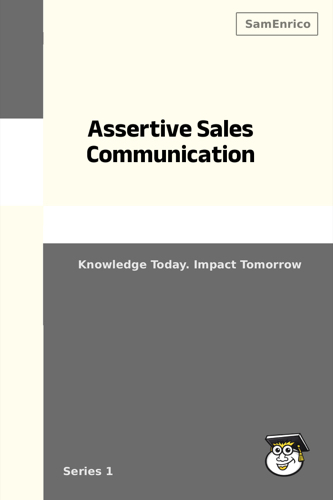
Assertive Sales Communication eBook
Close deals by respectfully persisting without pus
by Nance Linn
Close deals by respectfully persisting without pushing too hard.
Formats
Free sample
Chapter 1: The Ambivert Advantage--–- The man who sold more software than anyone in his company’s history never raised his voice. He never used a hard close. He never delivered an ultimatum. He was quiet, thoughtful, and spoke so slowly that junior reps often finished his sentences for him—incorrectly, every time. His name was David, and when new hires were introduced to him at company meetings, they invariably whispered to each other: “How is he the top performer?” The assumption, baked into decades of sales culture, was that great closers were loud, fast-talking, and aggressive.
David was none of those things. But he was also not shy. When he had something to say, he said it with a calm certainty that made buyers lean in. He listened more than he talked, but when he talked, he asked for the order. Every time.
He was neither the stereotypical extrovert nor the stereotypical introvert. He was something else entirely—something that sales training has largely ignored until very recently.This chapter introduces the single most important concept in assertive sales communication: the ambivert advantage. If you take nothing else from this book, understand this one truth: the most successful salespeople are neither aggressive extroverts nor passive introverts. They are ambiverts—people who naturally balance inquiry (asking questions, listening, observing) and advocacy (making statements, leading, closing). And here is the critical distinction that most sales books get wrong: not all introverts are created equal, and not all extroverts are doomed to fail.
The difference between winning and losing is not whether you are an introvert or an extrovert. The difference is whether you have learned to be assertive in your communication style, regardless of your natural temperament.Let us dismantle the myth that has dominated sales culture for half a century. The myth says that successful salespeople are extroverts—loud, gregarious, comfortable interrupting strangers, able to handle constant rejection without flinching. This myth has done incalculable damage. It has driven talented introverts out of sales careers they could have dominated.
It has encouraged extroverts to double down on behaviors that actually repel buyers. And it has created a generation of sales managers who mistake volume for velocity and activity for effectiveness.The research is unambiguous. Daniel Pink, in his groundbreaking book To Sell Is Human, analyzed data from decades of personality assessments and sales performance metrics. His finding upended conventional wisdom: extroverts do not outperform introverts in sales. In fact, they slightly underperform.
The reason is simple. Extroverts talk too much. They fill silence with chatter. They make assumptions instead of asking questions. They mistake their own enthusiasm for buyer interest.
And buyers have learned to recognize this. When a loud, fast-talking salesperson enters the room, the buyer’s defenses go up automatically. The extrovert’s energy, intended to build rapport, instead triggers resistance.But the opposite extreme is equally problematic. Passive introverts—those who listen well but never ask for the order—leave deals in limbo. They build relationships but fail to monetize them.
They wait for buyers to bring up the topic of price, commitment, or next steps, and when buyers do not, they interpret silence as rejection and move on to the next prospect. They leave enormous amounts of money on the table not because they lack skill, but because they lack the assertive willingness to lead the conversation to its natural conclusion.The ambivert solves both problems. An ambivert can listen like an introvert and lead like an extrovert. An ambivert knows when to lean into extroversion—to energize a stalled deal, to confidently state a recommendation, to ask directly for the close. And an ambivert knows when to lean into introversion—to let a buyer process complex information, to sit in silence while the buyer thinks, to ask one more question instead of making one more statement.
This flexibility is not a personality trait you are born with. It is a skill you can develop. And it is the foundation of every technique in this book.The Hidden Cost of Selling in Character Before we go further, let me ask you a question that will determine how much value you get from this book. When you are selling, are you acting? Are you putting on a persona that you think a “good salesperson” should wear?
Are you speaking faster than you naturally speak? Are you using words you would never use in a normal conversation? Are you forcing enthusiasm when you feel none? Are you pretending to be someone you are not?If you answered yes to any of those questions, you are paying the hidden cost of selling in character. That cost is exhaustion.
It is burnout. It is inconsistency from one call to the next. And it is a subtle signal of inauthenticity that buyers can detect even if they cannot name it. Buyers have met thousands of salespeople. They have heard every script, every closing technique, every manufactured enthusiasm.
They have developed a sixth sense for when someone is performing instead of being. And when they detect performance, they disengage.The solution is not to become a different person. The solution is to become a better version of the person you already are—to strip away the performance and replace it with calibrated, confident, assertive communication that feels natural because it is natural. The ambivert framework is not about pretending. It is about flexing.
Think of your natural communication style as a default setting. The ambivert learns to adjust that setting up or down as the situation demands, without breaking the underlying authenticity.The Two Types of Introverts (And Why the Distinction Matters)Here is where this book departs from most sales literature. Most books treat introverts as a single category: quiet people who struggle with sales. That is a gross oversimplification that has caused enormous harm. In my years of training salespeople, I have observed two fundamentally different types of introverts, and they require completely different approaches.The first type is the passive introvert.
This is the person who avoids conflict, fears rejection, and interprets a buyer’s hesitation as a personal verdict on their worth. The passive introvert listens beautifully but never asks for the order. They wait for the buyer to bring up price, next steps, or commitment. When the buyer says “I need to think about it,” the passive introvert hears “no” and disappears. When the buyer stops returning calls, the passive introvert assumes they did something wrong.
The passive introvert’s problem is not introversion. The problem is fear disguised as temperament. If you recognize yourself in this description, do not despair. This book will teach you to act despite your fear. The techniques are specific, repeatable, and effective.
You will learn to ask for the order even when your hands are shaking. You will learn to follow up even when you want to hide. You will learn that assertiveness is not the absence of fear but the willingness to act in its presence.The second type is the assertive introvert. This is the person who has conquered their fear (or never had much of it to begin with) but finds high-energy, high-frequency social interaction draining. The assertive introvert…
This is the end of the free sample. Get the eBook to keep going. Buy now
About this book
Details
- Author
- Nance Linn
- Publisher
- SamEnrico
- Language
- English
- Genre
- Non-Fiction, Self-Help, Sales
- Released
- 2026-06-06
- Pages (approx.)
- 135
- Available as
- eBook, Audiobook

Read better in the ZLOADR app
Your eBooks on your phone or tablet. Sign in with your SamEnrico account and start reading.
More by Nance Linn
 Imposter Syndrome Thought LogNance Linn$11.99
 Food Desert FamilyNance Linn$11.99
 The Joy of ArtNance Linn$11.99
 Mindfulness for Chronic Pain BeginnersNance Linn$11.99
 The Inferno of Dante: A Divine Vision in VerseNance Linn$11.99
 How to Start a Bagpipes and Reeds Business (Beginners Guide)Nance Linn$11.99
 Call Center RepresentativeNance Linn$11.99
 Datadog SWOT Library GuideNance Linn$12.99
 Contribution Margin Formula HandbookNance Linn$12.99
 Understanding Myoglobinuria RecurrentNance Linn$17.99
You may also like
 Hong Kong Handover 1997Dunn Johnnie$11.99
 Zumba For Postnatal Recovery CourseNeal Christian$11.99
 Zumba for BeginnersLadner Nikia$11.99
 YouTube Comment Mining GuideHumes Pandora$12.99
 Worry Box MeditationCarlin Rudy$11.99
 Workplace Stress MeditationNguyen Lynn$11.99
 Workplace Stress and Sleep RepairHawley Ivory$11.99
 Workplace Perfectionism CureDelaney Jeffry$11.99
 Workplace Injustice Anger GuideWallen Isabelle$11.99
 Work Addiction and Burnout LinkGreenwood Ester$11.99
 Women in Yoga and WellnessBeattie Galina$11.99
 Women in Stand Up ComedyChun Evangeline$11.99