
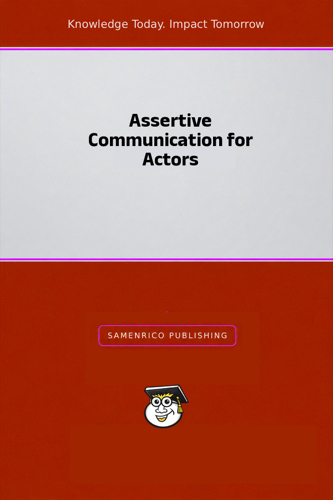
Assertive Communication for Actors eBook
Negotiate roles and boundaries without being label
Negotiate roles and boundaries without being labeled difficult.
Formats
Free sample
Chapter 1: The Anything Trap--The email arrives at 11:47 PM. You’ve been refreshing your inbox every four minutes for the past seven hours. The subject line reads: “Booking Confirmation – Role of [Name].” Your heart slams against your ribs. This is the one. The role that could change everything.
The part that three other actors in your class would kill for. You scroll down. The contract is attached. So are the rehearsal dates. And the rider.
And the nudity waiver. And the on-set weapons release. And the exclusivity clause that says you cannot accept any other work—not even a voiceover session—for the next fourteen months. Your finger hovers over the “accept” button. A small voice in the back of your throat whispers, “Some of this feels wrong.” Another voice, louder and more desperate, answers: “You cannot lose this job.” You click accept.
You tell yourself you will figure out the rest later.This is the Anything Trap.It is not a failure of talent. It is not a failure of courage. It is a failure of a very specific psychological mechanism that acting culture has spent decades weakening: the ability to distinguish between what serves the character and what harms the self. And until you understand how that trap is built—and how to dismantle it—you will keep clicking accept. Then resenting yourself.
Then burning out. Then wondering why the career you gave everything for feels like a slow suffocation.This chapter is about the psychology of that trap. It draws from cognitive behavioral therapy, from the lived experience of working actors, and from one central insight: actors are the only professionals who are actively trained to erase their own boundaries in the service of authenticity. We are told that our “instrument” must be open, vulnerable, and available at all times. But no violinist leaves their Stradivarius on a subway platform.
No surgeon performs a transplant without informed consent. Only actors are told that saying “yes” to everything—unreasonable hours, unsafe conditions, blurred emotional lines—is the mark of a true artist.The trap is not the job offer. The trap is the belief that you cannot afford to hesitate. And the first step out of the trap is to name it.The Anatomy of Audition Panic Let us examine the moment before the click. You have just finished a callback.
The casting director smiled. The director nodded. The producer laughed at your improvised line. You walk to your car—or to the subway, or to the café where you are pretending to work on a laptop—and your brain begins a specific chemical process. Cortisol rises.
Adrenaline follows. Your heart rate stays elevated for an average of three to six hours after a high-stakes audition, according to performance psychology research. In that state, your prefrontal cortex—the part of your brain responsible for long-term reasoning, risk assessment, and boundary setting—is partially offline. It has been hijacked by the limbic system, which only cares about one thing: survival.In evolutionary terms, your brain believes you are being chased by a predator. In professional terms, you believe you are being chased by unemployment.Audition panic is not a character flaw.
It is a neurochemical event. But like any event, you can learn to recognize its onset and refuse to make decisions while it is in control. The actor who signs a contract in the twenty-four hours following a callback is not making a professional decision. They are making a trauma response. And the industry knows this.
The reason contracts arrive late at night, the reason they expire quickly, the reason you are told “we need an answer by morning”—these are not coincidences. They are structural features of a system that profits from your panic.The antidote begins with a single practice: the overnight rule. No contract signed within twenty-four hours of an audition callback. No agreement made while your pulse is still elevated. You can say, “I am honored.
I need to review this with my representative. I will have an answer by [specific time tomorrow].” If the producer rescinds the offer because you asked for one night? That producer was not safe to work with. The trap closes only when you give yourself permission to pause.The Unspeakable Case Study Let me tell you about a working actor I will call Marcus. Marcus trained at a top conservatory.
He booked a recurring role on a prestige cable drama in his third year out of school. The role required his character to be physically restrained and interrogated in three episodes. The director told Marcus that the scene would be “more real” if the restraints were actual handcuffs, not breakaway props. Marcus hesitated. The director laughed and said, “You’re a trained actor.
You can handle it.” Marcus said yes. He did not want to seem difficult.The first day of shooting, the metal cuffs were tightened to the point where Marcus lost circulation in his left hand. He asked for a break. The director told him to “stay in it.” The scene required a hood over his head. Marcus asked if there would be a safety word.
The director said, “We’ll just call cut if anything goes wrong.” Nothing went wrong in the way the crew could see. Marcus finished the three episodes. His performance was praised. The show was renewed.Six months later, Marcus could not be in a crowded elevator. He could not wear a watch.
He could not let his partner hold his wrists during sex. He developed a tremor in his left hand that no neurologist could explain. He stopped auditioning. He stopped returning calls. He told his agent he was “taking a break.” Two years later, he left the profession entirely.
He now teaches high school English.Marcus is not an outlier. He is a case study in what happens when the Anything Trap closes around an actor who has no framework for distinguishing between character discomfort and self harm. The director was not necessarily malicious. The director was operating under the same toxic assumption that pervades our industry: that an actor’s instrument is infinite, that an actor’s boundary is an obstacle to art, that an actor who says “no” is weak.The tragedy of Marcus is not that he said yes. The tragedy is that no one had ever given him permission to say no.
No one had handed him a matrix for deciding, in the moment, whether a request served the role or violated the self. No one had told him that his body was not a prop.The Role vs. Self Matrix Here is the tool that would have saved Marcus. It will save you.The Role vs. Self Matrix is a two-axis decision tool that takes thirty seconds to apply and will change every professional relationship you enter.
Draw it on a napkin. Memorize it. Tape it to your bathroom mirror. The two axes are simple:Axis One: Who is this request for?Role: This serves the character. It helps tell the story.
It is in the script or a reasonable artistic interpretation of the script.Self: This serves me personally—my body, my time, my safety, my…
This is the end of the free sample. Get the eBook to keep going. Buy now
About this book
Details
- Author
- Ratliff Isaura
- Publisher
- SamEnrico
- Language
- English
- Genre
- Non-Fiction, Self-Help, Acting
- Released
- 2026-06-06
- Pages (approx.)
- 153
- Available as
- eBook, Audiobook

Read better in the ZLOADR app
Your eBooks on your phone or tablet. Sign in with your SamEnrico account and start reading.
More by Ratliff Isaura
 Stretching for Climbers GuideRatliff Isaura$11.99
 Only Child Loneliness Self WorthRatliff Isaura$11.99
 Attempt Survivor Teen StoryRatliff Isaura$11.99
 The Minimalist Comparison TrapRatliff Isaura$11.99
 Laughing Through the Barricades: The Comedy Frontline of Ukraine's WarRatliff Isaura$11.99
 Understanding Nance–horan SyndromeRatliff Isaura$17.99
 How to Start a Calculator (electronic) Business (Beginners Guide)Ratliff Isaura$11.99
 Technical to Business TranslationRatliff Isaura$12.99
 Citation Rule Podcast StudyRatliff Isaura$12.99
 Dispatch AssistantRatliff Isaura$11.99
You may also like
 Hong Kong Handover 1997Dunn Johnnie$11.99
 Zumba For Postnatal Recovery CourseNeal Christian$11.99
 Zumba for BeginnersLadner Nikia$11.99
 YouTube Comment Mining GuideHumes Pandora$12.99
 Worry Box MeditationCarlin Rudy$11.99
 Workplace Stress MeditationNguyen Lynn$11.99
 Workplace Stress and Sleep RepairHawley Ivory$11.99
 Workplace Perfectionism CureDelaney Jeffry$11.99
 Workplace Injustice Anger GuideWallen Isabelle$11.99
 Work Addiction and Burnout LinkGreenwood Ester$11.99
 Women in Yoga and WellnessBeattie Galina$11.99
 Women in Stand Up ComedyChun Evangeline$11.99