
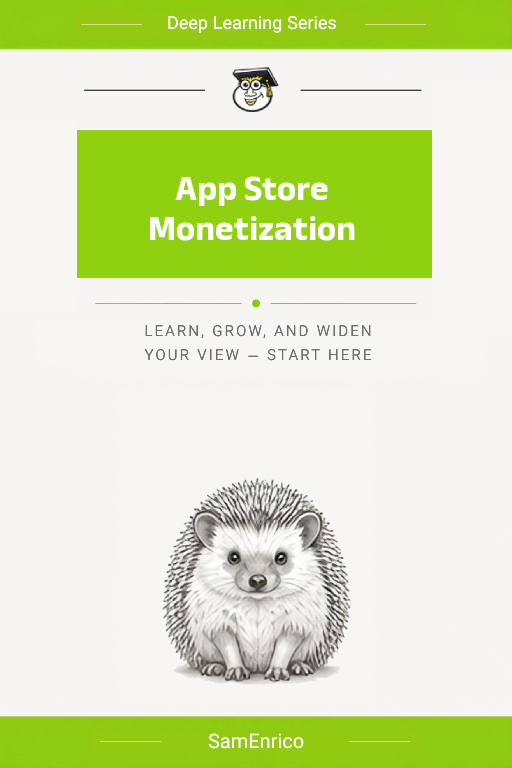
App Store Monetization eBook
Compare freemium, premium, and subscription models
Compare freemium, premium, and subscription models across gaming, productivity, and lifestyle apps.
Formats
Free sample
Chapter 1: The Zero-Friction Trap--–- In 2008, the App Store launched with a radical promise: anyone could build software for a device that lived in their pocket, and anyone could buy that software for the price of a cup of coffee. The $0.99 app was born. It was simple. It was elegant. And within five years, it was almost completely dead.Not because users stopped buying apps.
On the contrary, in 2024, consumers spent over $130 billion on mobile apps—more than the entire global box office revenue of Hollywood, more than the music industry, more than all but the largest national economies. But here is the paradox that confounds most developers: 94 percent of that revenue came from apps that are free to download. Not paid. Not even discounted. Free.The 0.99walldidnotcrumblebecauseofgreedorbaddesign.Itcrumbledbecauseofpsychology.Whenauserscrollsthroughthe App Storeandseesapricetagattachedtoathumbnail—0.99 wall did not crumble because of greed or bad design.
It crumbled because of psychology. When a user scrolls through the App Store and sees a price tag attached to a thumbnail—0.99walldidnotcrumblebecauseofgreedorbaddesign.Itcrumbledbecauseofpsychology.Whenauserscrollsthroughthe App Storeandseesapricetagattachedtoathumbnail—2.99, 4.99,even4.99, even 4.99,even0.99—their brain instantly asks a devastating question: "Is this unknown thing from a stranger worth my money right now?" The answer, 99 times out of 100, is no. But when that same user sees a "Get" button, the question changes. It becomes: "Is this worth my time to try?" That is a much lower bar. That is the bar you can clear.This chapter is about the single most important shift in app monetization over the past decade: the move from charging for access to charging for value after access.
It is the difference between a locked door and an open floor plan. It is the difference between a street vendor shouting prices at passersby and a restaurant giving out free samples. And it is the foundation upon which every successful monetization strategy in this book is built.The Graveyard of the $0.99 Wall Let us begin with a thought experiment. Imagine you are walking through a farmer's market. You see a stall selling jam.
There is a small jar for $3. You have never tasted this jam. You do not know the farmer. You do not know if the jam is sweet or sour, fresh or old. Do you buy it?
Probably not. You walk past.Now imagine the same farmer offers you a tiny plastic spoon with a dab of jam. Free. No obligation. You taste it.
It is delicious. Suddenly, the $3 jar does not seem like a risk. It seems like a bargain. You buy it.That is the shift from the $0.99 wall to the "try-before-you-buy" economy. The paid-upfront model forced users to make a commitment before receiving any value.
The freemium, subscription, and hybrid models flip that sequence: value first, payment later.The data is unforgiving. In 2010, paid apps accounted for over 60 percent of all App Store revenue. By 2015, that number had fallen below 20 percent. Today, it hovers around 6 percent. The remaining 94 percent comes from apps that are initially free.
This is not a trend. It is a tectonic shift.Consider the most successful apps of the past decade. Tik Tok: free. Instagram: free. You Tube: free.
Spotify: free with ads. Netflix: free trial then subscription. Candy Crush: free to play. Fortnite: free to download. The list is not accidental.
Every one of these companies understood that the biggest barrier to adoption is not price—it is decision friction.The Psychology of "Get" vs. "$0.99"To understand why the paid-upfront model failed, we must understand how the human brain evaluates risk. Behavioral economists have long studied the endowment effect: people demand much more to give up something they already have than they would pay to acquire it in the first place. A paid app asks the user to acquire something they do not yet value. A free app gives them something, then later asks if they want to keep the enhanced version.But there is another psychological force at work: loss aversion.
Losing 0.99feelsworsethanfinding0.99 feels worse than finding 0.99feelsworsethanfinding0.99 feels good. When a user sees a price tag on an app they have never used, their brain simulates the loss before the gain. "What if this app is terrible?" "What if it crashes?" "What if I never open it again?" These questions are rational, but they are also fatal to conversion.The "Get" button bypasses loss aversion entirely. There is no loss to simulate. There is only curiosity.
And curiosity is a remarkably cheap emotion to satisfy.This is why the most successful app developers have stopped thinking of their free tier as a "loss leader" or a "demo." They think of it as the product itself—just a version of the product that happens to be subsidized by paying users. The free user is not a freeloader. The free user is inventory. They are the crowd that attracts the whales. They are the data that trains the algorithm.
They are the network effect that makes the app valuable.Case Study: Splice and the 0.06 Percent No example illustrates this dynamic better than Splice, the music production and sample library platform. Splice is not a game. It is not a social network. It is a professional tool for musicians and producers. And yet, it follows the freemium model with stunning success.Here is the statistic that stops developers in their tracks: only approximately 0.06 percent of Splice's users ever pay.
That is six one-hundredths of one percent. By the logic of traditional commerce, Splice should have failed years ago. Ninety-nine point nine four percent of its users are free. They cost money in server bandwidth, customer support, and development. They generate zero direct revenue.But that 0.06 percent—the paying users—generates millions of dollars annually.
They are not casual users. They are professional producers, beatmakers, and sound designers who need unlimited access to Splice's vast library of samples, plugins, and collaboration tools. They are the whales. And they are willing to pay 10,10, 10,20, even $50 per month because the free tier gave them just enough value to become dependent.Splice's genius was not in its paywall design. It was in its understanding of the Whale Theory: in any sufficiently large user base, a tiny fraction of power users will generate the vast majority of revenue.
The role of the free tier is not to convert en masse. The role of the free tier is to be large enough that the tiny fraction of whales represents a meaningful absolute number.If 0.06 percent of your users pay, and you have 100,000 users, you have 60 paying customers. That is not a business. But if you have 10 million users, you have 6,000 paying customers. That is a very real business.
Scale is the engine. Free is the fuel.The Productivity Whale: Why "Power Users" Are Not Just Gamers The Whale Theory is most often discussed in the context of gaming, where "whales" (top 1 percent of spenders) can drop thousands of dollars on in-app purchases. But the same logic applies to productivity and lifestyle apps—only with different spending patterns.In productivity, the whale is not the person who spends $10,000 on virtual gems. The productivity whale is the person who uses the app for six hours a day, across three devices, with a team of collaborators. They are not buying cosmetic…
This is the end of the free sample. Get the eBook to keep going. Buy now
About this book
Details
- Author
- Shipman Cheryll
- Publisher
- SamEnrico
- Language
- English
- Genre
- Non-Fiction, Strategic Atlas, App Pricing
- Released
- 2026-06-01
- Pages (approx.)
- 139
- Available as
- eBook, Audiobook

Read better in the ZLOADR app
Your eBooks on your phone or tablet. Sign in with your SamEnrico account and start reading.
More by Shipman Cheryll
 The Praise Receiving GuideShipman Cheryll$11.99
 Bipolar Triggers IdentificationShipman Cheryll$11.99
 Financial Sector Cyber ReviewShipman Cheryll$11.99
 Shona Healing SculptureShipman Cheryll$11.99
 Vivitrol Induction ProtocolShipman Cheryll$11.99
 Blood on the Streets: The Dublin-Irish Mob and the Sicilian ConnectionShipman Cheryll$11.99
 Clinical SupervisorShipman Cheryll$11.99
 HARO Brand Mention StrategyShipman Cheryll$12.99
 Understanding Post-partum DepressionShipman Cheryll$17.99
 How to Become a Drawstring KnotterShipman Cheryll$11.99