
Non-FictionSelf-HelpEmotion Dynamics
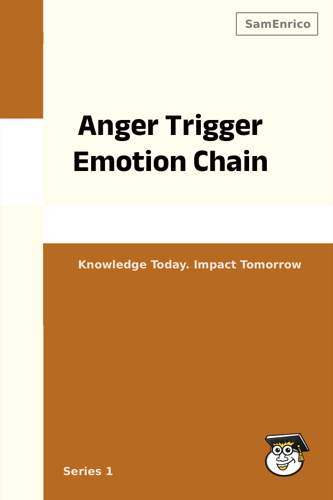
Anger Trigger Emotion Chain eBook
Trace anger back to primary emotions like hurt, fe
Trace anger back to primary emotions like hurt, fear, or shame that hide beneath.
Formats
Free sample
Chapter 1: The Mug That Shattered...--I once threw a ceramic mug at a wall because my husband loaded the dishwasher “wrong.”The mug was hand-thrown, cobalt blue, a gift from my sister. It hit the drywall at an angle, exploded into seven pieces, and left a gouge that stayed there for three years—long after he left. In the silence that followed the crash, I stood in the kitchen, breathing hard, waiting for the relief that never came. Instead, I felt what I always felt after an explosion: shame, exhaustion, and a hollow certainty that something inside me was broken in a way I could not name.The dishwasher, for the record, was fine. The mugs were fine.
The “wrong” was that he had placed the bowls facing left instead of right. That was it. That was the crime.I tell you this story not because I am proud of it—I am deeply ashamed of it—but because every person who has ever struggled with their own anger knows exactly what this moment feels like. The split second between trigger and explosion. The heat in the chest.
The words or actions that come out before you can stop them. And then the aftermath: the cleaning up of literal or metaphorical shards, the apology that never feels like enough, the quiet vow to “never do that again” that dissolves the next time someone cuts you off in traffic or forgets to text back.If you picked up this book, I suspect you know this cycle intimately. You may be someone who explodes—yelling, slamming doors, saying things that haunt you for weeks. Or you may be someone who suppresses—swallowing your anger until it turns into migraines, depression, or a quiet resentment that poisons your relationships from the inside. Or you may be someone who cycles between both: silent until you snap, sorry until you rage again.Here is what I have learned in the decade since that mug shattered: almost everything we have been taught about anger is wrong.We have been told that anger is dangerous, that good people don’t get angry, that anger should be controlled, managed, or eliminated entirely.
We have been told to count to ten, to take a deep breath, to “let it go.” And when those strategies fail—as they almost always do—we conclude that we are broken, that our anger is uniquely monstrous, that something is fundamentally wrong with us.But here is the truth that changed my life and the lives of thousands of people I have since worked with: anger is not the problem. Anger is a signal. It is the visible tip of an enormous emotional iceberg. Beneath the surface lies an entire chain of events—what I call the Anger Trigger Emotion Chain, or A-TEC—that unfolds in milliseconds and almost always follows the same pattern.The purpose of this book is to teach you to see that chain.Not to eliminate your anger. Not to shame you for your anger.
But to help you discern when your anger is your ally and when it is your enemy, and to give you the tools to break the chain at its source—not at the explosion, but at the hidden primary emotion that triggered it.The Cultural Lie That Keeps You Stuck Let me name something that may be uncomfortable to hear: our culture is deeply confused about anger. We have constructed a binary that does not actually exist in human psychology.On one side, we are told that anger is “bad.” This message comes from religious teachings about turning the other cheek, from self-help books that equate anger with toxicity, from parents who punished any expression of frustration, from workplaces that demand professional composure at all costs. The message is clear: good people do not get angry. If you feel anger, suppress it. Hide it.
Pretend it isn’t there.On the other side, we are told that anger is “righteous.” This message comes from a different set of voices: the social media posts that celebrate “calling people out,” the political movements that thrive on outrage, the relationship advice that tells you to “never let anyone disrespect you.” The message here is equally clear: anger is power. Anger is justice. If you are not angry, you are not paying attention.Most of us internalize both messages and end up in a impossible place. We suppress our anger until it explodes. Then we feel ashamed of the explosion.
Then we suppress again. The cycle continues.I want to propose a third way, one that is neither suppression nor indulgence. It is discernment.Anger Is Not One Thing The single most important distinction in this entire book—and I will ask you to return to it again and again—is the difference between what I call adaptive anger and maladaptive anger.These terms come from the work of Dr. Leslie Greenberg, a pioneer in emotion-focused therapy, and they have changed how I understand every angry moment of my life.Adaptive anger is clean. It arises in response to a genuine violation in the present moment.
Someone crosses your boundary. You are treated unfairly. A harm is done to you or to someone you love. Adaptive anger rises up, delivers its message—“Stop,” “This is wrong,” “I matter”—and then subsides. It does not leave destruction in its wake.
It does not linger for hours or days. It does not make you say things you regret. It is, in fact, a gift. It is your nervous system’s way of saying “Something here requires action.”Maladaptive anger, by contrast, is dirty. It is not really about the present moment, though it masquerades as such.
Maladaptive anger is a reaction that covers up a more vulnerable feeling—almost always hurt, fear, or shame. It is explosive or brooding or passive-aggressive. It leaves damage. It creates shame loops. It feels uncontrollable because, in a very real sense, it is not under your conscious control.
It is an old defense mechanism, learned in childhood, that has outlived its usefulness.Here is the crucial point: you cannot tell the difference between adaptive and maladaptive anger by the intensity of the feeling alone. A loud, passionate response can be perfectly adaptive if it is proportional to the violation. A quiet, seething resentment can be maladaptive if it is covering up old shame. The difference lies in what is driving the anger.Adaptive anger is driven by a present-moment boundary violation.Maladaptive anger is driven by a past wound that has been activated.The dishwasher incident was not adaptive anger. No one was violating my boundaries.
No injustice was occurring. My husband was loading the dishwasher in a slightly different orientation than I preferred. That was all. The explosion that followed was not about the dishwasher. It was about something else entirely—something I could not name at the time but have since come to understand.The Self-Assessment: Is Your Anger Friend or Foe?Before we go any further, I want you to take a few minutes to assess your own relationship with anger.
This is not a diagnostic test. There are no right or wrong answers. The purpose is simply to give you…
This is the end of the free sample. Get the eBook to keep going. Buy now
About this book
Details
- Author
- Gatewood Morgan
- Publisher
- SamEnrico
- Language
- English
- Genre
- Non-Fiction, Self-Help, Emotion Dynamics
- Released
- 2026-06-09
- Pages (approx.)
- 143
- Available as
- eBook, Audiobook

Read better in the ZLOADR app
Your eBooks on your phone or tablet. Sign in with your SamEnrico account and start reading.
More by Gatewood Morgan
 Supply Chain Scaling GuideGatewood Morgan$11.99
 Anger And Postpartum Depression GuideGatewood Morgan$11.99
 Financial Stress Pandemic AftermathGatewood Morgan$11.99
 The Raven’s Oath: Loki’s Forgotten GambitGatewood Morgan$11.99
 The Last Broadcast: The Mysterious Signals of 1923Gatewood Morgan$11.99
 Understanding HyperhomocysteinemiaGatewood Morgan$17.99
 Application Developer ConsultantGatewood Morgan$11.99
 Telehealth Patient Engagement OutlookGatewood Morgan$12.99
 Landing Page Conversion HandbookGatewood Morgan$12.99
 A Beginners Guide to Baseball pocket billiards (Volume 1)Gatewood Morgan$11.99
You may also like
 Hong Kong Handover 1997Dunn Johnnie$11.99
 Zumba For Postnatal Recovery CourseNeal Christian$11.99
 Zumba for BeginnersLadner Nikia$11.99
 YouTube Comment Mining GuideHumes Pandora$12.99
 Worry Box MeditationCarlin Rudy$11.99
 Workplace Stress MeditationNguyen Lynn$11.99
 Workplace Stress and Sleep RepairHawley Ivory$11.99
 Workplace Perfectionism CureDelaney Jeffry$11.99
 Workplace Injustice Anger GuideWallen Isabelle$11.99
 Work Addiction and Burnout LinkGreenwood Ester$11.99
 Women in Yoga and WellnessBeattie Galina$11.99
 Women in Stand Up ComedyChun Evangeline$11.99