
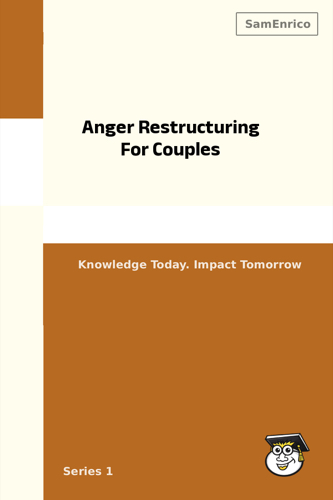
Anger Restructuring For Couples eBook
Practice cognitive work together to reduce relatio
Practice cognitive work together to reduce relationship conflict.
Formats
Free sample
Chapter 1: The Venting Trap--–- The marriage counselor’s office smelled faintly of lemon polish and stale coffee. Across from me sat a couple who had been fighting for twelve years about the same thing—or so they believed. He thought they fought about money. She thought they fought about his emotional unavailability. In reality, they fought about neither.
They fought about the story they told themselves three seconds after the other person spoke.I asked them to reenact a recent argument. He said, “You spent two hundred dollars on shoes without asking me.” She said, “You’re controlling.” He said, “See? You never listen.” She said, “See? You only care about money.” Within ninety seconds, they had insulted each other’s character, invoked every fight from the past decade, and arrived at the familiar conclusion that they were fundamentally incompatible.Then I asked a question that stopped them cold: “What did you think, in the exact moment before you felt angry?”He looked confused. “I didn’t think anything.
I just felt angry.”That is the lie that destroys relationships. The belief that anger arrives out of nowhere, like a weather system, something that happens to you rather than something you construct. And that lie has been sold to us for decades by pop psychology that told us to “vent,” “let it out,” and “express your feelings honestly.” That advice is not merely incomplete. It is poison.This book is built on a radically different premise: between a partner’s action and your anger, there is always a thought. It happens in less than a second.
It is often unconscious. But it is always there. Change that thought, and the anger dissolves before it reaches your mouth. That is Anger Restructuring—the systematic practice of catching, examining, and rebuilding the cognitive stories that turn minor irritations into three-day wars.Why Most Anger Management Advice Fails Couples Individual anger management teaches you to breathe, count to ten, or walk away. These are useful skills for preventing assault, but they do nothing to heal a relationship.
You can walk away from a thousand arguments and still feel secretly convinced that your partner is selfish, lazy, or stupid. The anger doesn’t go away; it goes underground, where it calcifies into contempt.Couples therapy, on the other hand, often focuses on communication skills—using “I statements,” active listening, and scheduled conversations. These are valuable tools, but they put the cart before the horse. You can say “I feel hurt” in the most gentle tone imaginable, but if the thought behind it is “He doesn’t care about me,” the message will leak through anyway. Your partner will hear the accusation behind the carefully crafted words.
The conflict will continue.The missing piece is cognitive. You cannot communicate your way out of a thought you have not examined.Let me give you a concrete example. A wife comes home from work. Her husband is sitting on the couch looking at his phone. She feels a surge of anger.
If she follows standard communication advice, she might say, “I feel frustrated when I come home and you’re on your phone.” That’s better than screaming, but it still misses the real problem. The real problem is the thought that flashed through her mind in the half-second before the anger: “He doesn’t care about my day.” Or “He’s lazy.” Or “I always have to do everything.”That thought may be true, false, or somewhere in between. But until she examines it, she will respond as if it is unquestionably true. And her husband will feel accused of a crime he didn’t know he was committing.Now consider the alternative. What if she caught that thought?
What if she said to herself, “I notice I’m having the thought that he doesn’t care about my day. Is that thought accurate? What evidence do I have? Could there be another explanation?” Perhaps he just finished a stressful call. Perhaps he didn’t hear the door.
Perhaps he is exhausted. The anger that felt so justified a moment ago now seems less certain. And from that place of uncertainty, she can actually ask him what is going on, rather than accusing him.That is Anger Restructuring. It is not suppression. It is not denial.
It is not pretending you aren’t angry. It is the hard, disciplined work of interrogating the thoughts that produce the anger in the first place.The Neuroscience of Why “Venting” Backfires In the 1970s, a psychologist named Albert Bandura conducted experiments that should have ended the myth of catharsis forever. He found that people who hit a punching bag while “venting” their anger actually became more aggressive afterward, not less. Their neural pathways for rage had been rehearsed and strengthened, like a path in the woods that becomes clearer with every footstep.Modern neuroscience explains why. Every time you replay a grievance, your brain releases cortisol and adrenaline.
These stress hormones prime your body for fight-or-flight. But more importantly, they strengthen the synaptic connections associated with that particular angry thought. Neurons that fire together wire together. The more you rehearse the thought “He never listens,” the more automatic that thought becomes. Eventually, it fires without any conscious effort at all.
You don’t decide to think it; it simply appears.This is the trap that most couples fall into. They believe that “getting it off their chest” will relieve pressure. In reality, they are carving deeper grooves of resentment into their own neural architecture.A 2019 study of 874 couples found that those who reported “venting frequently” had significantly higher rates of relationship deterioration over three years compared to couples who reported “pausing before responding.” The difference was not that the venting couples had more problems. It was that their approach to problems made everything worse.The “Third Entity” Concept: You Are on the Same Team Here is the single most important reframe in this book: your relationship is not the container for your individual feelings. Your relationship is a third entity—a living system that exists between you.
And right now, that system has a virus. The virus is not your partner. The virus is the pattern of anger that hijacks your cognitive processing.When a computer gets a virus, the IT team does not argue about whose fault it is. They do not say, “Well, if you hadn’t downloaded that file, we wouldn’t have this problem.” They say, “We have a problem. Let’s fix it together.”That is the stance of Anger Restructuring.
You and your partner are not adversaries. You are the IT team. The virus is the automatic thoughts, the distorted interpretations, the hidden rules that turn a sigh into an insult and a late arrival into a betrayal. Your job is to debug the system, not to win the argument.I have seen this reframe save marriages that were on the brink of divorce. The moment a couple stops asking “Who started it?” and starts asking “What is the pattern?” something shifts.
Defensiveness drops. Curiosity rises. Two people who were preparing for war suddenly realize they have been fighting the wrong enemy.The…
This is the end of the free sample. Get the eBook to keep going. Buy now
About this book
Details
- Author
- Cherry Pandora
- Publisher
- SamEnrico
- Language
- English
- Genre
- Non-Fiction, Self-Help, Couples
- Released
- 2026-06-06
- Pages (approx.)
- 136
- Available as
- eBook, Audiobook

Read better in the ZLOADR app
Your eBooks on your phone or tablet. Sign in with your SamEnrico account and start reading.
More by Cherry Pandora
 Empathy Course WorkbookCherry Pandora$11.99
 Parent Reading Time HackCherry Pandora$11.99
 Design Thinking Process PrimerCherry Pandora$11.99
 Detox Staff Training ManualCherry Pandora$11.99
 Group Flow State TriggersCherry Pandora$11.99
 Blue Zone Green Leafy GuideCherry Pandora$11.99
 Remote Productivity SchedulingCherry Pandora$11.99
 The Mosaic Lovers of Pompeii: A Forgotten Tale of Art and DevotionCherry Pandora$11.99
 The Ballad of the Heike: Ghostly Lament of the Fallen SamuraiCherry Pandora$11.99
 How to Produce HygrometersCherry Pandora$11.99
 A Collector's Handbook to the Healey 2.4-litre SportsmobileCherry Pandora$11.99
 Study Abroad Scholarship GuideCherry Pandora$12.99
You may also like
 Hong Kong Handover 1997Dunn Johnnie$11.99
 Zumba For Postnatal Recovery CourseNeal Christian$11.99
 Zumba for BeginnersLadner Nikia$11.99
 YouTube Comment Mining GuideHumes Pandora$12.99
 Worry Box MeditationCarlin Rudy$11.99
 Workplace Stress MeditationNguyen Lynn$11.99
 Workplace Stress and Sleep RepairHawley Ivory$11.99
 Workplace Perfectionism CureDelaney Jeffry$11.99
 Workplace Injustice Anger GuideWallen Isabelle$11.99
 Work Addiction and Burnout LinkGreenwood Ester$11.99
 Women in Yoga and WellnessBeattie Galina$11.99
 Women in Stand Up ComedyChun Evangeline$11.99