
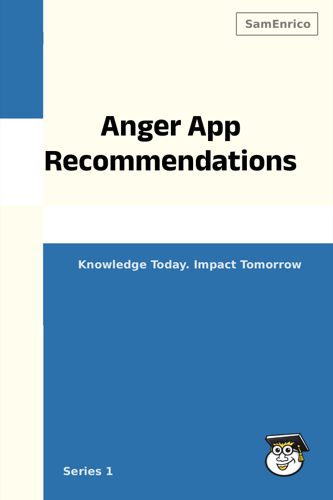
Anger App Recommendations eBook
Use smartphone tools for tracking triggers, breath
Use smartphone tools for tracking triggers, breathing exercises, and cognitive restructuring.
Formats
Free sample
Chapter 1: The 90-Second Window--You have ninety seconds to save yourself from your worst self.Not sixty. Not a hundred and twenty. Ninety. That is the precise window between the moment something triggers you and the moment the anger chemicals naturally clear from your bloodstream—if you stop adding fuel. This is not self-help guesswork.
It is neuroanatomy, discovered by Dr. Jill Bolte Taylor, a Harvard-trained brain scientist who had a front-row seat to her own stroke. She watched her brain fail in real time, and what she learned about emotions changed how we understand anger forever.Here is what she discovered. When a trigger hits—a cutting remark from your partner, a driver cutting you off, an email that makes your jaw clench—your amygdala activates in under half a second. It is the burglar alarm of your brain, designed to detect threats before your conscious mind even knows what is happening.
In the next two to five seconds, your body floods with cortisol and adrenaline. Your heart rate spikes. Your breathing shallows. Your muscles tense. Your prefrontal cortex—the rational, planning, decision-making part of your brain—starts to go offline.
This is the activation window. It is fast, automatic, and largely outside your control.But here is where most people get stuck. They believe that once the anger starts, they are passengers on a train they cannot stop. That is not true. The chemical surge that causes the physical sensations of anger—the heat, the pressure, the urge to lash out—lasts approximately ninety seconds.
Ninety seconds from the moment of activation, the chemicals begin to dissipate. Your liver metabolizes them. Your kidneys filter them out. Your nervous system returns to baseline.If you are still angry after ninety seconds, it is not because of biochemistry. It is because you are choosing to stay angry.
You are telling yourself the story again. You are replaying what they said. You are imagining what you should have said back. You are rehearsing the injustice, polishing the insult, and feeding the fire with your own thoughts.This is both terrifying and liberating. Terrifying because it means you cannot blame your biology for the explosion that happened three hours ago.
Liberating because it means you are not broken. Your brain works exactly as it evolved to work. The problem is not your hardware—it is your operating system. And just like your smartphone, your brain can be updated with the right tools.The question is not whether you get angry. You will.
Anger is a normal, healthy emotion designed to signal that something is wrong and give you the energy to fix it. The question is what you do with that ninety-second window. Do you use it to breathe, ground yourself, and choose a response? Or do you use it to rehearse a revenge fantasy that leaves you shaking with rage an hour later while the person who triggered you has already moved on with their life?This book exists because the answer is no longer a mystery. We have more research on anger management than ever before.
We have Cognitive Behavioral Therapy protocols tested on hundreds of thousands of patients. We have best-selling workbooks like When Anger Hurts, The Anger Control Workbook, and Gary Chapman's Anger that have changed lives. And we have something those workbooks never had: a device in your pocket that can deliver help exactly when you need it.Your phone is not the enemy.Your phone is the intervention.The Failure of Traditional Anger Management Let me tell you about Sarah. She is not real—I have combined details from dozens of clients and research subjects into a single composite—but her story is painfully familiar. Sarah is forty-two years old, a teacher with two teenagers and a mortgage.
She loves her family. She is good at her job. And she has a problem.Last month, she threw a coffee mug at her kitchen wall.She missed the wall. The mug shattered the window behind it. Glass sprayed onto the driveway where her neighbor was walking their dog.
The neighbor did not call the police, but they came over to ask if everything was okay. Sarah had to explain that she had lost her temper because her son left dirty dishes in the sink. Again.She sat on the couch afterward, shaking, humiliated, and exhausted. She had read anger management books before. She had even seen a therapist for six sessions, until the copay got too expensive.
She knew the theory. She understood that she should "take deep breaths" and "count to ten." But in the moment—in the two seconds between seeing the dirty dishes and throwing the mug—none of that knowledge helped. Her body was already in motion. The rational part of her brain was offline. The therapist's advice was a distant memory.This is the fundamental failure of traditional anger management.
It asks you to learn skills in a calm, safe environment—a therapist's office, a comfortable chair, a workbook at your kitchen table—and then somehow access those skills in the middle of a crisis. That is like learning to swim in a desert and then expecting to survive a riptide. The conditions are completely different. Your brain under threat does not function the same way as your brain at rest.The research is clear on this. When your sympathetic nervous system activates—when you are in "fight or flight" mode—your prefrontal cortex experiences reduced blood flow and glucose metabolism.
This is not a metaphor. Your actual brain tissue receives fewer resources. The neural pathways that allow you to recall workbook exercises, remember breathing techniques, and choose measured responses literally become harder to access. It is not that you are weak or undisciplined. It is that your biology has decided that survival is more important than politeness.What you need is not more knowledge.
You already know that yelling is bad and breathing is good. What you need is an intervention that arrives before your prefrontal cortex goes offline. You need a tool that requires zero cognitive effort to access. You need something that lives in your pocket, works in two seconds, and does not care whether you can remember Chapter Seven right now.You need your phone.The Two-Second Solution Here is the core insight that changes everything. You have two to five seconds from trigger to full physiological activation.
That is not much time. But it is enough time to press a button. It is enough time to tap a widget on your lock screen. It is enough time to say "Hey Siri, I'm angry" into your Apple Watch. And that one tap can open a breathing guide that walks you through the next ninety seconds.This is called a Just-In-Time Adaptive Intervention, or JITAI.
It is a clinical framework that has been used successfully for addiction recovery, eating disorders, and anxiety. The basic idea is simple: do not wait for the patient to remember to use a skill. Deliver the skill automatically when the patient needs it most.Anger management is a perfect use case for JITAIs because anger follows a predictable physiological timeline. When you log a 7 out…
This is the end of the free sample. Get the eBook to keep going. Buy now
About this book
Details
- Author
- Rivas Yesenia
- Publisher
- SamEnrico
- Language
- English
- Genre
- Non-Fiction, Self-Help, Apps
- Released
- 2026-06-08
- Pages (approx.)
- 135
- Available as
- eBook, Audiobook

Read better in the ZLOADR app
Your eBooks on your phone or tablet. Sign in with your SamEnrico account and start reading.
More by Rivas Yesenia
 Career Pivot Without BurnoutRivas Yesenia$11.99
 Industry Bars DatabaseRivas Yesenia$11.99
 The Crowd Noise ToleranceRivas Yesenia$11.99
 Antwerp Diamond Heist Escape Route MapRivas Yesenia$11.99
 Into the Abyss: Mapping the Arctic's Hidden WorldRivas Yesenia$11.99
 The Blockbuster Blunder: How a $400 Million Trade Shattered a DynastyRivas Yesenia$11.99
 Understanding Dissociative AmnesiaRivas Yesenia$17.99
 How to Start a Parsnip Growing Business (Beginners Guide)Rivas Yesenia$11.99
 UNC Argentina Free GuideRivas Yesenia$12.99
 H-1B Amendment GuideRivas Yesenia$12.99
 Biomed TechnicianRivas Yesenia$11.99
You may also like
 Morning Routine App GuideHowerton Iraida$11.99
 App Usage ReviewButterfield Lesha$11.99
 The TM App Usage GuideKinney Dodie$11.99
 The Sober App GuideBurnside Prince$11.99
 The Beginner's App GuideAshmore Morgan$11.99
 Anger Management Apps GuideThomson Lucina$11.99
 Sex Addiction App Blockers GuideWoodward Lenora$11.99
 Nightmare Rescripting App GuideWolf Glayds$11.99
 Self Hypnosis Smartphone AppsBunn Missy$11.99
 Anger Thought Record App GuideSimons Ardath$11.99
 Teen Self Esteem App GuidePetty Vanda$11.99
 Mindfulness for TechnologyDickerson Clelia$11.99