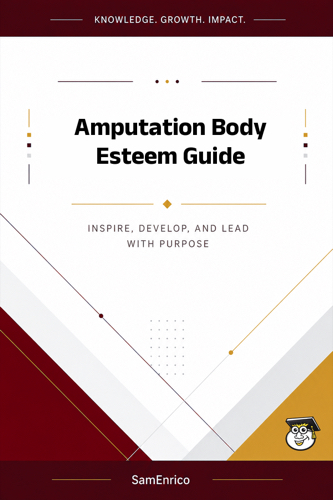
Amputation Body Esteem Guide
Navigate limb difference with pride and prosthetic
Navigate limb difference with pride and prosthetic self-expression.
Formats
About this book
Free sample
Chapter 1: The Ghost’s Blueprint...--–- The first time you feel a phantom itch in a limb that no longer exists, your brain will try to convince you that you are going mad. It will whisper that this sensation—the ache in your missing foot, the curl of your absent fingers, the sudden jolt of pain in a knee that was amputated years ago—must be a hallucination, a failure of will, or proof that you haven't truly accepted your loss. You are not mad. You are not weak. And you have not failed.
You are experiencing one of the most profound and least-understood phenomena in human neuroscience: the persistence of the body's internal map long after the territory has changed.This chapter exists to give you a new relationship with that ghost. Not as an enemy to be exorcised, nor as a wound to be ignored, but as a blueprint. Your brain's map of your body is not a photograph that fades when a limb is removed. It is more like a city's street grid—laid down over years, reinforced by every movement and touch, and astonishingly resistant to erasure. Understanding that map is the first and most essential step toward body esteem.
Because you cannot love a body you do not understand neurologically. And for the nearly two million people in the United States living with limb difference, the difference between suffering in silence and reclaiming your physical self often begins with a single question: What is the ghost, and why won't it leave?The Ghost Is Not a Psychological Failure Let us dispense with the most damaging myth first. Many amputees report that well-meaning doctors, therapists, or family members have suggested that phantom sensations—especially phantom pain—are "all in your head." This phrase is usually intended to mean "imaginary" or "psychosomatic in a pejorative sense." The truth is far more interesting. Phantom phenomena are entirely in your head, but not in the way you think. They live in the somatosensory cortex, the region of your brain that processes touch, position, and sensation for every square inch of your…
This is the end of the free sample. Get the eBook to keep going. Buy now
Contents
- Chapter 1
- Chapter 2
- Chapter 3
- Chapter 4
- Chapter 5
- Chapter 6
- Chapter 7
- Chapter 8
- Chapter 9
- Chapter 10
- Chapter 11
- Chapter 12
Details
- Author
- Gregory Everett
- Publisher
- SamEnrico
- Language
- English
- Genre
- Non-Fiction, Self-Help, Limb Difference
- Released
- 2026-06-06
- Pages (approx.)
- 134
- Available as
- eBook, Audiobook

Read better in the ZLOADR app
Your eBooks on your phone or tablet. Sign in with your SamEnrico account and start reading.
More by Gregory Everett
 Broken ToysGregory Everett$11.99
 Metta For Breakup HealingGregory Everett$11.99
 Eisenhower For Meetings GuideGregory Everett$11.99
 Tax Lien Wholesaling StrategyGregory Everett$11.99
 Immigrant AI Startup Founder JourneysGregory Everett$11.99
 Firangi and Desi DivideGregory Everett$11.99
 Borderline Parent Child WorthGregory Everett$11.99
 Shin Splints Prevention GuideGregory Everett$11.99
 The Healers of Axum: Ancient Africa's Medical PioneersGregory Everett$11.99
 The Forgotten Codebreakers of World War IGregory Everett$11.99
 Breaking the Sound Barrier: The Untold Story of Chuck Yeager and the Bell X-1Gregory Everett$11.99
 Prompt Engineering for Property Marketing FunnelsGregory Everett$11.99