
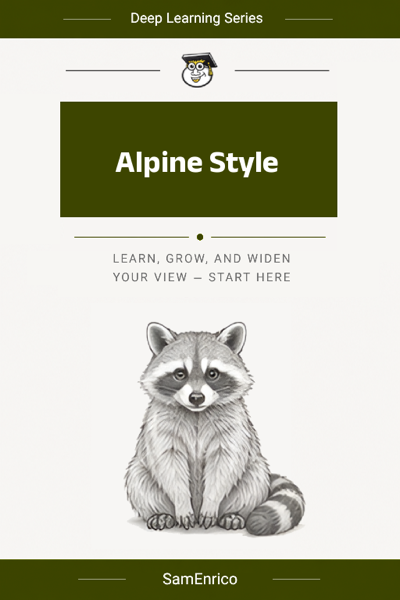
Non-FictionInformativeEducational
Alpine Style eBook
A Coursebook on Alpine Style
A Coursebook on Alpine Style
Formats
Free sample
Chapter 1: The Speed Paradox...–- Every year, dozens of climbers set out from the valley floor with heavy packs, multiple ropes, and a week's worth of food. They move slowly, deliberately, and safely—or so they believe. By the time afternoon rockfall sweeps down their chosen couloir or an unexpected storm pins them against the face, they have learned a brutal lesson: in the mountains, slow is not safe. Slow is exposed. Slow is a gamble that the weather, the rock, and your own body will hold together longer than they statistically will.This book is built on a single, counterintuitive truth that runs contrary to almost every survival instinct a climber possesses.
The fastest way up is the safest way down. Speed is not recklessness. Speed, when properly understood and executed, is the most sophisticated risk management tool available to the alpinist. This chapter dismantles the comfortable illusion that more gear, more time, and more caution produce more safety. It introduces the philosophical framework that governs every subsequent chapter: the Alpine Triangle, the mathematics of mountain time, and a unified decision system that will guide every choice you make on the rock, snow, and ice.Welcome to the Speed Principle.The Great Misconception: What Alpine Style Is Not Before we can understand what alpine style demands, we must first scrub away the misconceptions that cling to the term like frost to a north face.
Ask a dozen climbers to define "alpine style," and you will receive a dozen answers, most of them incomplete.Alpine style is not merely climbing without bottled oxygen. That is a high-altitude mountaineering distinction, irrelevant to the vast majority of alpine routes that top out below 5,000 meters. Alpine style is not simply climbing without fixed ropes or pre-stocked camps. Those are tactical choices, not philosophical ones. And alpine style is not synonymous with "light and fast" as a marketing slogan—though light and fast are its primary expressions.The most damaging misconception is that alpine style represents a purer, more virtuous, or more "authentic" form of climbing than expedition style.
This moral framing helps no one. Expedition tactics are not cowardly; they are appropriate for specific contexts: the 8,000-meter peaks of the Himalaya and Karakoram, where the altitude alone will kill you if you move too quickly, where the logistics of carrying months of supplies require fixed camps, and where the weather windows are measured in days, not hours. Expedition style is a rational response to extreme altitude and extreme remoteness.Alpine style is the rational response to everything else. That means the Alps, the Rockies, the Patagonian Andes, the Alaska Range, the Southern Alps of New Zealand, and the vast majority of mountain ranges on Earth. For 99% of the world's mountains, the expedition model is not just overkill—it is actively dangerous.
The climber who lugs a portaledge, a stove, two weeks of food, and a library of gear up a 600-meter granite face is not being cautious. They are being slow. And being slow on a 600-meter face means being exposed to rockfall, weather, and fatigue for twice as long as necessary.Alpine style, properly defined, is a complete operational philosophy based on three pillars:Minimum effective gear—carrying nothing that does not directly contribute to moving upward or managing essential risk.Continuous or near-continuous movement—minimizing stops for belays, transitions, and rest.Acceptance of calculated risk—understanding that a faster ascent with less gear exposes you to fewer total hours of objective hazard, even if each individual hour carries slightly higher subjective risk.The third pillar is the one most novice alpinists misunderstand. They look at a climber simul-climbing a 500-meter ridge with a single rope and a handful of cams and see recklessness. What they fail to see is the calculation beneath the surface: that climber will be off that ridge in four hours, while the "cautious" party pitching it out will take twelve hours.
In those twelve hours, the cautious party will pass through the afternoon rockfall window, may get caught in an evening storm, and will fatigue to the point of poor judgment. The "reckless" climber is back in the hut drinking beer.This is the Speed Principle in its purest form: Speed is safety. Efficiency is survival.The Alpine Triangle: Speed, Weight, Risk Every decision in alpine climbing—what to pack, when to start, whether to place a piece of protection or keep moving—can be understood through a single conceptual model. The Alpine Triangle has three vertices: Speed, Weight, and Risk.Speed is your rate of movement across the route, measured in vertical meters per hour or horizontal kilometers per hour. Speed is not a fixed number; it varies with terrain, fatigue, and conditions.
A good alpinist can move at 300 vertical meters per hour on moderate snow, 150 meters per hour on 4th-class scrambling, and 50 meters per hour on sustained 5.7 rock. Speed is the output variable—what you are trying to maximize given the constraints of the other two vertices.Weight is the total mass of everything you carry: your pack, your rack, your rope, your clothing, your food, your water, your emergency gear. Every gram matters not because you are trying to set a record, but because every gram slows you down. The relationship between weight and speed is nearly linear on steep terrain: add 5 kilograms to a 70-kilogram climber, and your speed on a sustained 30-degree slope drops by approximately 7 percent. On technical terrain, the penalty is even steeper because heavy packs shift your center of gravity and interfere with balance.Risk is the most misunderstood vertex.
Risk is not a single number; it is a combination of objective hazards (rockfall, avalanche, weather, crevasses) and subjective hazards (fatigue, poor judgment, hypoxia, technical error). The critical insight of the Alpine Triangle is that risk is a function of exposure time. The longer you spend on a route, the more likely you are to experience an objective hazard. A 1 percent chance of rockfall per hour becomes a 12 percent chance over a 12-hour climb, but only a 4 percent chance over a 4-hour climb.The Law of the Triangle: You cannot change one vertex without affecting the others.Consider a climber who decides to "play it safe" by adding extra gear: a second rope, a full first aid kit, a stove, extra food, a bivy sack. Weight increases.
Speed decreases. Exposure time increases. Objective hazard probability increases. The climber has increased their overall risk while believing they were decreasing it.Consider the opposite: a climber who sheds the second rope, replaces the full first aid kit with a 150-gram Ziploc (see Chapter 11), leaves the stove at home, and carries only a survival bivy. Weight decreases.
Speed increases. Exposure time decreases. Objective hazard probability decreases. The climber has decreased their overall risk while appearing to outsiders as reckless.This is the paradox that gives this chapter its name. The climber who carries less gear is not taking more risk.
They are taking less total risk because they spend less time in harm's way. The exception, which we will explore throughout this book, is catastrophic risk—the low-probability, high-consequence event that could kill you instantly regardless of how fast you move. A fall…
This is the end of the free sample. Get the eBook to keep going. Buy now
About this book
Details
- Author
- Skelton Gillian
- Publisher
- SamEnrico
- Language
- English
- Genre
- Non-Fiction, Informative, Educational
- Released
- 2026-06-02
- Pages (approx.)
- 141
- Available as
- eBook, Audiobook

Read better in the ZLOADR app
Your eBooks on your phone or tablet. Sign in with your SamEnrico account and start reading.
More by Skelton Gillian
 The Compulsive Worker Recovery PlanSkelton Gillian$11.99
 The Body Scan for CaregiversSkelton Gillian$11.99
 Joseph Bonaparte Spain GuideSkelton Gillian$11.99
 Stress and Fibromyalgia FlaresSkelton Gillian$11.99
 The Alchemists of Florence: Secrets of the Medici LabyrinthSkelton Gillian$11.99
 How to Produce a Bale WrapperSkelton Gillian$11.99
 Lagos Airport Pop Up LogisticsSkelton Gillian$12.99
 How to Start a Book Keeping Machine Business (Beginners Guide)Skelton Gillian$11.99
You may also like
 Hong Kong Handover 1997Dunn Johnnie$11.99
 Zumba For Postnatal Recovery CourseNeal Christian$11.99
 Zumba for BeginnersLadner Nikia$11.99
 YouTube Comment Mining GuideHumes Pandora$12.99
 Worry Box MeditationCarlin Rudy$11.99
 Workplace Stress MeditationNguyen Lynn$11.99
 Workplace Stress and Sleep RepairHawley Ivory$11.99
 Workplace Perfectionism CureDelaney Jeffry$11.99
 Workplace Injustice Anger GuideWallen Isabelle$11.99
 Work Addiction and Burnout LinkGreenwood Ester$11.99
 Women in Yoga and WellnessBeattie Galina$11.99
 Women in Stand Up ComedyChun Evangeline$11.99