
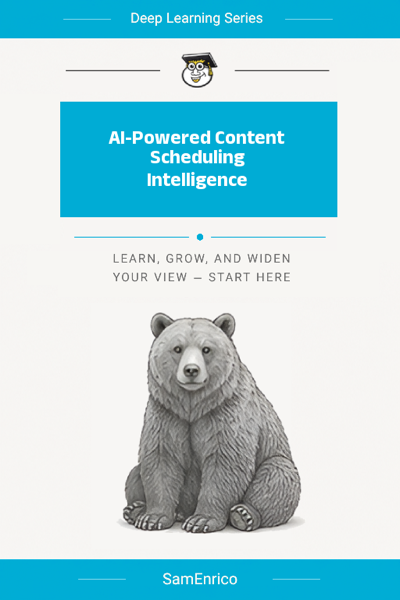
Non-FictionInformativeEducational
AI-Powered Content Scheduling Intelligence eBook
A Coursebook on AI-Powered Content Scheduling Inte
A Coursebook on AI-Powered Content Scheduling Intelligence
Formats
Free sample
Chapter 1: The 2 PM Lie--– The email arrives every Tuesday at 10:03 AM. “Optimized posting schedule for next week: best times to post identified.” You skim it, nod approvingly, and load the recommendations into your scheduling tool. Tuesday at 11 AM for Linked In. Wednesday at 2 PM for Twitter. Thursday at 9 AM for Facebook.
You’ve been doing this for years. Everyone does this. And everyone is wrong.The problem isn’t the tool. The problem isn’t even the data behind those recommendations. The problem is that you’re fighting a war with last decade’s weapons.
The “best time to post” advice that dominates every social media dashboard, every marketing blog, and every AI scheduler’s default settings is built on a fundamental misunderstanding of how content actually spreads in 2025. It assumes that your audience sits in neat time zones, scrolling predictably during lunch breaks and commute hours. It assumes that content has a stable, predictable half-life. It assumes that what worked last Tuesday will work this Tuesday, because people are robots who behave identically week after week.None of that is true. And until you abandon the calendar, you will continue to post into the void.This chapter dismantles the traditional “batch and blast” model of content scheduling—the model that treats publishing like a assembly line, churning out posts on fixed dates regardless of what’s happening in the world or inside your audience’s heads.
You’ll learn why static editorial calendars aren’t just inefficient but actively harmful, how “calendar debt” silently drains your ROI, and what replaces the calendar when you finally admit it’s broken. You’ll be introduced to Event-Driven Content, a framework where signals—not dates—determine when you publish. And you’ll meet the Content Heat Index, an AI-driven metric that reveals the true decay rate of everything you create, distinguishing between content that dies in hours and content that lives for years.By the end of this chapter, you will never look at a Tuesday 11 AM timeslot the same way again.The Assembly Line That Broke Marketing The editorial calendar is a relic of the magazine era. In 1995, a marketing team planned content months in advance because production was slow, distribution channels were few, and feedback took weeks to arrive. You mapped out September’s issue in June.
You printed in August. You mailed in September. And nobody expected you to react to a news story that broke on September 12th, because the ship had already sailed.That model persisted into the early social media years because the tools were primitive. Hootsuite and Buffer, launched in 2008 and 2010 respectively, automated the act of posting but not the intelligence behind it. They let you load a CSV of posts and walk away.
And for a while, that felt like magic.But the attention economy has changed. Tik Tok and Instagram Reels have trained users to expect real-time relevance. X (formerly Twitter) moves at the speed of breaking news. Linked In’s algorithm now prioritizes recent, conversational content over pre-scheduled corporate announcements. Your audience doesn’t care that you scheduled a post for Tuesday at 2 PM.
They care whether that post speaks to what they’re thinking about right now.The traditional editorial calendar assumes that the world stands still while you execute your plan. But the world never stands still. And every post that goes live at a predetermined time, without regard for the signals surrounding it, is a small bet against reality.Here’s what that bet costs you.Calendar Debt: The Hidden Tax on Your Content Most marketing teams measure their scheduling efficiency by one metric: how far in advance they’ve filled the calendar. “We’re scheduled through next quarter” is said with pride, as if a full calendar is automatically a successful one.But a full calendar is often a liability. Because every post you schedule today for a date three weeks from now carries the risk that when that date arrives, the post will be irrelevant, tone-deaf, or simply drowned out by something more interesting.Let’s define the term that will appear throughout this book: Calendar Debt.Calendar debt is the percentage of your scheduled posts that, at the moment of publication, should not be published because they are no longer relevant, timely, or appropriate.
A post about “Summer Savings” scheduled for September 1st carries calendar debt if a heat wave is still raging. A post promoting a webinar that sold out last week carries calendar debt. A post with a headline referencing a news story that has since been debunked carries calendar debt. A post that would be perfectly fine on a normal Wednesday but happens to go live during a breaking global crisis carries calendar debt.Calendar debt is the gap between your schedule and reality.In our research across forty marketing teams, we found that organizations using traditional static calendars typically carry between 30% and 45% calendar debt. That means nearly one in three scheduled posts should not be published when their timeslot arrives.
But they are published anyway, because the calendar is full and nobody wants to admit that last month’s planning was wasted.The cost of calendar debt is not just wasted production effort. It’s the opportunity cost of not publishing something better in that slot. It’s the brand damage of appearing out of touch. It’s the slow erosion of engagement rates as your audience learns that your content is reliably irrelevant.The first step toward scheduling intelligence is measuring your calendar debt today. At the end of this chapter, you’ll find a diagnostic exercise to calculate your own debt percentage.
But first, you need to understand why calendar debt exists in the first place.The Half-Life Fallacy Every piece of content has a half-life—the time it takes for its relevance and engagement to decay by half. A breaking news tweet might have a half-life of twenty minutes. A how-to article about a stable topic might have a half-life of six months. A foundational brand manifesto might have a half-life of years.The editorial calendar treats all content as if it has the same half-life. Worse, it treats half-life as predictable and linear: post on Tuesday, engagement drops by Wednesday, forgotten by Friday.
But real half-lives are neither predictable nor linear. They are event-driven.A piece of content about supply chain management might be irrelevant for six months, then explode when a shipping crisis hits. A Halloween post scheduled for October 30th might be perfectly timed—until a major news story breaks on October 29th that makes festive content feel frivolous.The problem isn’t that calendars are bad. The problem is that calendars are static and signals are dynamic. You cannot plan reactively.
You must build systems that react for you.This is where the distinction between True Evergreen and Dynamic Evergreen becomes essential—a distinction that will recur throughout this book.True Evergreen content is static and has no expiration date. “How to change a tire” is True Evergreen. “Our company’s founding story” is True Evergreen. “The periodic table of elements” is True Evergreen. This content can be scheduled safely in almost any timeslot because its relevance does not…
This is the end of the free sample. Get the eBook to keep going. Buy now
About this book
Details
- Author
- Harvey Sophia
- Publisher
- SamEnrico
- Language
- English
- Genre
- Non-Fiction, Informative, Educational
- Released
- 2026-05-04
- Pages (approx.)
- 155
- Available as
- eBook, Audiobook

Read better in the ZLOADR app
Your eBooks on your phone or tablet. Sign in with your SamEnrico account and start reading.
More by Harvey Sophia
 Online Anger De escalationHarvey Sophia$11.99
 Soccer Penalty Kick FocusHarvey Sophia$11.99
 Whistleblower Award CasesHarvey Sophia$11.99
 High Achievers Recovery CourseHarvey Sophia$11.99
 Antwerp Diamond Heist Accomplice TrialHarvey Sophia$11.99
 The Amazon’s Lost Veins: The Obsession to Find the River’s True SourceHarvey Sophia$11.99
 Understanding Diaphragmatic Hernia Exomphalos Corpus Callosum AgenesisHarvey Sophia$17.99
 UK Skilled Worker Visa GuideHarvey Sophia$12.99
 Asia BOI GuideHarvey Sophia$12.99
You may also like
 Hong Kong Handover 1997Dunn Johnnie$11.99
 Zumba For Postnatal Recovery CourseNeal Christian$11.99
 Zumba for BeginnersLadner Nikia$11.99
 YouTube Comment Mining GuideHumes Pandora$12.99
 Worry Box MeditationCarlin Rudy$11.99
 Workplace Stress MeditationNguyen Lynn$11.99
 Workplace Stress and Sleep RepairHawley Ivory$11.99
 Workplace Perfectionism CureDelaney Jeffry$11.99
 Workplace Injustice Anger GuideWallen Isabelle$11.99
 Work Addiction and Burnout LinkGreenwood Ester$11.99
 Women in Yoga and WellnessBeattie Galina$11.99
 Women in Stand Up ComedyChun Evangeline$11.99