
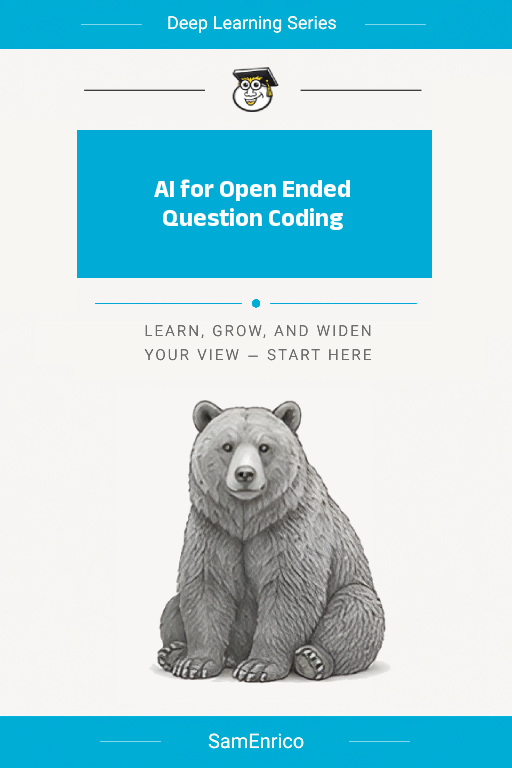
Non-FictionAI OperatorConsumer Insights
AI for Open Ended Question Coding Audiobook
Automatically code and tag open-ended survey respo
Automatically code and tag open-ended survey responses using AI. Replace manual coding processes.
Formats
Free sample
Chapter 1: The Hundred-Thousand-Dollar Box--–- Every year, organizations around the world collect millions of open-ended survey responses. They ask questions like “What could we have done better?” or “Why did you choose us over our competitors?” or “Please explain your score.” And then, after collecting this rich, qualitative gold, most of them do the same thing: they ignore it. Not because they want to. Not because the data lacks value. But because manually coding open-ended text responses is slow, expensive, and emotionally exhausting.
This chapter reveals the true cost of that avoidance and sets the stage for an entirely new way of working.The Box That Eats Budgets Every survey platform has one. Qualtrics calls it “Open Text – Please Specify.” Survey Monkey labels it “Other (please explain).” Google Forms simply provides a blank line. Researchers have learned to dread this field not because it fails to collect useful information—quite the opposite. The problem is what happens after the “Submit” button is clicked.Consider a typical customer satisfaction survey. You ask a closed-ended question: “On a scale of 0 to 10, how likely are you to recommend our company to a friend?” The respondent selects a 9.
That is a data point. It takes 0.3 seconds to process. Then you ask the open-ended follow-up: “What is the primary reason for your score?” The respondent writes: “The checkout process was confusing on mobile, but your customer service agent named Sarah was incredibly helpful when I called.”That single sentence contains at least three distinct codes: “Mobile checkout usability,” “Customer service effectiveness,” and a named entity reference to an employee. A human coder needs to read it, parse it, apply the correct taxonomy codes, and move to the next response. At best, that takes thirty seconds.
At scale, that becomes a nightmare.Let us do the math. A moderately sized survey with 10,000 open-ended responses. A skilled human coder, working at peak efficiency, can process approximately 20 responses per hour. That assumes clear writing, a well-designed codebook, and no interruptions. In reality, coder fatigue sets in after ninety minutes, accuracy drops, and the pace slows to 12–15 responses per hour.
For simplicity, we will use 20 responses per hour. That equals 500 hours of coding time. At a conservative 30perhourforaresearchassociateorjunioranalyst,thedirectlaborcostis30 per hour for a research associate or junior analyst, the direct labor cost is 30perhourforaresearchassociateorjunioranalyst,thedirectlaborcostis15,000.But that is only the beginning.The Hidden Multipliers of Manual Coding The 15,000figureassumesasinglecoderworkingalonewithoutsupervision,withoutqualitychecks,andwithoutanydisagreementresolution.Inpractice,researchteamsemploymultiplecoderstoreduceindividualbias.Twocodersworkingindependentlyonthesame10,000responsesdoublesthelaborcostto15,000 figure assumes…
This is the end of the free sample. Get the Audiobook to keep going. Buy now
About this book
Details
- Author
- Gerard Tatiana
- Publisher
- SamEnrico
- Language
- English
- Genre
- Non-Fiction, AI Operator, Consumer Insights
- Released
- 2026-05-30
- Pages (approx.)
- 142
- Available as
- eBook, Audiobook

Listen in the VoxFlicks app
Audiobooks and audio dramas wherever you go. Sign in with your SamEnrico account and press play.
More by Gerard Tatiana
 Young People AA GuideGerard Tatiana$11.99
 Japanese American Internee VetGerard Tatiana$11.99
 Feedback Receptivity EQGerard Tatiana$11.99
 Fear of Abandonment WorkbookGerard Tatiana$11.99
 The Clockwork Conspiracy: How the 1969 Moon Landing Almost FailedGerard Tatiana$11.99
 How to Become a LinkerGerard Tatiana$11.99
 Learn to Play the Cello (Violoncello)Gerard Tatiana$11.99
 Housing CoordinatorGerard Tatiana$11.99
You may also like
 Hong Kong Handover 1997Dunn Johnnie$11.99
 Zumba For Postnatal Recovery CourseNeal Christian$11.99
 Zumba for BeginnersLadner Nikia$11.99
 YouTube Comment Mining GuideHumes Pandora$12.99
 Worry Box MeditationCarlin Rudy$11.99
 Workplace Stress MeditationNguyen Lynn$11.99
 Workplace Stress and Sleep RepairHawley Ivory$11.99
 Workplace Perfectionism CureDelaney Jeffry$11.99
 Workplace Injustice Anger GuideWallen Isabelle$11.99
 Work Addiction and Burnout LinkGreenwood Ester$11.99
 Women in Yoga and WellnessBeattie Galina$11.99
 Women in Stand Up ComedyChun Evangeline$11.99