
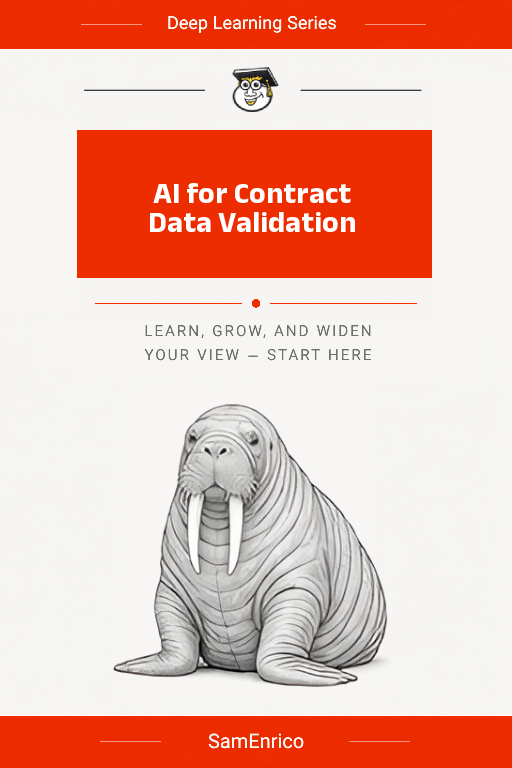
Non-FictionAI OperatorLegal Operations
AI for Contract Data Validation eBook
Validate extracted contract data against source do
Validate extracted contract data against source documents. Flag inconsistencies for review.
Formats
Free sample
Chapter 1: The Ground Truth Paradox...–- Every contract tells two stories. One is written in ink, frozen in time on a signed PDF. The other lives in databases, spreadsheets, and CLM fields—entered by tired paralegals, copied from faulty OCR, or transcribed from a blurry phone photo of a wet signature. These two stories are never identical. The gap between them is where million-dollar errors hide, and until you understand why that gap exists, no amount of AI will save you.The $87,000 Comma In 2019, a mid‑sized logistics company signed a three‑year transportation agreement with a vendor. The contract was standard: a base rate of $1,200 per shipment, with a fuel surcharge calculated as a percentage of the base rate. The recitals page stated the surcharge as “5.5%.” The payment schedule table, generated from a different template, stated “5.5%” as well. On the surface, the document was consistent.But the OCR system that extracted data into the company’s contract lifecycle management (CLM) platform misread the period in “5.5%” as a comma on three of the forty‑two pages—specifically, the pages that were printed from a low‑resolution scanner after the contract had been folded. The extracted value in the CLM read “5,5%,” which the system interpreted as “fifty‑five percent” after stripping non‑numeric characters and applying a naive decimal placement rule.Over thirty‑six months, the company overpaid by $87,000.When the discrepancy was finally discovered during an audit, the vendor pointed to the signed PDF: “The contract says 5.5%. You paid us according to the data you entered. Not our problem.” The company sued. They lost. The judge ruled that the executed contract controlled, and the company’s internal systems were not the vendor’s responsibility.The comma cost $87,000. But the real loss was in the lesson: extraction without validation is not automation. It is accelerated error.Why Traditional Methods Fail If you have worked with contracts for more than six months, you have your own version of this story. Perhaps it was a termination date misread as “06/07/2025” instead of “07/06/2025,” causing an auto‑renewal that added 200,000inunwantedspend.Perhapsitwasaliabilitycapof“200,000 in unwanted spend. Perhaps it was a liability cap of “200,000inunwantedspend.Perhapsitwasaliabilitycapof“1,000,000” extracted from a signature block while the indemnification clause on page fourteen stated “no cap”—a contradiction that no reviewer caught because the two sections were reviewed by different people on different days.Traditional contract review relies on three methods, each with catastrophic blind spots.Method One: Manual Data Entry. A paralegal reads the PDF and types values into fields. The error rate for manual transcription across multiple fields averages 4% per field, meaning a contract with fifty data points has an 87% chance of containing at least one error. Humans are not bad at this work because they are lazy. They are bad at it because the human brain is not designed for repetitive, low‑variation pattern matching. After the tenth contract, the eyes glaze. After the fiftieth, the brain starts autocorrecting what it sees—turning “30 days” into “30 days” (correct) while missing that the neighboring field says “NET 30” instead of “NET 45.”Method Two: OCR‑Only Extraction. Optical character recognition is remarkable technology. It can convert a 1994 fax of a photocopy into machine‑readable text with surprising accuracy. But OCR has no understanding of what it reads. It sees shapes, not meaning. A “1” and an “I” are visually similar; a “0” and an “O” are indistinguishable in many fonts. When OCR extracts a date as “January l5th, 2024” (using a lowercase L instead of the numeral 1), no amount of post‑processing can reliably distinguish a typo from an intentional abbreviation. OCR also fails catastrophically on tables, footnotes, and any text that does not flow in a straight line from left margin to right margin.Method Three: Rules‑Based Extraction with Regular Expressions. Regex is powerful for structured patterns: phone numbers, email addresses, social security numbers. But contracts are not structured documents. They are narratives with embedded data. A termination clause might appear as “This agreement may be terminated by either party upon thirty (30) days written notice” in one contract and “30‑day termination right applies after the initial term” in another. Regex cannot generalize. It can only match what you explicitly tell it to match. Every variation requires a new rule, and the rulebook quickly becomes an unmaintainable beast of edge cases.All three methods share the same fundamental flaw: they treat extraction as the final step. But extraction is never final. It is always provisional. The only way to know if extracted data is correct is to validate it against the source document—not once, but continuously, with a framework that understands that different types of data require different validation strategies.The Paradigm Shift: From Extraction to Validation This book proposes a fundamental inversion of the traditional contract data pipeline. In the old model, the workflow looked like this:Ingest → Extract → Store → (Optionally) Review → Execute Validation was an afterthought, squeezed between storage and execution if budget and time allowed. In the new model, validation is the central organizing principle:Ingest → Normalize → Validate → (If Valid) Store → Execute → (If Invalid) Flag → Remediate → Re‑validate The difference is not merely procedural. It is philosophical. In the old model, the system trusts the extractor and distrusts the document. In the new model, the system trusts the document as the ground truth and treats every extraction as a hypothesis to be tested.This shift has profound implications for how you architect your systems, train your models, and design your review workflows. It means accepting that no extractor—whether human or machine—is ever perfect. It means building systems that detect imperfection rather than systems that pretend perfection is possible. And it means designing interfaces that make validation fast and even pleasant, because if validation is painful, people will skip it, and you will be back to the old model.What Is Ground Truth, Really?The phrase “ground truth” appears frequently in machine learning literature. It refers to the correct label or value against which model predictions are measured. In contract validation, ground truth seems simple: it is the executed PDF. But as we will see throughout this book, even this seemingly obvious definition hides complexity.Consider a contract that has been signed, scanned, emailed, printed, re‑scanned, and uploaded to a CLM. The PDF in the system is a compressed image of a printout of a scan of a signature page. The original executed document exists only as dead trees in a filing cabinet three states away. Is the degraded PDF still ground truth?Consider a contract that references an exhibit. The exhibit is attached as a separate file. The PDF contains the words “See Exhibit A for pricing,” but Exhibit A was never scanned because the original was handwritten and the scanning operator thought it was a sticky note. Is the incomplete PDF ground truth?Consider a contract that was digitally signed in Docu Sign. The PDF in the CLM is a flattened representation of the signing ceremony. The original signing order—who signed first, the timestamps, the IP addresses—exists only in Docu Sign’s audit log. Is the flattened PDF ground truth?The answer, which we will develop throughout this chapter and refine in Chapter 2, is that ground truth is a commitment, not a file. You commit to treating a particular representation of…
This is the end of the free sample. Get the eBook to keep going. Buy now
About this book
Details
- Author
- Condon Sherril
- Publisher
- SamEnrico
- Language
- English
- Genre
- Non-Fiction, AI Operator, Legal Operations
- Released
- 2026-05-30
- Pages (approx.)
- 142
- Available as
- eBook, Audiobook

Read better in the ZLOADR app
Your eBooks on your phone or tablet. Sign in with your SamEnrico account and start reading.
More by Condon Sherril
 Community Cleanup SponsorshipCondon Sherril$11.99
 Street Musician BiographyCondon Sherril$11.99
 Canva Brand Identity for BakeriesCondon Sherril$11.99
 Smoking Cessation Bullet JournalCondon Sherril$11.99
 The Day the Dollar Died: How a Single Bank Run Toppled a NationCondon Sherril$11.99
 Learn to Play the Bass TrumpetCondon Sherril$11.99
 Forensic ExaminerCondon Sherril$11.99
 How to Become a Loading InspectorCondon Sherril$11.99
You may also like
 Hong Kong Handover 1997Dunn Johnnie$11.99
 Zumba For Postnatal Recovery CourseNeal Christian$11.99
 Zumba for BeginnersLadner Nikia$11.99
 YouTube Comment Mining GuideHumes Pandora$12.99
 Worry Box MeditationCarlin Rudy$11.99
 Workplace Stress MeditationNguyen Lynn$11.99
 Workplace Stress and Sleep RepairHawley Ivory$11.99
 Workplace Perfectionism CureDelaney Jeffry$11.99
 Workplace Injustice Anger GuideWallen Isabelle$11.99
 Work Addiction and Burnout LinkGreenwood Ester$11.99
 Women in Yoga and WellnessBeattie Galina$11.99
 Women in Stand Up ComedyChun Evangeline$11.99