
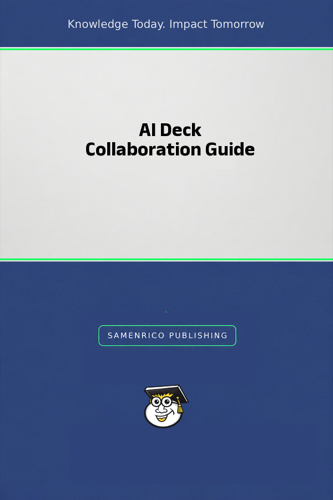
AI Deck Collaboration Guide eBook
Use AI to facilitate team slide deck creation and
by Oakley Oliva
Use AI to facilitate team slide deck creation and review.
Formats
Free sample
Chapter 1: The Fifty-Thousand-Dollar Hour--Every hour your team spends wrestling with a slide deck costs your company more than you think—and the math is worse than you imagine.Let us run the numbers together. A single mid-level manager earns $80,000 per year. Add benefits, overhead, and the cost of the three other people they will drag into the review process, and that manager’s hour costs the organization roughly $150. But that is not the real number. The real number is what you lose when that deck fails.
When a proposal gets rejected. When a budget request is denied. When a client chooses a competitor because your presentation confused them. Those losses routinely run into the hundreds of thousands—sometimes millions—of dollars. And the deck was the final common pathway for all of it.This book exists because we have all lived through the nightmare.
You know the one. It starts on a Tuesday morning when your manager says, “We need a deck for the senior leadership review on Friday.” You have no slides. You have a folder full of research PDFs, a spreadsheet with fourteen tabs, and a set of conflicting opinions from six stakeholders. By Wednesday, you have a draft. By Wednesday afternoon, you have seventeen email threads debating the font size on slide four.
By Thursday, you have reorganized the deck three times because three different people have three different theories about the “story.” By Friday morning, you present a deck that no one loves but everyone has compromised on. The leadership team nods politely, asks two confused questions, and defers the decision to “next quarter.” You have just lost your company $50,000 in salary time. You have also lost the opportunity. And you are so exhausted that you do not even have the energy to be angry about it.This is the fifty-thousand-dollar hour. It is not a single hour.
It is the accumulated hours of misalignment, friction, and low-value work that turn a five-hour task into a fifty-hour catastrophe. And it is entirely preventable.The Great Misunderstanding Most professionals believe that slide decks are a necessary evil—a formatting exercise that has little to do with real thinking. They are wrong. A slide deck is never just a document. It is a theory of persuasion.
It is a map of how you believe another human being’s mind moves from confusion to clarity to commitment. Every slide, every transition, every chart is a bet about what your audience needs to hear, in what order, and with what emotional weight.When your team builds a deck poorly, you are not just wasting time. You are revealing that your team does not share a common theory of persuasion. You are discovering that three people on your team think data convinces people, two people think stories convince people, and one person thinks that a really clever diagram will do the trick. None of them are entirely wrong, but none of them are aligned.
And without alignment, your deck becomes a Rorschach test—every stakeholder sees their own priority reflected back at them, and no one sees the coherent argument that might actually move the audience.This is where artificial intelligence enters the conversation, but probably not in the way you expect. The popular narrative about AI and presentations goes something like this: “Type a prompt, get a deck, done.” That narrative is seductive and false. The teams that succeed with AI are not the ones that treat it as a magic button. They are the ones that treat AI as a collaborator, a sparring partner, and a relentless executor of grunt work. They are the ones that have learned a new skill: how to direct artificial intelligence the way a film director directs a crew.The Cognitive Load Trap Before we talk about solutions, we need to understand why traditional slide creation fails so reliably.
The answer comes from cognitive science, specifically from two well-established theories that most business professionals have never heard of but experience every single day.Cognitive Load Theory, developed by John Sweller in the 1980s, describes the limited capacity of working memory. Your audience can hold approximately four discrete pieces of information in their conscious mind at any given moment. That is it. Everything beyond that either gets forgotten, ignored, or—worst of all—processed so slowly that the speaker moves on before the listener has caught up.The Cognitive Theory of Multimedia Learning (CTML) , advanced by Richard Mayer, adds a second constraint. Human beings have two separate channels for processing information: a visual channel and an auditory channel.
When those channels are balanced—meaning the speaker says different things than the slides show—learning and retention improve dramatically. When the channels are overloaded—meaning the speaker reads bullet points while the audience reads the same bullet points—the brain short-circuits. Retention drops to near zero.Here is what this means for your slide decks. Every time you put a dense paragraph of text on a slide and then read it aloud, you are asking your audience’s visual channel and auditory channel to process identical information simultaneously. There is no synergy.
There is only redundancy. And redundancy, in cognitive terms, is noise. Your audience checks out. They check email. They mentally compose their grocery list.
You have lost them, and you might not even know it until the Q&A session when someone asks a question that you answered on slide three.The traditional response to this problem has been to make slides simpler—fewer words, bigger fonts, more images. That helps, but it does not solve the deeper problem. The deeper problem is that teams do not know what belongs on the slide versus what belongs in the speaker’s mouth. And they do not know because they have never been taught. Most professionals learn to make slides through osmosis and suffering, not through training.
They imitate the bad decks they have seen, producing a culture of mediocrity that reproduces itself endlessly.The Committee Disease If cognitive overload is the first plague of team slide creation, death by committee is the second. The symptoms are unmistakable. A deck enters a shared folder. Ten people leave comments. Half the comments contradict the other half.
The original author tries to reconcile them, producing a version that pleases no one. Another round of comments arrives. The timeline doubles. Morale craters.Death by committee has three root causes, each more destructive than the last.The first root cause is ambiguity of authority. When five people are empowered to comment but no one is empowered to decide, the deck becomes a political football.
Each commenter uses their feedback to advance their own agenda, not the deck’s effectiveness. The person who wants a bigger logo is not actually worried about branding; they are asserting their status. The person who wants to add a slide about a minor technical detail is not worried about accuracy; they are making sure their expertise is visible. These are not design problems. They are governance problems dressed up as design problems.The second root cause is the absence of objective criteria.
When you ask ten people to evaluate a deck and give them no shared framework, you get ten different subjective…
This is the end of the free sample. Get the eBook to keep going. Buy now
About this book
Details
- Author
- Oakley Oliva
- Publisher
- SamEnrico
- Language
- English
- Genre
- Non-Fiction, AI Operator
- Released
- 2026-06-07
- Pages (approx.)
- 141
- Available as
- eBook, Audiobook

Read better in the ZLOADR app
Your eBooks on your phone or tablet. Sign in with your SamEnrico account and start reading.
More by Oakley Oliva
 Trans Body Esteem GuideOakley Oliva$11.99
 Dream Character Journaling GuideOakley Oliva$11.99
 The Greased Cartridge IncidentOakley Oliva$11.99
 Strength Training For CrossfitOakley Oliva$11.99
 Recall Notification System GuideOakley Oliva$11.99
 Death Dreams In ChildhoodOakley Oliva$11.99
 Slovenian Wood Processing UpgradeOakley Oliva$11.99
 Cu Chi Tunnel RatOakley Oliva$11.99
 From Rags to Retail: The Unlikely Rise of SheinOakley Oliva$11.99
 The Last Song of the Sumerians: When Civilization Fell SilentOakley Oliva$11.99
 Firestorm: The Sky That BurnedOakley Oliva$11.99
 Understanding Acropigmentation of DohiOakley Oliva$17.99
You may also like
 Hong Kong Handover 1997Dunn Johnnie$11.99
 Zumba For Postnatal Recovery CourseNeal Christian$11.99
 Zumba for BeginnersLadner Nikia$11.99
 YouTube Comment Mining GuideHumes Pandora$12.99
 Worry Box MeditationCarlin Rudy$11.99
 Workplace Stress MeditationNguyen Lynn$11.99
 Workplace Stress and Sleep RepairHawley Ivory$11.99
 Workplace Perfectionism CureDelaney Jeffry$11.99
 Workplace Injustice Anger GuideWallen Isabelle$11.99
 Work Addiction and Burnout LinkGreenwood Ester$11.99
 Women in Yoga and WellnessBeattie Galina$11.99
 Women in Stand Up ComedyChun Evangeline$11.99