
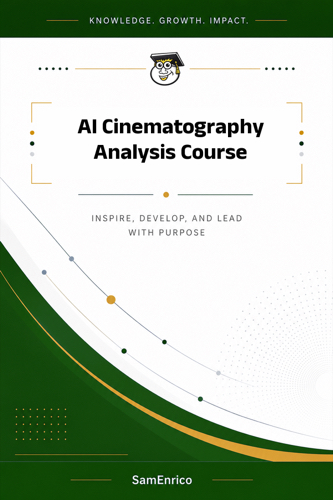
Non-FictionAI OperatorCinematography
AI Cinematography Analysis Course
Analyze shot composition, lighting, and camera mov
Analyze shot composition, lighting, and camera movement using computer vision to improve raw footage.
Formats
About this book
Free sample
Chapter 1: The Blind Editor--–- Every filmmaker has felt it. You stare at a shot—your shot—and something is wrong. The exposure looks fine. The composition follows the rule of thirds. The actor gave a good performance.
But the shot feels… dead. You cannot explain why. Your producer cannot explain why. The audience will not explain why—they will simply stop watching.This is the blind spot of human perception. Your brain is an extraordinary pattern-matching machine, but it is also a liar.
It adapts to light, so you stop noticing underexposure. It tracks motion, so you miss the micro-shakes ruining your dolly shot. It craves narrative, so it ignores the exit sign burning in the corner of the frame. You see what you want to see. The audience sees what is actually there.For a century, cinematographers have relied on two things to overcome this blind spot: expensive monitors with waveform scopes, and years of training to trust the machine more than their eyes.
But waveform scopes only measure light intensity. Vector scopes only measure color. Neither one tells you, "That lamp is intersecting your actor's head and destroying the composition."Enter computer vision. Not the science-fiction kind—the practical, boring, mathematical kind. A computer looking at your shot does not care about the story.
It does not get tired. It does not "adapt" to bad lighting. It sees pixels. It measures numbers. And when you learn to ask it the right questions, it becomes the most honest collaborator you have ever worked with.This book is not about replacing your eye.
It is about giving your eye a second opinion—one that comes with a spreadsheet.The Paradox of Cinematography Analysis Before we write a single line of code, we need to understand why this is so hard. Human visual perception is not a camera. It is a construction. Your retina captures noisy, incomplete data. Your brain fills in the gaps, corrects the colors, smooths the motion, and presents you with a seamless illusion of reality.
This is wonderful for surviving in the jungle. It is terrible for evaluating a shot.Consider exposure. You look at a…
This is the end of the free sample. Get the eBook to keep going. Buy now
Contents
- Chapter 1
- Chapter 2
- Chapter 3
- Chapter 4
- Chapter 5
- Chapter 6
- Chapter 7
- Chapter 8
- Chapter 9
- Chapter 10
- Chapter 11
- Chapter 12
Details
- Author
- Edmond Evette
- Publisher
- SamEnrico
- Language
- English
- Genre
- Non-Fiction, AI Operator, Cinematography
- Released
- 2026-06-06
- Pages (approx.)
- 157
- Available as
- eBook, Audiobook

Read better in the ZLOADR app
Your eBooks on your phone or tablet. Sign in with your SamEnrico account and start reading.
More by Edmond Evette
 Baghdad Round City PlanningEdmond Evette$11.99
 Panic Disorder Substance Induced GuideEdmond Evette$11.99
 Aging Pituitary Gland FunctionEdmond Evette$11.99
 The Gambling Addiction Recovery WorkbookEdmond Evette$11.99
 The Last Flight of the Concorde: When Supersonic Dreams CrashedEdmond Evette$11.99
 Into the Amazon's Heart: The Perils and Triumphs of the Xingu River ExpeditionEdmond Evette$11.99
 Mig WelderEdmond Evette$11.99
 Ecommerce Startup Funding OutlookEdmond Evette$12.99
 Coding Bootcamp Dropout RatesEdmond Evette$12.99
 Understanding BronchiectasisEdmond Evette$17.99
 How to Become a Saw FilerEdmond Evette$11.99
You may also like
 Hong Kong Handover 1997Dunn Johnnie$11.99
 Zumba For Postnatal Recovery CourseNeal Christian$11.99
 Zumba for BeginnersLadner Nikia$11.99
 YouTube Comment Mining GuideHumes Pandora$12.99
 Worry Box MeditationCarlin Rudy$11.99
 Workplace Stress MeditationNguyen Lynn$11.99
 Workplace Stress and Sleep RepairHawley Ivory$11.99
 Workplace Perfectionism CureDelaney Jeffry$11.99
 Workplace Injustice Anger GuideWallen Isabelle$11.99
 Work Addiction and Burnout LinkGreenwood Ester$11.99
 Women in Yoga and WellnessBeattie Galina$11.99
 Women in Stand Up ComedyChun Evangeline$11.99