
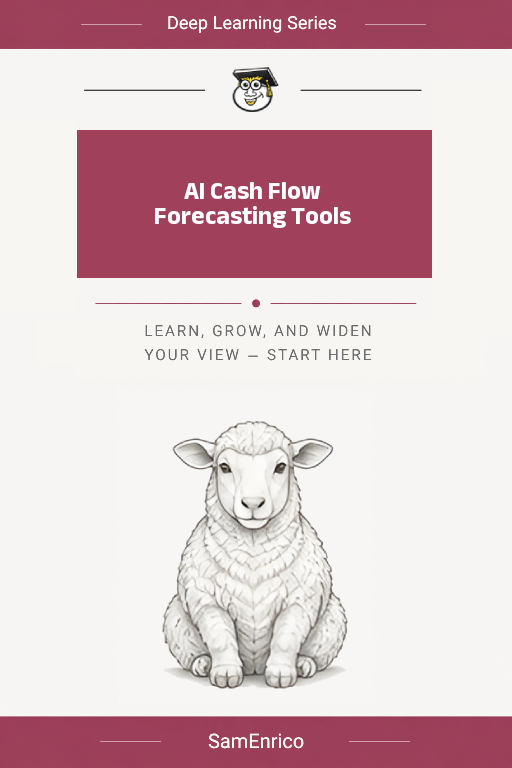
Non-FictionBusiness BriefCash Flow
AI Cash Flow Forecasting Tools
Predict future cash positions based on historical
Predict future cash positions based on historical patterns and upcoming invoices using AI.
Formats
About this book
Free sample
Chapter 1: The Fiction of Due Dates--–- On a chilly Tuesday morning in March, the CFO of a 200millionmanufacturingcompanysatstaringatthreedifferentspreadsheets,eachshowingadifferentcashbalanceforthesamebankaccount.Thetreasuryanalystinsistedthecompanywouldendthemonthwith200 million manufacturing company sat staring at three different spreadsheets, each showing a different cash balance for the same bank account. The treasury analyst insisted the company would end the month with 200millionmanufacturingcompanysatstaringatthreedifferentspreadsheets,eachshowingadifferentcashbalanceforthesamebankaccount.Thetreasuryanalystinsistedthecompanywouldendthemonthwith1.2 million. The controller’s model showed a 400,000shortfall.The ERP’snativecashflowreportpredictedacomfortable400,000 shortfall. The ERP’s native cash flow report predicted a comfortable 400,000shortfall.The ERP’snativecashflowreportpredictedacomfortable850,000. All three were wrong.
All three were built on the same flawed assumption: that customers pay on their due dates and suppliers wait patiently for theirs. Within six weeks, that company would be drawing on its emergency credit line for the first time in a decade.This is not a story about bad accounting or incompetent finance teams. It is a story about a broken paradigm that persists across virtually every organization on the planet. The traditional cash flow forecast, whether built in Excel, housed in an ERP module, or delivered by a dedicated treasury system, rests on a foundation of fiction. That fiction is the due date.We have been trained to believe that the date printed on an invoice carries meaning.
We build elaborate models around that date. We calculate days sales outstanding based on that date. We set collections targets, supplier payment runs, and even executive bonuses based on variances from that date. But the due date is not a prediction. It is a negotiation, a hope, a contractual artifact that bears little resemblance to actual human payment behavior.This chapter will dismantle the myths that keep finance teams trapped in reactive forecasting.
It will introduce the fundamental distinction between deterministic and probabilistic thinking. And it will provide a clear-eyed assessment of why spreadsheets, despite their flexibility and familiarity, are actively holding your organization back from predictive intelligence. By the end of this chapter, you will understand why the most sophisticated finance leaders are abandoning static models and embracing AI-driven approaches that forecast not what should happen, but what will happen.The Great Illusion: Why Your Forecast…
This is the end of the free sample. Get the eBook to keep going. Buy now
Contents
- Chapter 1
- Chapter 2
- Chapter 3
- Chapter 4
- Chapter 5
- Chapter 6
- Chapter 7
- Chapter 8
- Chapter 9
- Chapter 10
- Chapter 11
- Chapter 12
Details
- Author
- Nunes Dorothea
- Publisher
- SamEnrico
- Language
- English
- Genre
- Non-Fiction, Business Brief, Cash Flow
- Released
- 2026-06-01
- Pages (approx.)
- 124
- Available as
- eBook, Audiobook

Read better in the ZLOADR app
Your eBooks on your phone or tablet. Sign in with your SamEnrico account and start reading.
More by Nunes Dorothea
 Tumblr Nostalgia Loop CureNunes Dorothea$11.99
 Sibling Holiday Stress GuideNunes Dorothea$11.99
 HIIT Group Fitness GuideNunes Dorothea$11.99
 TCM Blood Stasis GuideNunes Dorothea$11.99
 The Alchemists of Enlightenment: How Coffee Houses Fueled the Scientific RevolutionNunes Dorothea$11.99
 How to Produce a Check WeigherNunes Dorothea$11.99
 Puli BreedingNunes Dorothea$11.99
 How to Start a Pipe System Construction for Steam Generators Business (Beginners Guide)Nunes Dorothea$11.99
You may also like
 Hong Kong Handover 1997Dunn Johnnie$11.99
 Zumba For Postnatal Recovery CourseNeal Christian$11.99
 Zumba for BeginnersLadner Nikia$11.99
 YouTube Comment Mining GuideHumes Pandora$12.99
 Worry Box MeditationCarlin Rudy$11.99
 Workplace Stress MeditationNguyen Lynn$11.99
 Workplace Stress and Sleep RepairHawley Ivory$11.99
 Workplace Perfectionism CureDelaney Jeffry$11.99
 Workplace Injustice Anger GuideWallen Isabelle$11.99
 Work Addiction and Burnout LinkGreenwood Ester$11.99
 Women in Yoga and WellnessBeattie Galina$11.99
 Women in Stand Up ComedyChun Evangeline$11.99