
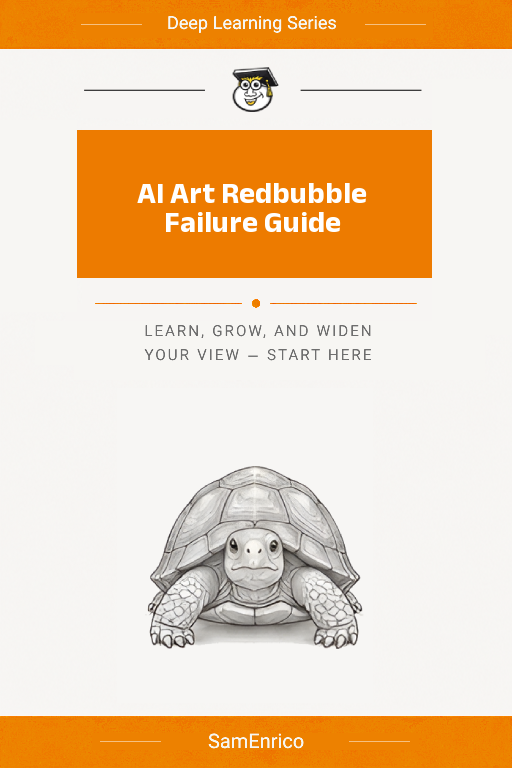
Non-FictionSide Hustle ArchitectCommon MistakesLessons
AI Art Redbubble Failure Guide eBook
Avoid common mistakes when selling AI art on Redbu
by Galvan Clora
Avoid common mistakes when selling AI art on Redbubble including copyright violations.
Formats
Free sample
Chapter 1: The Gold Rush Graveyard--–- The You Tube video promised “passive income,” “set it and forget it,” and “$10,000 a month with zero artistic skill.” The thumbnail showed a young man smiling in front of a laptop, a stack of cash, and an AI-generated image of a cyberpunk cat. You clicked. You watched. You believed.That was three months ago. Today, your Redbubble account is suspended.
You have seventeen cents in unpaid royalties. And you just received a legal notice from a law firm representing a company you’ve never heard of, demanding you cease and desist selling “derivative works” of a character you thought was “different enough.”You are not alone. You are standing in a graveyard.Chapter 1 is not about how to succeed. It is about why failure is the default. It is a tour of the common grave markers—the mistakes that 99 percent of AI art sellers make within their first ninety days.
If you understand these graves before you dig your own, you might just walk out of the graveyard alive.The Promise That Kills Every gold rush has two types of people: the ones who mine and the ones who sell shovels. In the AI art gold rush of 2024 through 2026, the shovel sellers are You Tube gurus, Tik Tok hustlers, and online course creators who have never shipped a T-shirt in their lives. Their promise is seductive because it is simple: type a few words, click a button, upload to Redbubble, and watch money appear.The reality is brutal. Redbubble is not a passive income machine. It is a high-stakes marketplace with sophisticated anti-spam algorithms, aggressive copyright enforcement, and a legal framework that holds you—not the AI, not the platform—fully responsible for every pixel you upload.
The passive income fantasy dies within weeks, replaced by the cold silence of zero sales or the sudden shock of an account termination email.But here is the crucial distinction that most sellers never grasp until it is too late: Redbubble is financially low-risk but legally high-risk. You can upload for free. You pay nothing upfront. That is the bait. The trap is that each upload carries potential legal liability, account termination risk, and the slow erosion of your time and energy.
Financial risk is zero. Legal and operational risk is enormous. Most sellers confuse the two and pay the price.The Three Pillars of Failure After analyzing hundreds of seller reports from Reddit, You Tube comments, Discord servers, and platform analytics (all anecdotal, but consistent), three categories of failure emerge again and again. Think of them as three legs of a stool. If any one leg breaks, your account collapses.Pillar One: Legal Ignorance – The most common cause of termination.
Sellers upload designs featuring copyrighted characters, trademarked logos, or celebrity likenesses. They mistakenly believe that “the AI made it” or “it’s fan art” or “I changed the color” offers protection. It does not. Legally, you are the publisher. The AI is a tool, not a co-defendant.Pillar Two: Technical Spam – Sellers treat Redbubble like an SEO game.
They stuff tags with irrelevant keywords, hoping to capture search traffic for “Disney” even though their design is a generic cat. They upload hundreds of designs per day, triggering anti-bot algorithms. Redbubble is not Google. It is a marketplace that wants to surface quality, not quantity. Spam tactics lead to shadow suppression and eventual termination.Pillar Three: Artistic Laziness – Sellers post raw, unedited AI generations with obvious flaws: six-fingered hands, garbled text, warped anatomy, low resolution, or visible artifacts from upscaling.
These designs receive no sales, no favorites, and no engagement. Redbubble’s algorithms notice. Accounts that produce no value get de-prioritized. The seller keeps uploading into a void, wondering why nothing works.These three pillars are not separate problems. They feed each other.
Legal ignorance leads to risky designs. Technical spam amplifies the risk because tag stuffing attracts legal scrutiny. Artistic laziness means even the safe designs fail to sell, so the seller doubles down on spam and infringement, accelerating the crash.Let us examine each pillar in detail, because understanding the anatomy of failure is the first step toward avoiding it.Pillar One: Legal Ignorance – The Quiet Lawsuit The most dangerous failure mode is also the most common. It begins with a simple prompt: “Pikachu wearing a top hat, steampunk style, high quality.” The AI generates something cute. The seller uploads it to Redbubble with the title “Steampunk Pikachu” and tags including “Pokémon, Nintendo, Pikachu, anime, gaming.” Within twenty-four hours, Nintendo’s automated enforcement bots find the listing.
They send a DMCA takedown notice to Redbubble. Redbubble removes the design and adds a strike to the seller’s account.The seller is confused. “But I changed the style,” they think. “It’s transformative. It’s fan art.
I’m not selling it as official merchandise.”None of that matters.Under US copyright and trademark law, intent is irrelevant. The test is whether the design is substantially similar to a protected work and whether it creates a likelihood of confusion in the marketplace. A steampunk Pikachu is still recognizable as Pikachu. The name “Pikachu” in the title and tags is a direct trademark violation. Nintendo does not care about artistic intent.
They care about protecting their brand.The seller now has a strike. They may not even know it because Redbubble does not show strikes to sellers. They only see that one design was removed. They assume it is a warning. They post another similar design the next week.
Another takedown. Another strike. On the third violation, Redbubble terminates the account permanently. The seller is locked out. Their tax ID is flagged.
They cannot return.This scenario plays out thousands of times per month across Redbubble, Etsy, and other print-on-demand platforms. The sellers are not bad people. They are not malicious counterfeiters. They are ordinary people who believed a You Tube video that said “AI art is free money” and never explained trademark law.The most painful part is that the legal risks extend far beyond account termination. In theory, rights holders can sue individual sellers for statutory damages.
For copyright infringement, damages range from 750to750 to 750to30,000 per work, and up to 150,000forwillfulinfringement.Fortrademarkinfringementandrightofpublicityviolations,somestatesimposedamagesof150,000 for willful infringement. For trademark infringement and right of publicity violations, some states impose damages of 150,000forwillfulinfringement.Fortrademarkinfringementandrightofpublicityviolations,somestatesimposedamagesof1,000 to $50,000 per violation. Lawsuits against individual Redbubble sellers are rare because most sellers have no money to collect, but they are not impossible. The risk exists. The fear is real.Pillar Two: Technical Spam – The Algorithm’s Red Flag The second pillar is less dramatic than legal termination but equally deadly.
It is death by a thousand cuts, administered by Redbubble’s spam detection algorithms.Redbubble is not a search engine. It is a curated marketplace. Its machine learning systems are trained to identify and promote high-quality, unique, relevant designs while suppressing low-effort, mass-uploaded, keyword-stuffed spam. The algorithm looks for three specific behaviors.First, keyword stuffing. Many sellers believe that more tags equal more visibility.
They add fifty tags to every design, including irrelevant brand names like “Disney,” “Nike,” “Gucci,” “Star Wars,” “Marvel,” and “Batman” even when the design is a…
This is the end of the free sample. Get the eBook to keep going. Buy now
About this book
Details
- Author
- Galvan Clora
- Publisher
- SamEnrico
- Language
- English
- Genre
- Non-Fiction, Side Hustle Architect, Common Mistakes, Lessons
- Released
- 2026-06-01
- Pages (approx.)
- 119
- Available as
- eBook, Audiobook

Read better in the ZLOADR app
Your eBooks on your phone or tablet. Sign in with your SamEnrico account and start reading.
More by Galvan Clora
 Metabolic Syndrome Blood Pressure GuideGalvan Clora$11.99
 Francis Preaching to Birds ManualGalvan Clora$11.99
 Recurring Dream Journal WorkbookGalvan Clora$11.99
 Financial Caregiver Burnout GuideGalvan Clora$11.99
 Assertiveness for New Mothers GuideGalvan Clora$11.99
 Whispers of the Frozen Forest: The Lost Expedition of the Arctic FoxGalvan Clora$11.99
 The Deep Sea Pioneers: Unlocking the AbyssGalvan Clora$11.99
 SAFe for Medtronic StartupsGalvan Clora$12.99
 Healthcare ManagementGalvan Clora$11.99
 Understanding EpendymoblastomaGalvan Clora$17.99
 How to Start a Damage Evaluators Business (Beginners Guide)Galvan Clora$11.99
You may also like
 Hong Kong Handover 1997Dunn Johnnie$11.99
 Zumba For Postnatal Recovery CourseNeal Christian$11.99
 Zumba for BeginnersLadner Nikia$11.99
 YouTube Comment Mining GuideHumes Pandora$12.99
 Worry Box MeditationCarlin Rudy$11.99
 Workplace Stress MeditationNguyen Lynn$11.99
 Workplace Stress and Sleep RepairHawley Ivory$11.99
 Workplace Perfectionism CureDelaney Jeffry$11.99
 Workplace Injustice Anger GuideWallen Isabelle$11.99
 Work Addiction and Burnout LinkGreenwood Ester$11.99
 Women in Yoga and WellnessBeattie Galina$11.99
 Women in Stand Up ComedyChun Evangeline$11.99