
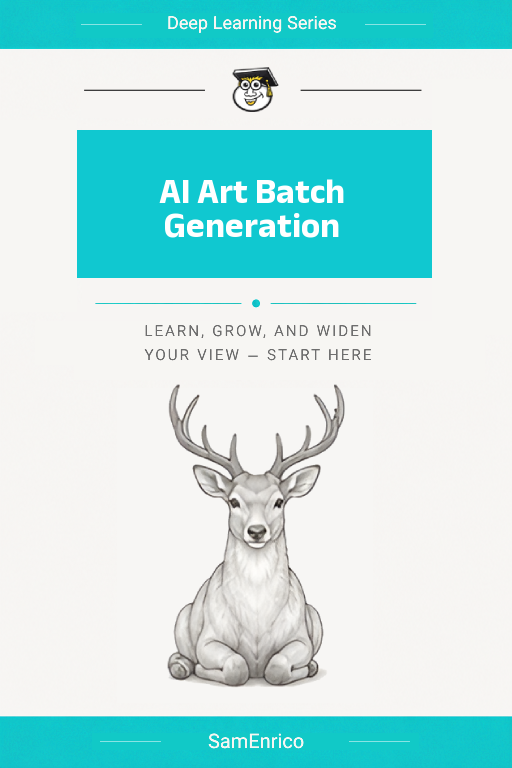
Non-FictionSide Hustle ArchitectBatch GenerationEfficiency
AI Art Batch Generation eBook
Generate AI art in batches for Redbubble using pro
Generate AI art in batches for Redbubble using prompt variations and automation.
Formats
Free sample
Chapter 1: The Inventory Engine--–- Sarah was not an artist. By her own admission, she could barely draw a stick figure that didn't look like it had suffered a neurological event. She had tried selling on Redbubble twice before—once with a collection of poorly photographed pet portraits, once with text-based designs she typed in Canva. Both shops died silent deaths, accumulating exactly three sales: two from her mother and one from a confused stranger who immediately requested a refund.Six months later, Sarah's third shop crossed two thousand dollars in a single month. She had not learned to draw.
She had not hired a designer. She had not spent hours agonizing over color palettes or composition. What she had done was shift her mindset from "creating art" to "building an inventory engine." And that shift is what this entire book is about.This is not a book about making one beautiful image. There are dozens of books for that. This is a book about generating one hundred, five hundred, or ten thousand images systematically, strategically, and profitably.
It is about turning the unpredictable, chaotic act of AI generation into a repeatable, scalable workflow that feeds your Redbubble shop like a machine.If you came here hoping to learn how to craft the perfect prompt for a single masterpiece, close this book and walk away. That path leads to frustration, inconsistency, and shops that look like abandoned warehouses. But if you are ready to think in sets, batches, and variations—if you are ready to let the market decide what works while you focus on the one thing humans still do better than AI, which is curating and strategizing—then turn the page.The One-Image Trap Every seller falls into the One-Image Trap. It feels natural. You have an idea—a cute cat wearing a wizard hat, a retro sunset over a mountain range, a motivational quote in elegant typography.
You spend twenty minutes refining the prompt. You generate ten versions, pick the best one, upscale it, write a title and tags, upload it to Redbubble, and... nothing happens. So you repeat the process. Another idea.
Another twenty minutes. Another single image. Another silence.The trap is seductive because each image feels like progress. You are creating! You are uploading!
But mathematically, the One-Image Trap is a slow death. Redbubble has over eight million active designs. Your single image is competing against millions of others for a few seconds of a buyer's attention. The probability that any one design—no matter how beautiful—will be seen, clicked, and purchased is astronomically low.Here is the hard truth that bestselling Redbubble sellers understand and struggling sellers resist: volume is not the enemy of quality. Volume is the prerequisite for discovery.Redbubble's search algorithm works like this: when a user searches for "cottagecore mushroom sticker," the algorithm scans all designs that contain those keywords in their title, tags, or description.
It then ranks them based on a complex blend of relevance, historical sales, and—crucially—shop activity. Shops that upload consistently are treated as more trustworthy. Shops with hundreds of designs are treated as more established. Shops that appear to be active businesses, not hobbyists, get a permanent boost.The One-Image Trap keeps you in hobbyist territory forever. One image per day means three hundred sixty-five images per year.
That sounds like a lot until you realize that top sellers often upload fifty to one hundred new designs per week. Not because they work eighty hours—but because they have built systems. They think in batches. They think in templates. They think in engines.The Guess vs.
Choose Paradigm Let me introduce a concept that will rewire how you think about AI art generation: Guess vs. Choose.When you generate a single image, you are guessing. You are betting that your personal taste—what you find beautiful, clever, or trendy—aligns with what thousands of anonymous buyers will want to put on a t-shirt, a sticker, or a phone case. That is a dangerous bet. Your taste is not the market's taste.
Your favorite color might be teal; the market might be buying mustard yellow. Your favorite animal might be foxes; the market might be obsessed with axolotls this month.Even worse, you have no data. One image generates no signal. If it sells zero copies, was that because the image was bad, the niche was wrong, the tags were weak, or simply bad luck? You cannot know.
You are guessing in the dark.When you generate one hundred variations systematically, you are choosing. You are no longer guessing what works—you are presenting the market with options and letting the market tell you. One hundred variations of "cottagecore mushroom sticker" in different color palettes, compositions, and styles will generate real data. Within a few weeks, you will know: buyers prefer red caps over blue, close-up shots over wide angles, and watercolor textures over flat vector. Now you are no longer guessing.
You are choosing based on evidence.This is the core shift that separates profitable batch generators from frustrated one-off artists. Guessing is emotional. Choosing is strategic. Guessing asks, "Do I like this?" Choosing asks, "Does the market like this?" The second question is the only one that pays your bills.Why Redbubble Specifically? (And Not Other Platforms)Before we go further, a necessary clarification.
This book focuses exclusively on Redbubble. Not because other platforms are bad—Merch by Amazon, Spreadshirt, and Tee Public all have their strengths—but because Redbubble has three characteristics that make batch generation uniquely powerful:Characteristic 1: Seamless patterns are first-class citizens. Redbubble's all-over print products (duvet covers, shower curtains, leggings, tote bags) thrive on repeating patterns. Batch generation can produce hundreds of seamless patterns from a single template by varying colors and compositions. Merch by Amazon does not support seamless patterns at all.
Spreadshirt does, but with a clunkier upload process.Characteristic 2: Fifty tags per design. Redbubble allows up to fifty tags. That is an enormous surface area for keyword optimization. Batch generation paired with automated metadata creation can saturate an entire niche's search landscape, making your shop the default answer for dozens of long-tail searches.Characteristic 3: The algorithm rewards volume. Unlike Etsy, which has complex quality scores and heavily weights reviews, Redbubble's algorithm is comparatively straightforward: more designs, more uploads, more sales → higher ranking.
This is a batch generator's dream. Every new design is a new lottery ticket, and you can print lottery tickets at scale.If you sell on other platforms, the principles in this book will apply—but the specific workflows (seamless pattern generation, metadata structure, automation scripts) will need adaptation. Throughout the book, I will call out when a technique is Redbubble-specific. Assume everything else is universal.The Automation Paradox: Replacing Repetition, Not Creativity Whenever I teach batch generation, someone asks the same question: "Doesn't this just replace artists with robots?"The answer is no, and the reason is the Automation Paradox. Automation is not a substitute for creativity.
Automation is a substitute for repetition. And repetition was never the creative part of art.Think about what a human artist actually does when creating a hundred variations of a design by hand. They…
This is the end of the free sample. Get the eBook to keep going. Buy now
About this book
Details
- Author
- Winchester Sanda
- Publisher
- SamEnrico
- Language
- English
- Genre
- Non-Fiction, Side Hustle Architect, Batch Generation, Efficiency
- Released
- 2026-06-01
- Pages (approx.)
- 136
- Available as
- eBook, Audiobook

Read better in the ZLOADR app
Your eBooks on your phone or tablet. Sign in with your SamEnrico account and start reading.
More by Winchester Sanda
 Pregnancy Dream Symbolism GuideWinchester Sanda$11.99
 Metabolic Syndrome Complete GuideWinchester Sanda$11.99
 Francis and Sultan Al Kamil EncounterWinchester Sanda$11.99
 Financial Isolation Recovery GuideWinchester Sanda$11.99
 Assertiveness for Caregivers GuideWinchester Sanda$11.99
 Into the White Silence: The Forgotten Arctic Expedition of Alexander KolchakWinchester Sanda$11.99
 Understanding Epidemic EncephalomyelitisWinchester Sanda$17.99
 Silicon Shadows: The Vanished Billionaire's AI HeistWinchester Sanda$11.99
 Scrum for Unity StartupsWinchester Sanda$12.99
 High School PrincipalWinchester Sanda$11.99
 How to Start a Dairy Produce N.e.c (wholesale) Business (Beginners Guide)Winchester Sanda$11.99
You may also like
 Hong Kong Handover 1997Dunn Johnnie$11.99
 Zumba For Postnatal Recovery CourseNeal Christian$11.99
 Zumba for BeginnersLadner Nikia$11.99
 YouTube Comment Mining GuideHumes Pandora$12.99
 Worry Box MeditationCarlin Rudy$11.99
 Workplace Stress MeditationNguyen Lynn$11.99
 Workplace Stress and Sleep RepairHawley Ivory$11.99
 Workplace Perfectionism CureDelaney Jeffry$11.99
 Workplace Injustice Anger GuideWallen Isabelle$11.99
 Work Addiction and Burnout LinkGreenwood Ester$11.99
 Women in Yoga and WellnessBeattie Galina$11.99
 Women in Stand Up ComedyChun Evangeline$11.99