
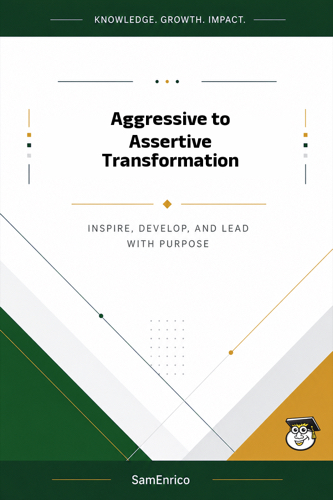
Aggressive to Assertive Transformation eBook
Teaches replacing domination and yelling with calm
by Ashmore Fae
Teaches replacing domination and yelling with calm, respectful boundary setting.
Formats
Free sample
Chapter 1: The Rupture That Speaks--The morning had started like any other. Coffee, a glance at emails, the quiet hum of a household not yet fully awake. And then, in a span of ninety seconds, everything tilted. A child spilled cereal. A partner asked an innocent question about the evening plans.
A phone pinged with a work message that could have waited. Nothing catastrophic. Nothing that, viewed from the outside, would warrant more than a mild sigh. And yet, by the time the kitchen floor was wiped and the front door had slammed, three people were crying, two relationships had taken a fresh wound, and one person—the one whose voice had risen highest—was sitting in a car, heart pounding, wondering, What is wrong with me?This is the rupture that speaks. It is not the explosion that makes the news.
It is the everyday detonation that happens in kitchens, office hallways, living rooms, and parking lots. It is the moment when frustration curdles into volume, when a reasonable request becomes a weapon, when a person who wants nothing more than to be understood instead becomes unbearable. And it leaves behind a specific kind of silence: the silence of people who have learned to walk on eggshells, the silence of a partner who no longer brings up difficult topics, the silence of a child who has stopped explaining how they feel.If you are reading this book, you already know this silence. You may be the one who created it. You may be the one who lives inside it.
Either way, you are here because you have begun to suspect something important: that winning the argument is not the same as keeping the relationship. That being loud is not the same as being powerful. That somewhere beneath the yelling, the sarcasm, the door-slamming, and the cold silences, there is a different way to be—a way that does not require you to shrink or to roar, but simply to stand firmly in your own dignity while allowing others to stand in theirs.This chapter is not a call to shame. It is not a lecture about how anger is bad or how nice people never raise their voices. In fact, the opposite is true.
Anger is essential. Anger is a messenger. The problem is not that you feel angry; the problem is what you do with that feeling when it arrives. Most people who struggle with aggression are not monsters. They are exhausted, overwhelmed, poorly equipped, or deeply afraid.
They have learned—often from parents, from workplaces, from a culture that rewards dominance—that volume equals authority and that the loudest voice wins. And for a while, that strategy works. People back down. Children comply. Coworkers stop arguing.
The immediate reward is intoxicating. But the long-term cost is devastating.Let us name that cost clearly. Aggression destroys respect. It does not create it. When you yell, the person on the receiving end is not thinking, What a strong, admirable person.
They are thinking, I need to get away from this person. Their nervous system floods with cortisol and adrenaline. Their prefrontal cortex—the part of the brain responsible for logic, reasoning, and long-term planning—shuts down. They may comply in the moment, but that compliance is not cooperation. It is survival behavior.
And survival behavior breeds resentment, withdrawal, and eventual retaliation. This is the illusion of control: you think you are steering the ship, but you are actually drilling holes in the hull.This book exists because that cycle can be interrupted. You can learn to replace domination with boundary-setting, volume with clarity, and yelling with calm, firm communication. The tools exist. The neuroscience is clear.
And thousands of people have made this transformation before you. But the first step is not learning a new script or memorizing a breathing technique. The first step is looking directly at the cost of what you have been doing and deciding that you are no longer willing to pay it.The Moment You Knew Something Had to Change Everyone who transforms their relationship with aggression has a turning point. Sometimes it is dramatic: a partner packs a bag. A boss issues a final warning.
A child says, “I’m scared of you when you’re angry.” Sometimes it is quieter: a look of exhaustion on a loved one’s face, a moment of disorientation after yelling where you cannot remember why you started, a realization that you are more alone than you used to be. This chapter asks you to recall that moment. Not to wallow in guilt, but to harvest the information it contains.Guilt is a strange companion. It can paralyze, or it can mobilize. Most aggressive people swing between explosive outbursts and crushing guilt, and that guilt—instead of leading to change—leads to appeasement.
You yell, then you feel terrible, then you become passive and overly accommodating, then you build resentment, then you explode again. This is the cycle that keeps you trapped. And it will continue until you understand that guilt without action is just self-punishment. The question is not whether you have done damage. The question is whether you are willing to learn a different way.In the chapters ahead, you will build a complete toolkit.
You will learn the physiology of calm—why the urge to yell peaks at about ninety seconds and then begins to fall, and how to ride that wave without acting on it. You will learn to identify your specific triggers, the particular situations that reliably produce aggression, and you will build a customized plan to intercept those moments. You will learn the difference between protective aggression (defense, fear-based) and predatory aggression (control, power-based), and you will discover that each requires a different response. You will learn structured communication formulas like DEAR MAN, which turns vague yelling into specific, negotiable requests. You will learn how to say no without apology, how to hold a boundary without hostility, and how to repair damage when—not if—you relapse.
Because you will relapse. That is not failure. That is being human. The difference between toxic aggression and transforming aggression is what you do after you blow up.But before any of that, you must sit in the truth of this chapter: that your current strategy is not working. Not really.
Not in the ways that matter.The Respect Paradox: Why Domination Fails Let us examine the respect paradox in detail, because it is the single most misunderstood dynamic in aggressive behavior. Most people who yell believe they are commanding respect. They believe that raising their voice signals seriousness, that intimidation demonstrates strength, that making someone flinch proves they are not to be trifled with. This is a profound error, and it is reinforced by almost every cultural message we receive. Watch any movie about a powerful CEO, a tough coach, a no-nonsense parent.
They yell. They dominate. And the story rewards them. The team wins. The employee straightens up.
The child finally listens.Real life does not work that way. In real life, the person who yells is not remembered as powerful. They are remembered as frightening. And fear is not respect. Respect is voluntary.…
This is the end of the free sample. Get the eBook to keep going. Buy now
About this book
Details
- Author
- Ashmore Fae
- Publisher
- SamEnrico
- Language
- English
- Genre
- Non-Fiction, Self-Help, Anger
- Released
- 2026-06-12
- Pages (approx.)
- 131
- Available as
- eBook, Audiobook

Read better in the ZLOADR app
Your eBooks on your phone or tablet. Sign in with your SamEnrico account and start reading.
More by Ashmore Fae
 Teacher Guide to Teen ConfidenceAshmore Fae$11.99
 Scheduling for Shift WorkersAshmore Fae$11.99
 IBS Herbal Medicine GuideAshmore Fae$11.99
 Focus Windows Strategy GuideAshmore Fae$11.99
 Geo Arbitrage for ProgrammersAshmore Fae$11.99
 The Low Profile FreelancerAshmore Fae$11.99
 Driving Music for CalmnessAshmore Fae$11.99
 The Fire Below: Katia and Maurice Krafft’s Dance with VolcanoesAshmore Fae$11.99
 Echoes of the Lost Colony: The Roanoke EnigmaAshmore Fae$11.99
 The Complete Guide to the Mcdougall DietAshmore Fae$11.99
 Automation SpecialistAshmore Fae$11.99
 How to Start a Mosque Business (Beginners Guide)Ashmore Fae$11.99
You may also like
 Hong Kong Handover 1997Dunn Johnnie$11.99
 Zumba For Postnatal Recovery CourseNeal Christian$11.99
 Zumba for BeginnersLadner Nikia$11.99
 YouTube Comment Mining GuideHumes Pandora$12.99
 Worry Box MeditationCarlin Rudy$11.99
 Workplace Stress MeditationNguyen Lynn$11.99
 Workplace Stress and Sleep RepairHawley Ivory$11.99
 Workplace Perfectionism CureDelaney Jeffry$11.99
 Workplace Injustice Anger GuideWallen Isabelle$11.99
 Work Addiction and Burnout LinkGreenwood Ester$11.99
 Women in Yoga and WellnessBeattie Galina$11.99
 Women in Stand Up ComedyChun Evangeline$11.99