
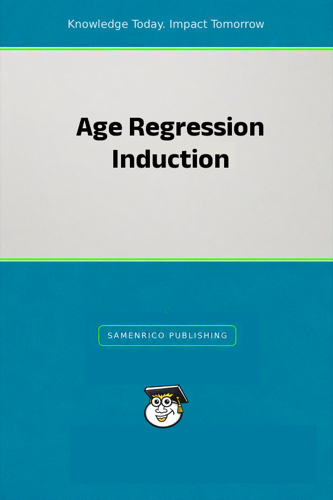
Non-FictionSelf-HelpAge Regression
Age Regression Induction eBook
Return to younger state through trance.
Return to younger state through trance.
Formats
Free sample
Chapter 1: The Forgotten Instruction--–- The first time I watched a client fail to regress, I made every mistake in the book. She was a forty-two-year-old accountant with a phobia of elevators that had cost her three job promotions. Her conscious mind wanted nothing more than to ride a lift to the nineteenth floor. Her unconscious mind had other plans. I guided her through a standard induction, counted her down a staircase of years, and asked her to describe her seventh birthday party.
She described it perfectly—from the outside. “I see myself at the table,” she said, “and I’m wearing a blue dress. There’s a cake with seven candles.” I asked how she felt. She said, “She looks happy.” Not “I am happy.” She. The pronoun gave everything away.
My client was not reliving her seventh birthday. She was watching a movie of it from the mezzanine, safely detached, intellectually present but emotionally absent. I had induced memory recall, not age regression. The difference would take me another decade of clinical work to fully understand.This chapter dismantles the single most common misunderstanding in all of hypnotherapy: the assumption that remembering the past is the same as returning to it. We will establish precise clinical terminology, map the spectrum of regressive phenomena, resolve the illusion-versus-reality debate that has divided the field since the nineteenth century, and introduce the one instruction that separates superficial recall from profound revivification.
By the end of this chapter, you will never again confuse a client’s narrative memory with a genuine return to a younger state.The Three Faces of Regression The literature of clinical hypnosis has suffered for decades from terminological promiscuity. The word “regression” has been used to describe everything from a client playfully sucking their thumb to a full somnambulistic reliving of a traumatic birth. These are not the same phenomenon. They are not even close. The first task of any competent practitioner is to distinguish among three fundamentally distinct states.Behavioral regression occupies the shallowest end of the spectrum.
In this state, the client acts younger without feeling younger. Their posture may shift, their voice may become more childlike, they may engage in age-inappropriate behaviors such as crying or clinging. However, when questioned directly, they will acknowledge that they are an adult “pretending” or “going along with the process.” Behavioral regression is often confused with genuine regression by inexperienced therapists because it looks convincing from the outside. A client may speak in a high-pitched voice, refer to themselves as “little,” and exhibit childlike mannerisms while their adult consciousness remains fully intact behind the performance. This is not healing.
This is compliance dressed in costume.Affective regression goes deeper. In this state, the client feels younger emotionally while retaining adult orientation. They may experience sudden waves of vulnerability, fear, joy, or shame that belong to an earlier developmental stage. Their emotional responses become age-inappropriate: a minor criticism triggers the raw humiliation of a five-year-old; a gentle question provokes the wordless terror of a toddler facing an angry parent. Yet when the therapist asks, “How old are you right now?” the client can still answer correctly.
They know they are an adult. They simply feel like a child. Affective regression is powerful and therapeutically useful, particularly for inner child work, but it is not full regression.Revivification is the gold standard. This term, borrowed from the French hypnotist Pierre Janet and refined by Milton Erickson, describes a state in which the client does not remember the past but re-lives it as if it is happening in the present moment. The subject’s temporal orientation shifts completely.
When asked their age, they will answer with the age of the regression—five, eight, twelve—without hesitation or irony. They will describe the room around them as it appeared decades ago. They will feel the temperature, smell the air, experience the visceral fear or joy of that long-vanished moment. Most critically, they will have temporary amnesia for their adult identity and future knowledge. The forty-year-old accountant does not know she is forty during revivification.
She is seven, sitting at a birthday party, and the cake has seven candles.This amnesia is not a side effect. It is the engine of therapeutic change.The Spectrum of Regression: From Performance to Reliving No client arrives at a single point on the regression spectrum and stays there. The skilled therapist learns to assess where a given client falls during the first session and, more importantly, how to move them along the spectrum toward deeper states over time.Pseudo-regression sits at the shallowest level. The client is fully aware of their adult identity and is either consciously cooperating with the therapist’s suggestions or consciously resisting them. This is not regression at all in the phenomenological sense; it is imaginative role-play.
Pseudo-regression can be useful for demonstration purposes or for highly analytical clients who need to build trust before surrendering control, but it produces no lasting therapeutic change. The client is essentially reciting lines from a script they have written about their past, not accessing the raw, unedited footage.Simple age recall represents the next level. Here, the client can access episodic memories from childhood with unusual clarity. They can describe events, conversations, sensory details. However, they do so from the perspective of their adult self looking backward.
The memory is a mental image they examine, not a world they inhabit. This is what most people mean when they say “I remember my childhood.” It is a useful clinical tool for gathering history but carries no transformative power.Affective regression, as described above, adds emotional immersion to recall. The client feels the feelings of the younger self while maintaining adult cognitive orientation. This is where significant therapeutic work can begin, particularly for issues rooted in emotional conditioning such as phobias, attachment wounds, and shame-based patterns.Partial revivification involves temporary loss of adult orientation for specific sensory modalities. A client may be unable to see the therapy room but can still hear the therapist’s voice as an adult.
Or they may speak from a child’s perspective but retain flickering awareness of their adult context. This is a transitional state, often frustrating for both therapist and client, but it signals that deeper work is possible.Somnambulistic revivification is the deepest level. The client experiences complete loss of adult orientation and temporary amnesia for their future life. They are, for all phenomenological purposes, the age to which they have regressed. Their responses are spontaneous, unmonitored, and unfiltered by adult social conditioning.
This state produces the most dramatic and lasting therapeutic results—and the most spectacular clinical failures when mishandled.The spectrum is not a ladder that every client must climb. Some clients will never reach somnambulistic revivification, and that is perfectly acceptable. Many therapeutic goals can be achieved at the affective regression level. However, the therapist must know where their client currently stands and what interventions are appropriate for that depth. Attempting re-parenting work with a client in pseudo-regression is like performing surgery on a mannequin.
The motions are correct. The outcome is zero.The Illusion Versus Reality Debate: What Actually Happens in Regression?No discussion of age regression can…
This is the end of the free sample. Get the eBook to keep going. Buy now
About this book
Details
- Author
- Brannon Celesta
- Publisher
- SamEnrico
- Language
- English
- Genre
- Non-Fiction, Self-Help, Age Regression
- Released
- 2026-06-11
- Pages (approx.)
- 149
- Available as
- eBook, Audiobook

Read better in the ZLOADR app
Your eBooks on your phone or tablet. Sign in with your SamEnrico account and start reading.
More by Brannon Celesta
 The DNA Test SurpriseBrannon Celesta$11.99
 Firefighter Critical Incident StressBrannon Celesta$11.99
 NVC For Addiction RecoveryBrannon Celesta$11.99
 Trolls: The Plastic Invasion - How a Danish Design Took Over the WorldBrannon Celesta$11.99
 Long Term PTSD ManagementBrannon Celesta$12.99
 How to Become a Machine HelperBrannon Celesta$11.99
 How to Produce Bilge CleanerBrannon Celesta$11.99
 UI UX DesignerBrannon Celesta$11.99
You may also like
 Hong Kong Handover 1997Dunn Johnnie$11.99
 Zumba For Postnatal Recovery CourseNeal Christian$11.99
 Zumba for BeginnersLadner Nikia$11.99
 YouTube Comment Mining GuideHumes Pandora$12.99
 Worry Box MeditationCarlin Rudy$11.99
 Workplace Stress MeditationNguyen Lynn$11.99
 Workplace Stress and Sleep RepairHawley Ivory$11.99
 Workplace Perfectionism CureDelaney Jeffry$11.99
 Workplace Injustice Anger GuideWallen Isabelle$11.99
 Work Addiction and Burnout LinkGreenwood Ester$11.99
 Women in Yoga and WellnessBeattie Galina$11.99
 Women in Stand Up ComedyChun Evangeline$11.99