
Non-FictionInformativeEducational
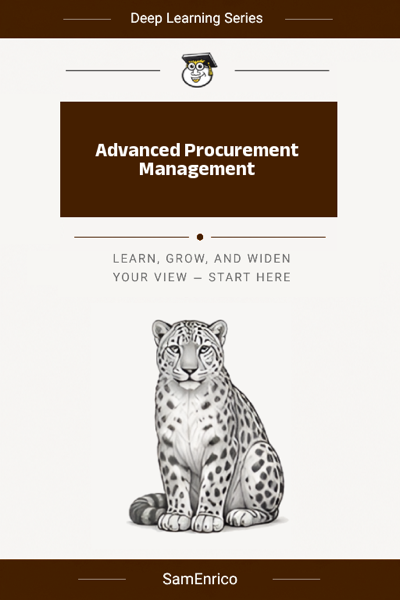
Advanced Procurement Management eBook
A Coursebook on Advanced Procurement Management
A Coursebook on Advanced Procurement Management
Formats
Free sample
Chapter 1: The $47 Million Lie--–- Let me tell you about the 47millionmistake Ialmostmade.Iwassittinginaglass−walledconferenceroomonthethirty−secondfloor,surroundedbysevenexecutiveswhobelieved Iwasabouttosavethemafortune.Thespreadsheetonthescreenwasbeautiful—greencellseverywhere,a1447 million mistake I almost made. I was sitting in a glass-walled conference room on the thirty-second floor, surrounded by seven executives who believed I was about to save them a fortune. The spreadsheet on the screen was beautiful—green cells everywhere, a 14% unit price reduction, annual savings of 47millionmistake Ialmostmade.Iwassittinginaglass−walledconferenceroomonthethirty−secondfloor,surroundedbysevenexecutiveswhobelieved Iwasabouttosavethemafortune.Thespreadsheetonthescreenwasbeautiful—greencellseverywhere,a1412.4 million. The CFO was already mentally spending the money. The COO was nodding.
The CEO said, “Great work, procurement.” And I almost let them believe it.But I had a problem. A quiet, nagging, ulcer-growing problem. I had been in procurement for fifteen years. I knew how to run an RFP. I knew how to beat suppliers down on price.
I knew how to present a savings number that would get me a bonus and a pat on the back. But I also knew—deep down, in the part of my brain I tried to ignore—that the $12.4 million was a lie.Not a malicious lie. Not fraud. But a lie nonetheless. Because that 14% price reduction came from a supplier whose quality had been slipping for two years.
A supplier whose on-time delivery had dropped from 98% to 87%. A supplier whose warranty claims had doubled in the last eighteen months. I had chosen the lowest bidder. Again. And I knew—I absolutely knew—that within twelve months, that 12.4millionin“savings”wouldbeeatenalivebyexpeditedfreight,productionrework,customerreturns,andrelationshiprepaircosts.Therealnumber,if Ihadbeenhonestwithmyself?Anetlossof12.4 million in “savings” would be eaten alive by expedited freight, production rework, customer returns, and relationship repair costs.
The real number, if I had been honest with myself? A net loss of 12.4millionin“savings”wouldbeeatenalivebyexpeditedfreight,productionrework,customerreturns,andrelationshiprepaircosts.Therealnumber,if Ihadbeenhonestwithmyself?Anetlossof47 million over three years.This book exists because I made that mistake. Because I watched hundreds of procurement professionals make the same mistake. Because the procurement function is drowning in a crisis that no one wants to name: we have been optimizing for the wrong thing for forty years, and it is costing companies fortunes.This is the chapter where we stop lying about procurement’s role. This is where we stop pretending that “cost savings” is the only measure of success.
This is where we rebuild procurement from the ground up—not as a tactical support function that chases discounts, but as a strategic weapon that creates enterprise value.Welcome to the reckoning.The Evolution of Procurement: From Clerks to Strategists To understand where procurement has gone wrong, we must first understand where it came from. The journey from clerical order-taker to strategic business partner is not a straight line—it is a story of missed opportunities, well-intentioned metrics, and a profession that learned to celebrate the wrong victories.The Clerical Era (1950s–1980s): Procurement was a paperwork factory. Purchase orders, receiving tickets, invoice matching, and filing cabinets. The procurement professional was not a decision-maker; they were an administrator who executed requests from internal customers. Success meant following the rules, not breaking them.
Strategic thinking was not only unnecessary—it was actively discouraged. “Just get the requisition processed” was the mantra. This era created a generation of procurement professionals who knew how to fill out forms but had no idea how to influence business outcomes.The Cost-Focused Era (1990s–2010s): Then came the revolution. Consultants, academics, and forward-thinking executives realized that procurement controlled significant spend—and that reducing that spend went straight to the bottom line. The mantra shifted: “Every dollar saved is a dollar earned.” Procurement was reborn as a cost-cutting machine.
Strategic sourcing emerged. RFPs became sophisticated. Negotiation training became mandatory. And the metric that mattered above all others was cost savings.On the surface, this was progress. Procurement gained a seat at the table.
Budgets increased. Talent improved. But a cancer was growing beneath the surface. Because when you measure procurement exclusively by cost savings, procurement will optimize exclusively for cost savings. And when you optimize for cost savings, you ignore quality, delivery, innovation, risk, sustainability, and relationship value.
You become the buyer who celebrates a 14% price reduction while the factory shuts down because the cheaper supplier’s parts don’t fit.The Crisis Era (2015–Present): The cracks became visible. Supply chain disruptions—from the Thailand floods to the COVID-19 pandemic to the Suez Canal blockage—exposed the fragility of cost-optimized supply networks. Supplier bankruptcies revealed the danger of financial distress ignored. Sustainability scandals showed the reputational cost of looking the other way. And through it all, procurement professionals found themselves explaining why their “savings” didn’t prevent the crisis.We are now entering a new era.
Call it the Value Era, the Resilience Era, or simply the Reckoning. The old rules no longer apply. The organizations that survive and thrive will be those that redefine procurement’s mandate—not as cost reduction, but as integrated value creation.The Integrated Value Procurement (IVP) Framework So what replaces the cost-savings religion? Over the past decade, working with organizations across manufacturing, technology, healthcare, and retail, I have synthesized a framework that captures the full scope of procurement’s contribution. I call it the Integrated Value Procurement framework, or IVP.IVP is built on four pillars.
Each pillar represents a dimension of value that procurement must actively manage. None can be sacrificed for the others. The goal is not to maximize any single pillar but to balance all four in a way that aligns with corporate strategy.Pillar One: Cost Optimization Let me be clear: cost still matters. It always will. Any procurement leader who ignores cost will not be a procurement leader for long.
But notice the word: optimization, not minimization. Cost optimization means paying the right price for the right value, not the lowest price regardless of consequences. It means understanding total cost of ownership, not just unit price. It means recognizing that a higher-priced supplier with better quality, faster delivery, and innovative capability may be less expensive over the life of the asset.The cost-optimized procurement professional asks: “What is the right price for the value we need?” not “Who has the lowest number?”Pillar Two: Quality Assurance Quality is not a separate function; it is a procurement outcome. Every supplier selection decision is a quality decision.
Every contract term shapes quality behavior. Every performance review either reinforces or undermines quality standards. Procurement cannot delegate quality to the QA department and walk away.The quality-assured procurement professional asks: “How do we design quality into the sourcing process from the beginning?” not “How do we inspect quality problems after they occur?”Pillar Three: Risk Resilience Risk is not something to be avoided; it is something to be managed. The most resilient supply chains are not those that eliminate risk—that is impossible—but those that identify, assess, mitigate, monitor, and learn from risk. Resilience is a design choice.
It means building redundancy into critical supply nodes, maintaining strategic inventory buffers, developing alternative sourcing options, and stress-testing the supply network against plausible disruptions.The risk-resilient procurement professional asks: “What could break, and how will we respond?” not “What is the cheapest way to get this delivered?”Pillar Four: Sustainability Sustainability is not…
This is the end of the free sample. Get the eBook to keep going. Buy now
About this book
Details
- Author
- Matos Melonie
- Publisher
- SamEnrico
- Language
- English
- Genre
- Non-Fiction, Informative, Educational
- Released
- 2026-05-11
- Pages (approx.)
- 148
- Available as
- eBook, Audiobook

Read better in the ZLOADR app
Your eBooks on your phone or tablet. Sign in with your SamEnrico account and start reading.
More by Matos Melonie
 Youth Mental Health First Aid In SchoolsMatos Melonie$11.99
 Pattern Recognition TipsMatos Melonie$11.99
 Highway Fury Self Control GuideMatos Melonie$11.99
 Delegation JournalMatos Melonie$11.99
 TM For MenopauseMatos Melonie$11.99
 The Catholic Art PurgeMatos Melonie$11.99
 Light Exposure and RecallMatos Melonie$11.99
 Sexual Addiction Residential CareMatos Melonie$11.99
 Affirmations For Job LossMatos Melonie$11.99
 Whispers of the Forbidden Shore: The Secret Affair That Shook a NationMatos Melonie$11.99
 The Lost Voyage of the San José: Survival and Betrayal in the AmazonMatos Melonie$11.99
 The Golden Treasury of Queen Tiya: How an Ethiopian Monarch Built a Dynasty of Wealth and WisdomMatos Melonie$11.99
You may also like
 Hong Kong Handover 1997Dunn Johnnie$11.99
 Zumba For Postnatal Recovery CourseNeal Christian$11.99
 Zumba for BeginnersLadner Nikia$11.99
 YouTube Comment Mining GuideHumes Pandora$12.99
 Worry Box MeditationCarlin Rudy$11.99
 Workplace Stress MeditationNguyen Lynn$11.99
 Workplace Stress and Sleep RepairHawley Ivory$11.99
 Workplace Perfectionism CureDelaney Jeffry$11.99
 Workplace Injustice Anger GuideWallen Isabelle$11.99
 Work Addiction and Burnout LinkGreenwood Ester$11.99
 Women in Yoga and WellnessBeattie Galina$11.99
 Women in Stand Up ComedyChun Evangeline$11.99