
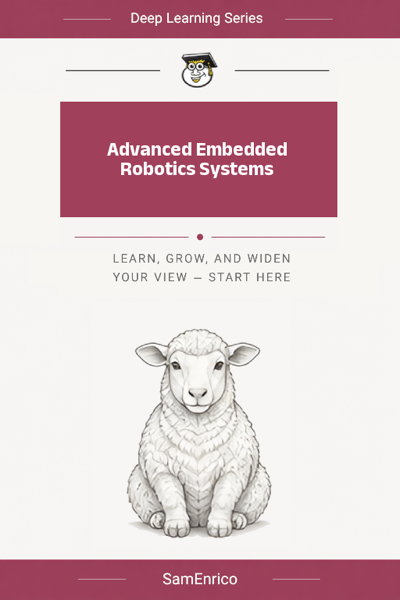
Non-FictionInformativeEducational
Advanced Embedded Robotics Systems eBook
A Coursebook on Advanced Embedded Robotics Systems
by Glass Reena
A Coursebook on Advanced Embedded Robotics Systems
Formats
Free sample
Chapter 1: The First Wobble...--–- Two years ago, I watched my first self-balancing robot face-plant into a concrete floor forty-seven times before it finally stood upright. That forty-eighth attempt taught me more about real‑time operating systems than any textbook ever could. The robot — a lash‑up of mismatched DC motors, a second‑hand MPU6050 IMU, and an Arduino Uno that was definitely not rated for the task — would twitch, strain, shimmy for a glorious half‑second, and then slam its plastic chassis into the ground with a sound like a falling encyclopedia. Each failure was a lesson disguised as a crash. The forty‑seventh crash, in particular, revealed something I had been ignoring for weeks: the microcontroller was doing too many things at once. It was reading the IMU, calculating PID corrections, updating motor PWMs, and printing debug messages over serial — all in a single, sequential loop. By the time it finished printing “IMU angle: 12.3°,” the robot had already fallen over.–- I tell you this not to discourage you, but to give you permission to fail forward. Every expert embedded roboticist has a pile of melted motor drivers, shattered propellers, and mysteriously smoking capacitors in their past. This book is designed to minimize that pile while maximizing what you learn from each inevitable mistake. In the next thirty minutes — yes, minutes — you will build something that works on the first try using parts that cost less than a video game. Then, and only then, we will tear it apart and make it smarter.The 30‑Minute Win: Your First Real‑Time Balancing Act–- Before we dive into theory, let’s earn a victory. Grab the following components: one ESP32 development board (any variant with at least 4MB flash), one MPU6050 IMU module, one L298N motor driver, two DC motors with wheels, a 7.4V Li‑Po battery, and a small robot chassis (or a piece of acrylic and some standoffs). You can find all of these for under $50 on any electronics supplier site.–- Flash the pre‑written balancing code (available at the book’s companion website, along with a QR code printed on the inside cover) onto the ESP32. Mount the hardware loosely — we are not aiming for perfection yet. Place the robot on the floor, power it on, and gently lean it forward. Does it twitch? Does it try to stay upright for even half a second? Congratulations. You have just executed a real‑time control loop with microsecond precision. The robot is not stable yet — it will probably still fall — but you have crossed the threshold from spectator to builder.–- Now, let us understand what just happened. The ESP32 ran two tasks concurrently using Free RTOS: one reading the IMU at 500 Hz, and another updating the motor PWMs at 200 Hz. The critical insight is that these tasks were scheduled with precise timing guarantees. The IMU task always ran exactly every two milliseconds, regardless of what else the processor was doing. That determinism is what separates a balancing robot from a floor ornament.Why This Chapter Matters for Your Career–- Before we go any further, let’s talk about money — specifically, the money that companies will pay you for the skills you are about to learn. According to the 2025 IEEE Robotics and Automation Salary Survey, embedded robotics engineers with real‑time system expertise earn a median base salary of $145,000 in the United States, with top quartile earners (those who understand heterogeneous computing and RTOS scheduling) clearing $185,000. Job postings for “Robotics Software Engineer” at Tesla, Boston Dynamics, and Amazon Robotics all list “real‑time embedded systems” and “multicore architecture” as preferred or required qualifications.–- But salary is only part of the story. The demand for engineers who can bridge the gap between hardware and software — who can read a schematic, write an interrupt handler, and tune a PID loop — has grown 340% over the last five years. This is not a niche skill set. Every autonomous vacuum, delivery drone, surgical robot, and self‑driving car relies on a foundation of embedded real‑time systems. The robot you just built, wobbly as it is, uses the same architectural principles as a Mars rover. The difference is scale and redundancy, not fundamentals.–- By the end of this chapter, you will be able to walk into a job interview and explain, with confidence, why a self‑balancing scooter cannot run on a general‑purpose operating system. You will be able to calculate worst‑case execution time for a control loop. You will know why heterogenous computing (CPUs, GPUs, and NPUs on the same die) is the future of robotics. And you will have a working — if imperfect — robot to show for it.The Taxonomy of Embedded Systems: What You Thought You Knew–- Let’s clear up a common confusion. An embedded system is not simply a “small computer.” It is a computing system designed for a specific function, with constraints that would cripple a general‑purpose machine. Your laptop has gigabytes of RAM, a cooling fan, and an operating system that assumes infinite patience from the user. An embedded robotics controller has kilobytes of RAM, no fan, and an operating system (if any) that must guarantee response times in microseconds.–- We can classify embedded processors into four broad categories, each with distinct trade-offs:–- Microcontrollers (MCUs) – Devices like the Arduino Uno (ATmega328P), ESP32, and STM32 series. These integrate CPU, RAM, flash, and peripherals (GPIO, ADCs, PWM, communication interfaces) on a single chip. They run bare metal or an RTOS. Strengths: low cost ($2–$20), low power (milliwatts), high determinism. Weaknesses: limited compute (MHz clock speeds, kilobytes of RAM). Used in motor control, sensor fusion, and real-time loops.–- Microprocessors (MPUs) – Devices like the Raspberry Pi’s BCM2711 (Cortex-A72) or Beagle Bone’s AM335x. These require external RAM and storage, run a full operating system (Linux, usually), and prioritize throughput over determinism. Strengths: high compute (GHz, gigabytes of RAM), rich software ecosystem. Weaknesses: non‑real‑time, higher power (watts), slower boot (seconds vs. milliseconds). Used in vision processing, path planning, and user interfaces.–- Digital Signal Processors (DSPs) – Specialized chips designed for mathematical operations common in signal processing (FIR filters, FFTs). Less common in general robotics but critical in specialized applications like sonar, radar, and high‑end audio. Strengths: extremely efficient for specific math. Weaknesses: harder to program, narrow applicability.–- Field‑Programmable Gate Arrays (FPGAs) – Configurable hardware that can implement custom digital circuits. You program the connections between logic blocks, not a sequence of instructions. Strengths: unparalleled parallelism and latency (nanoseconds). Weaknesses: expensive, difficult to program (Verilog/VHDL), power‑hungry. Used in high‑end industrial robotics and space applications.–- The confusion arises because modern “system on chip” (So C) devices blur these boundaries. The NVIDIA Jetson Orin, for example, contains a multicore ARM Cortex‑A78 CPU (microprocessor), a GPU with 2048 CUDA cores, a deep learning accelerator (NVDLA), and a real‑time ARM Cortex‑R5 core (microcontroller) — all on one piece of silicon. A single robot can use the Cortex‑R5 for motor control, the CPU for path planning, and the GPU for vision inference, all without contention.–- The Mistake I Made: Early in my career, I designed a drone using only a Raspberry Pi. No microcontroller, no RTOS — just Linux running on a single board. The drone flew beautifully…
This is the end of the free sample. Get the eBook to keep going. Buy now
About this book
Details
- Author
- Glass Reena
- Publisher
- SamEnrico
- Language
- English
- Genre
- Non-Fiction, Informative, Educational
- Released
- 2026-06-03
- Pages (approx.)
- 155
- Available as
- eBook, Audiobook

Read better in the ZLOADR app
Your eBooks on your phone or tablet. Sign in with your SamEnrico account and start reading.
More by Glass Reena
 Shoe and Handbag HoardingGlass Reena$11.99
 Self Hypnosis For Rugby KickingGlass Reena$11.99
 Building Relationship With MenteesGlass Reena$11.99
 Dream of Falling MeaningGlass Reena$11.99
 Money And Marriage CounselingGlass Reena$11.99
 Phone Call Anxiety PrepGlass Reena$11.99
 Anapanasati for VeteransGlass Reena$11.99
 Stroke Parent RecoveryGlass Reena$11.99
 Dave Chappelle UncutGlass Reena$11.99
 The Divine Architect: Mozart’s Musical RevolutionGlass Reena$11.99
 Letters Across the Front: Love and War in the Iran-Iraq WarGlass Reena$11.99
 The Queen’s Gambit: A Life of Chess and ShadowsGlass Reena$11.99
You may also like
 Hong Kong Handover 1997Dunn Johnnie$11.99
 Zumba For Postnatal Recovery CourseNeal Christian$11.99
 Zumba for BeginnersLadner Nikia$11.99
 YouTube Comment Mining GuideHumes Pandora$12.99
 Worry Box MeditationCarlin Rudy$11.99
 Workplace Stress MeditationNguyen Lynn$11.99
 Workplace Stress and Sleep RepairHawley Ivory$11.99
 Workplace Perfectionism CureDelaney Jeffry$11.99
 Workplace Injustice Anger GuideWallen Isabelle$11.99
 Work Addiction and Burnout LinkGreenwood Ester$11.99
 Women in Yoga and WellnessBeattie Galina$11.99
 Women in Stand Up ComedyChun Evangeline$11.99